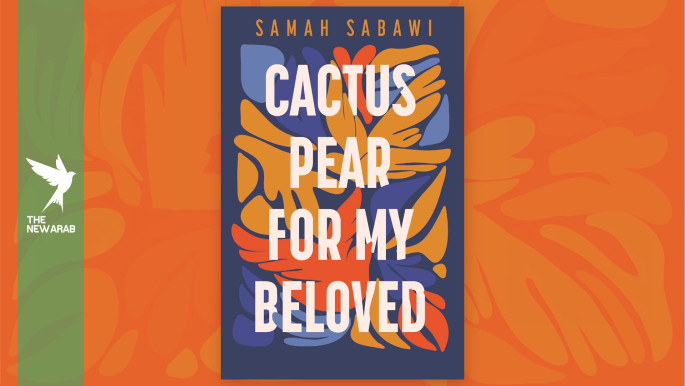
For Samah Sabawi, bringing her novel Cactus Pear for My Beloved to life was a labour of love – both for Gaza and her family.
And that is no exaggeration. It took 10 years, from the moment she first started writing, through to publication day, and hours (and hours) spent in between, undergoing research and interview recordings with her late father.
Despite being an established commentator, poet and award-winning playwright, this is Samah’s first novel.
She was spurred on to write it after Israel demolished a slew of high-rise buildings in Gaza City towards the end of its brutal 51-day aggression in mid-2014.
“It was as if they were testing the waters to see how much they could get away with,” Samah tells The New Arab.
“It’s this constant erasure of the city and then having people rebuild and rise again, and then another war comes and more erasure. So I started writing for so many reasons, but this was definitely one of them,” she adds.
“I also really wanted to get the stories from dad before he passed away. I was very privileged and honoured to be the person who got to tell the story of our family through him.”
While it reads like a novel, Cactus Pear for My Beloved is based on Samah’s family history.
Spanning much of the 20th century, it traces the life of her father, poet Abdul Karim Sabawi, from childhood in British-occupied Gaza through displacement and exile in Australia.
She ties it to the history of Palestine as a whole, covering major historical events such as the 1948 Nakba and 1967 Naksa.
The story of struggle, resistance and displacement is layered with joy and love, notably the courtship between Samah’s parents.
Since its publication in September 2024, it has been nominated for numerous literary prizes.
In Australia, where Samah is based, Cactus Pear for My Beloved was shortlisted for the Prime Minister’s Literary Awards, the NSW Literary Awards’ Douglas Stewart Prize, and the prestigious Stella Prize, the country’s equivalent to the Women’s Prize for Fiction.
The book was also highly commended in the Victorian Premier’s Literary Award and longlisted in the Palestine Book Awards.
But for Samah, celebrating these milestones was always bittersweet, and it wasn’t just because her book and subsequent author tour and speaking events took place in the middle of the Gaza genocide.
Shortly after it was released, her father passed away.
“It was very emotional,” she reflects.
“To have to go and eulogise my dad over and over again with every book event, and there were so many events that I had to do… and in all of them, I was talking about Gaza the way it was, and I was talking about my father’s story.
“Since I’ve written it, we’ve seen more of Gaza being destroyed, and then I get invited to these award ceremonies and… I didn’t know what I was celebrating by that point,” she continues.
“This book was supposed to counter the erasure of Gaza, but in reality, we were living this incredible attempt at erasing Gaza. This book came out during a period where Gaza was mourning, but it was supposed to celebrate Gaza’s history – and celebrate my father’s life.”
Nevertheless, Samah is proud that her father got to read her book before he passed away, although at one point it looked like he wouldn’t make it to the book launch.
In February 2024, he fell and broke five ribs. He was placed in intensive care and had a 50-50 chance of surviving, especially since he refused to use the respiratory help or to do exercises to expand his lungs. It got to a point where Samah had to somewhat threaten her father to ensure he could make it out of there.
“I just sat by his bed in the hospital, held his hand and said to him, ‘Baba, if you leave us now, I’m not publishing this book, and nobody will ever know your story. You’d better stick around until the book comes out,'” she recalls.
“And he did. He stuck around all the way to October, when the book came out, and for the book launch. I was very happy that he was there, and he was very happy too. But part of me was feeling like he was going to let go now, which he did.”
Samah went on to say that in the last two weeks of his life, her father listened to the audio version of her book on a loop in his room. “He was very, very proud of it,” she says.
Writing her book entailed 60 hours of recorded interviews with her father, and countless more hours of unrecorded conversations. The interviews were all done in Arabic, so there was the added layer of needing to transcribe them into English.
While time-consuming, Samah now cherishes the memories she created with her father as part of the process.
“Memory doesn’t come in a linear fashion, so what I did was just leave the recording on and have these very long conversations with him, and in a way, that was my reward. It’s not the book coming out. It’s that I had spent all this time with my dad listening to his stories. How many people can say that?” she says.
During these conversations, Samah was surprised to learn things about Gaza that she hadn’t known before, especially details from the early 20th century – before the Nakba – that are seldom discussed in mainstream media or on social media.
“Gaza is the most known place in the world, but it’s also the least known place in the world,” she says.
“We only see it through the news. We see it through our social media posts. But we don’t experience it the way it was, or the way it was before the Oslo Accords or the 1980s. So it was good to be able to go back and reconstruct all that.
“I would record my father’s interviews, and then I had this spreadsheet where I would chop up pieces and put them within the timeline where they belong,” she adds.
“Then, when I had enough of a specific timeline, I would research the politics that were happening during that timeline, and then I would try to thread it all together. The politics, the music people were listening to, and the references to notable Palestinian resistance figures, like George Habash and Ghassan Kanafani, when they were on the rise.
“Often it was really hard to find research for these threads, and I relied on oral testimony and family letters for a whole lot of things – even interruptions from my mum clarifying things during the interview – to put together that bigger picture of my dad’s story.”
At the time of her interview with The New Arab, Samah said she hadn’t had the emotional capacity to listen back to the recorded conversations with her father.
As the genocide raged on, she felt she didn’t have room for more grief as Israeli bombs kept dropping on Gaza.
But on the one-year anniversary of his passing, she surprised herself.
“I thought it was going to be a really sad day, but I woke up in the morning, and I said, ‘I’m going to do it today. I’m going to listen to his voice,'” Samah shared.
“I’ve got a lot of recordings of his poetry. So I started listening to his voice and his poems, and I found myself laughing and really enjoying being with him.
“It just filled me up with so much happiness, and I didn’t realise how much I missed him and how much I missed his voice. I feel saturated with his love and presence, so maybe it’s time for me to go back to these recordings now.”
Cactus Pear for My Beloved by Samah Sabawi is out now via Penguin Random House
Elias Jahshan is the social media editor at The New Arab. He is also the editor of This Arab Is Queer and This Queer Arab Family, both via Saqi Books