A girl is dead. It’s a tragic accident. The family is devastated.
Or.
A girl is dead. She brought it on herself. The family did it.
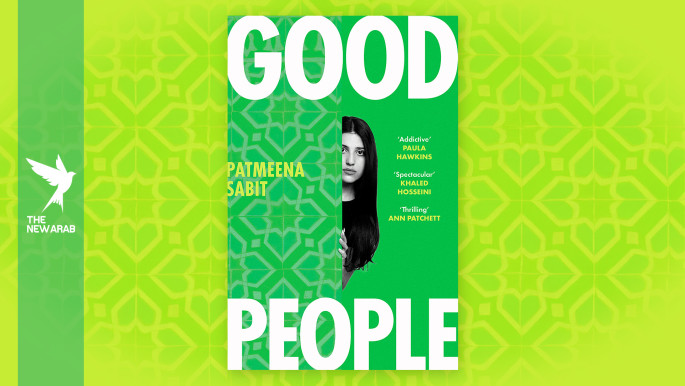
That’s the question posed in Patmeena Sabit’s engrossing debut novel, Good People. The book follows the Sharaf family, a model Afghan immigrant family who built a life for themselves in Virginia from the ground up.
Eldest daughter Zorah is “the apple of her father’s eye,” but after her unexpected death, everyone has an opinion on what really happened.
Patmeena tells the story through the voices of those around the family, from neighbours and members of the Afghan community to journalists and law enforcement. The one family we never hear from? The Sharafs.
“I was writing this book for a very, very long time. I did play around with using different voices from the family, but what I came up against time and time again was the fact that, in these crimes, the voice of the victim is silenced. To me, to include the voices of the family seemed like a tremendous imbalance,” Patmeena tells The New Arab.
With a background in international development and globalisation, Patmeena specialised in women’s and children’s rights.
The spark for Good People came when she penned her graduate thesis on honour crimes in Jordan: “I began following honour crimes in the US, Canada and Europe, and was struck by the way these crimes were reported in the media. There was a lack of perspective from the communities where these crimes had occurred,” she reflects.
Redressing the balance, Patmeena’s chorus of opinions allows her to examine the dynamics that give rise to so-called honour killings, which “are fed by certain values and belief systems,” and the way Islamophobic and xenophobic discourse can be fuelled by the way the media covers these stories.
“I wanted to present how multifaceted and complex these issues are,” she says.
The result is a story that challenges readers’ expectations to the very last page, never letting audiences settle into their idea of what really happened that night.
“The book was not meant to be didactic,” Patmeena explains.
“It was about exploring these communities and the differing perceptions within them. Even within this culturally conservative Afghan community, there are some who are more sympathetic to Zorah’s plight and others who are critical.”
With the ending clear in her mind from the start, Patmeena was able to write convincingly from both sides of the opinion.
“I’m glad the idea of a family accused came to me initially. I could write sections from the perspective of people who believed they were guilty, then I could write in defence of them in an authentic way. Every reader’s picture is going to be different depending on what you picked out from the narrative; who you believe to be credible and the tellers of truth,” she adds.
It’s hard to discuss the intricacies of Good People without spoilers, but one overarching theme is the American Dream. Rahmat Sharaf, Zorah’s father and arguably our lead character, has an unshakeable belief in the ability to thrive in the United States.
The book begins with stories of the Sharaf’s humble beginnings; Rahmat, the son of a bricklayer, hustles for every dollar to elevate his family after fleeing Afghanistan.
Now, the family lives in one of the most prestigious neighbourhoods in the state – but, as immigrants, acceptance is only ever conditional.
“In Afghanistan, being the son of a bricklayer would have obstructed his path to success. America, for him, becomes a great equaliser, and he’s determined to prove that he will be successful,” the author tells The New Arab.
“His children will not just be average; his son isn’t just going to be a doctor, he’s going to be a neurosurgeon. His daughter will not only go to Harvard Law School but also become a Supreme Court Justice. But you’re right in that the community, while awed by his success, is also critical of the way that he and his wife choose to parent their children,” Patmeena explains.
But the Sharaf’s don’t only have to contest with the opinions of white Americans, facing judgment from Afghan circles too. The family is criticised for putting up a Christmas tree, hosting a Fourth of July barbecue and the way they “let” their daughter dress.
The Sharafs might be thousands of miles away, but the mindset is harder to shift. Patmeena deftly showcases the diversity of perspectives through the narrators of Good People, including the elderly Qandi Gul, whose colourful, vivid, and poetic turns of phrase are reminiscent of all our grandparents.
“We thought it was the land, our country, that was cursed. In truth, the curse is on us, our people,” Gul says, reflecting a woman who has seen Afghanistan in peace and what it became in war.
“At the start of the book, she opens with this picture of children as innocent flowers who have only known war and how people fled because of those children. She speaks about the suffering and grief of exile. I heard this sentiment growing up, that when something bad happens within the community, it must be a curse within us as people, even in exile,” Patmeena explains.
And while she translates most of these passages into English, Patmeena retained some phrases in Pashto and Dari: “They’re such expressive languages. Some words didn’t have a direct translation in English – even using the closest approximation dulled them.”
With a title like Good People, does Patmeena believe there are any in the pages of the novel?
“That’s the question that hovers above everything. We are all a product of where we were born, how we were brought up and the values we were brought up with,” she responds.
“Do we all believe that what has been instilled in us is good? What happens when you come up against something that is alien to that? How open-minded, compassionate and empathetic are you when you come up against something that you don’t understand?”
That’s a question only you can answer.
Isabella Silvers is a multi-award-winning editor and journalist, having written for Cosmopolitan, Women’s Health, Refinery 29 and more. She also writes a weekly newsletter on mixed-race identity, titled Mixed Messages
Follow her on Instagram: @izzymks