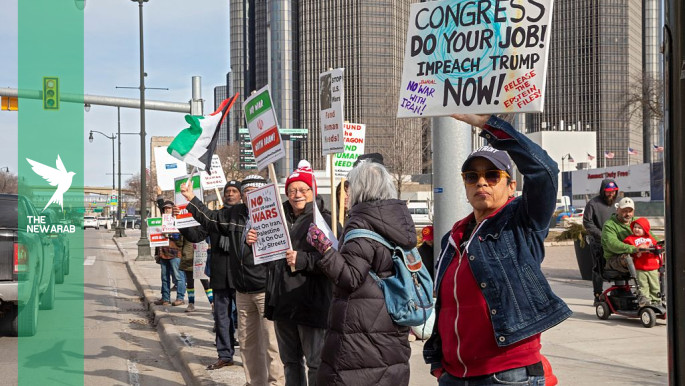
People gather in downtown Detroit to protest President Trump’s decision to start war with Iran. [Getty]
Within hours of joint US-Israeli airstrikes on Iran, anti-war activists across the US had mobilised demonstrations.
This wasn’t a spontaneous movement, but one rooted in over two decades of anti-war activism, largely spurred by the 2003 US-led invasion of Iraq.
“Iran and the entire Middle East has been thrown into chaos as the Trump administration and Israel unleash a massive bombing campaign that has already claimed hundreds of lives,” reads a statement by the ANSWER Coalition (Act Now to Stop War and End Racism), an umbrella organisation of protest groups, issued on 28 February, the first day of the US-Israeli attacks on Iran.
“The people of this country overwhelmingly oppose the attack, but that opposition needs to be expressed in the streets so it is impossible to ignore,” the statement continues.
A poll published in The New York Times on Tuesday showed that the ongoing war on Iran is the least popular US foreign war in modern history, with 41 per cent approval, compared with 97 per cent approval at the beginning of World War I.
Today’s anti-war movement differs from those of previous generations in that it crosses political and ideological lines (such as the Vietnam and Iraq wars, with solidly leftist opposition).
“When you talk about the anti-war movement, it’s fragmented ideologically. It’s different from the past,” David Frank, professor of rhetoric and political communication at the University of Oregon, told The New Arab.
Even more unifying and non-partisan than the anti-war movement is the growing frustration over the cost-of-living crisis.
US President Donald Trump campaigned on both issues, galvanising voters from impoverished regions, most notably the Rust Belt, where many residents had served in Iraq and Afghanistan, only to return home to few job opportunities.
Trump successfully portrayed his opponents as elite warmongers who had left behind rural Americans. Jeb Bush, who was initially expected to win the Republican primary, couldn’t get past his brother’s decision to invade Iraq. Similarly, Hillary Clinton couldn’t overcome her Senate vote for the Iraq War or her husband’s North American Free Trade Agreement on the debate stage with Trump.
The 2016 presidential election was a turning point for many Republicans who finally saw an outlet for their frustrations, including growing discontent over their tax dollars going to foreign wars that many Americans increasingly linked to a declining standard of living.
Merideth Aby, a Minnesota-based steering member for Anti-War Action Network, told TNA that many who voice support for their street protests say they are struggling with the cost of living themselves.
“‘Money for human needs, not for war’ has been our slogan. This particularly resonates now. People have hard lives. They feel betrayed,” she said, noting that their affiliates have doubled in the last year.
In 2024, Trump again won on a similar platform: a promise of no new wars and to lower the cost of living. He chose Iraq War veterans JD Vance as Vice President and Tulsi Gabbard as National Security Advisor, both of whom had been vocal opponents of unnecessary wars.
Just over a year into his second term, Trump’s war on Iran has created a new diverse coalition of war opponents.
Celebrity podcaster Joe Rogan, who endorsed Trump in 2024, now says many of the president’s supporters feel betrayed over his war in Iran.
Similarly, former Congresswoman Marjorie Taylor Greene, who had long been a supporter of Trump, is now vocally speaking out against the war, pointing to civilian deaths and warning that further escalation could lead to a draft and could cost the Republicans the 2026 midterm elections.
Other prominent right-wing figures who have spoken out against Trump’s war on Iran include broadcasters Megyn Kelly and Tucker Carlson, as well as a former White House chief strategist from the president’s first administration.
Though these right-wing voices against a US war on Iran do not constitute a critical mass, they could be indicative of their followers and viewers—millions of Americans with whom they have daily contact.
Today’s war critics are far from the largely leftist activists seen during the Vietnam and Iraq wars, and as the conflict becomes more deadly, their numbers could grow.
The bombing of more than 170 children at a girls’ school in Iran, with a preliminary Pentagon inquiry finding the US at fault, is not being forgotten.
“You need something like that for people to mobilise,” said Frank.