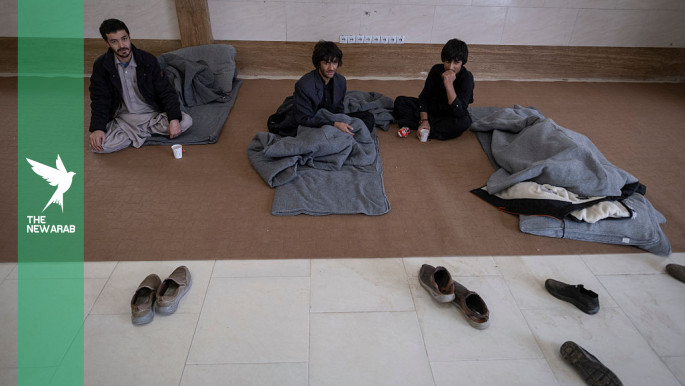
Afghan refugees sit in the Alghadir Refugee Camp located in the suburb of the border city of Zahedan near Iran’s eastern border with Afghanistan, in Sistan and Baluchistan Province, 1,486 km east of Tehran, Iran, on 18 December 2025. [Getty]
Thousands of Afghan refugees have begun fleeing Iran back toward Afghanistan through the Islam Qala border crossing after US and Israeli airstrikes began on 28 February, with those arriving describing scenes of panic, fuel shortages, and crowds mobbing food markets in Iranian cities.
Iranian media have over 1,300 casualties across the country, though the figures have not been independently verified.
But for the vast majority of Iran’s Afghan population, estimated at over 3.8 million as of early 2025, leaving is not a realistic option.
Hundreds of thousands remain trapped in Tehran’s poorest southern and eastern districts, where crumbling apartment blocks sit close to the industrial and military zones now under bombardment.
According to eyewitnesses, in the days since the first raids, food has vanished from local markets, electricity and water have cut out for hours at a time, and prices for staples have doubled.
Dozens of Afghans have been killed under rubble or by shrapnel, according to a source in Iran’s health ministry. Many of the dead remain unclaimed because relatives fear that approaching hospitals will lead to arrest or deportation.
The crisis has exposed the extreme vulnerability of a community that was already surviving at the margins of Iranian society. Afghans have migrated to Iran in successive waves since the Soviet invasion of the 1980s, through the Taliban’s rise in the 1990s, the American war in the 2000s, and most recently after the US withdrawal in 2021 and the reimposition of Taliban rule.
Many came seeking education, particularly young women barred from schooling past the sixth grade at home. Others sought medical care, employment, or a transit point toward Europe.
Crumbling shelter
Iran now hosts the largest Afghan diaspora in the world, but only a tiny fraction live in the country’s 20 state-managed settlements. The overwhelming majority have integrated into urban centres where work is available, but legal protections are not.
Tehran’s Afghan population is concentrated in neighbourhoods such as Shoush, Nazi Abad, Rey, Shour Abad, and Baqershahr, where ageing apartment blocks press together along narrow streets.
A single flat often houses three or four families, splitting rent and sharing kitchens, corridors, and a single bathroom that may serve 40 or 50 people on one floor. Young unmarried men sleep in shifts on worn carpets in rooms of a few square metres.
Many Afgans refugees say that Iranian brokers routinely inflate rents and extort additional payments in exchange for not reporting tenants to the authorities.
Asadullah Rahimi Ali, a 34-year-old taxi driver in eastern Tehran, shares one such flat with three other Afghan families.
“We divide the room into small spaces for sleeping and eating with old curtains,” he said.
The buildings were dangerous long before the first missile struck. Walls leak, ceilings crack at slight tremors, and power cuts out for days. Now, when explosions shake the structures, masonry falls, and dust fills the hallways, Rahimi Ali runs with children to basements or back corridors that provide little real protection.
“Every explosion reminds me that nobody cares about us,” he said. “This war we did not choose has turned our lives into a chain of moments filled with fear.”
Noorullah Ahmadi, a 23-year-old construction worker in south Tehran, said his building has lost portions of its walls to nearby blasts, and the sites where he earns a daily wage close without warning when raids begin.
“The children in the neighbourhood cry constantly, and the women try to calm them, but the sound of explosions makes everything feel meaningless,” he told The New Arab.
During the 12-day war between Iran and Israel in 2025, Iranian authorities accused Afghans of acting as agents of Israel, a charge that preceded mass deportations. Residents say the same scapegoating climate has returned, making them reluctant to seek shelter in official facilities or approach any government institution.
Due to heightened economic pressure and security concerns, Iran forced back over 1.5 million Afghans in 2025 alone, and the war has now compressed years of structural marginalisation into days of raw survival.
A collapsing economy
Even before the airstrikes, Afghanistan’s refugees occupied the lowest rung of Iran’s labour market. Most held temporary or informal jobs in construction, transport, street vending, and domestic cleaning, earning minimal wages with no legal standing.
According to those interviewed by TNA, Afghans were excluded from subsidised bread through a government smart-card system that bars non-Iranians. Hospitals treated undocumented Afghans only for cash at inflated prices, and schools either refused their children or charged prohibitive fees. International sanctions and oil price pressures had already strained Iran’s economy, and that turbulence fell disproportionately on a population with no safety net.
Rahmatullah Shafaq, a 35-year-old street vendor who sells bread and fruit in eastern Tehran, said his livelihood has collapsed.
“The markets close suddenly, the roads are full of rubble, and every step is a risk,” he lamented, adding that he now feeds his wife and three children in a single room they share with another family.
“Getting food has become a gruelling task. Water and electricity cut out constantly,” he added.
Fazlullah Haidari, a 42-year-old carpenter in northeast Tehran, said the workshop where he earns his income has shut down repeatedly because raw materials have grown scarce and supply lines into the city have been severed.
“Sometimes I give everything I have to buy food while I watch the children suffer from hunger and fear,” he said.
Kamila Sadiq, a 25-year-old house cleaner whose wages are the sole income for her mother and siblings, said the danger has made even reaching her employers difficult.
“Every day we live feels like facing death and poverty at the same time,” she said.
Afghans in Iran’s labour market are frequently utilised as a source of cheap labour and relegated to informal roles where exploitation is routine. The internet blackouts that have accompanied the crisis cut off many from the informal work and study arrangements that sustained them, and from contact with relatives outside the country.
Psychological wounds without treatment
Gul Naz Faiq, a 30-year-old Afghan nurse who works at a local health clinic in northern Tehran, said undocumented refugees have largely stopped visiting medical facilities.
The fear of identification and deportation, always present, has intensified under wartime conditions, and injuries from shelling go untreated as a result.
“I feel like we are just ghosts moving between crumbling buildings, trying to survive despite everything,” she said. “The children are growing up in an environment full of fear and rubble. They do not know what normal life or play looks like.”
Anxiety, depression, and symptoms consistent with post-traumatic stress disorder were already widespread in the community. Children who grew up hearing slurs and watching police raids now witness daily explosions and columns of black smoke.
Rahaf Yousufzai, a 27-year-old private tutor in south Tehran, said her work has become nearly impossible.
“The explosions make the children terrified, and we cannot continue learning under these conditions,” she said. She has considered fleeing but sees no safe destination.
All of these pressures fall with particular force on Afghan women living in Iran alone, many of whom left Afghanistan specifically to pursue the education denied to them under Taliban rule. The war and the internet shutdowns have undermined the very purpose of their migration.
This article is produced in collaboration with Egab.