Escalation between Iran and Israel disrupts the West Bank: Fear without shelters and a life hanging in the balance (Getty image)
Last night was extraordinary for Khaled Odeh, a 47-year-old father from Huwara, as sirens sounded and he watched missiles launched by Iran toward Israel streak across the sky.
In that moment, the occupied West Bank, despite being geographically removed from the front lines, is it teetering on the edge.
“The sky looked as if it had split open with rivers of fire,” Odeh told The New Arab, recalling the explosions reverberating through the surrounding mountains.
His children woke in panic, asking whether the war would reach their home. “I didn’t know what to tell them. We don’t have shelters, sirens, or clear instructions if missiles or shrapnel land in our area,” he added.
Unlike Israeli cities, where air raid sirens signal danger, Palestinians in the occupied West Bank have no such early warning system. Public shelters are virtually nonexistent, and civil defence infrastructure is unprepared for long-range missile threats.
While residents are accustomed to military incursions, checkpoints, and arrests, the sudden possibility of the skies turning into a corridor for regional strikes introduces a new form of vulnerability.
Near Nablus, local eyewitnesses said that shrapnel was falling in open areas around villages, prompting civil defence interventions. Though no injuries were reported, residents voiced deep concern.
“We are completely exposed […] If something happens, we won’t have anywhere to hide,” Odeh said.
Economic strain, movement restrictions
The fear wasn’t limited to Nablus. In Hebron, residents of neighbourhoods like Ras al-Joura and Ibn Rushd Square took to the rooftops to track missile trajectories, while others stayed indoors to avoid falling debris.
Samer al-Qawasmi, a merchant in Hebron’s Old City market, told TNA that the regional escalation added another layer of tension to an already difficult daily life.
“We live under daily pressure from checkpoints and settlements. Any escalation means more closures and stricter security measures,” he explained.
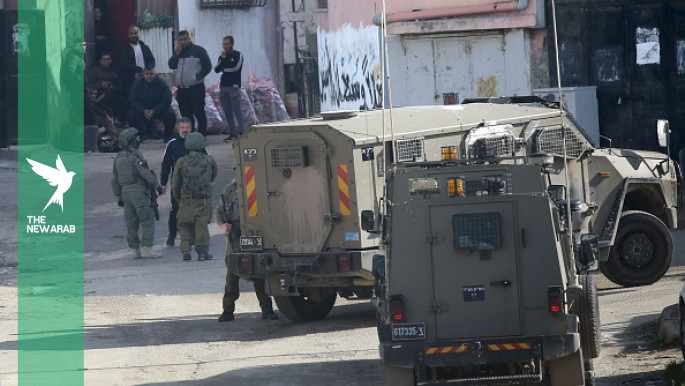
Israeli forces tightened access to the cities in the occupied West Bank, deploying mobile checkpoints overnight. In Nablus, sudden closures caused traffic jams and prevented hundreds of workers from reaching jobs inside the Green Line or nearby cities.
Ayman Daraghmeh, a 50-year-old taxi driver and father of five, described the closures as “strangling people economically.”
“People are barely managing. When roads close unexpectedly, workers lose a day’s income, businesses stall, and families fear leaving home,” he added.
Some residents have begun stockpiling essentials. In Ramallah, neighbourhoods including Al-Tira, Beitunia, and Al-Amari refugee camp saw families watching the night sky, anxiously following news reports.
Rana Hamdan, an NGO worker, described the scene as “surreal and frightening. Even if missiles aren’t targeting us, just seeing them fly overhead leaves a deep psychological impact. Children hide behind windows, and adults anxiously refresh the news.”
Government measures, persistent vulnerability
Amid the tension, the Palestinian government announced precautionary measures as part of a comprehensive emergency plan.
Mohammed Al-Amour, Minister of Economy, confirmed that strategic reserves of flour, rice, sugar, oil, and meat are sufficient for three to six months, alongside medical supplies and baby formula.
In a press statement, he said that a decentralised distribution plan aims to ensure access even during road closures and urged citizens to avoid panic buying, warning it could destabilise markets.
In the health sector, Mutasim Muhaysin, Assistant Undersecretary for Hospital Affairs, activated the Health Crisis Management Centre and raised alert levels in hospitals.
Medical supplies, fuel, and electricity were checked, non-emergency staff leave was suspended, and emergency centres were established in remote areas.
Minister of Social Development and Relief, Samah Hamad, emphasised that the ministry’s warehouses are stocked with food and necessities for children and the elderly, with ongoing coordination to support vulnerable populations.
Yet, for residents, these measures offer little solace against the larger fear: the occupied West Bank lacks shelters and warning systems, leaving civilians as passive observers in a conflict over which they have no control.
“We live under occupation and feel the effects of any regional escalation, but we have no means of protection. All we can do is wait and pray that nothing falls on our heads,” Mohammed Bowaitil told TNA.
Between the anxiety of incoming missiles, tighter security measures, and fragile livelihoods, life in the occupied West Bank is dictated by a war in which it is not directly engaged, but whose psychological and economic toll is undeniable.