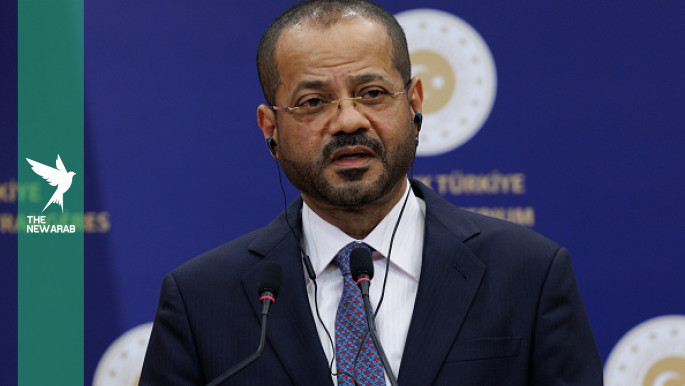
Omani FM Badr bin Hamad Al Busaidi has insisted his country will not support the US-Israeli war on Iran [Getty]
A drone attack on Oman’s Salalah Port on Wednesday has further tested ties between Iran and the Gulf sultanate, which acted as a key mediator between Tehran and Washington before the outbreak of war earlier this month.
Drones struck fuel storage tanks in the port, Oman TV reported, citing an energy ministry official who said that there was no disruption to the continuity of oil supplies or petroleum derivatives in the country.
Fire crews attended the scene to tackle a huge blaze that engulfed the storage facility, initially saying it would “take some time” to put out. It was later revealed that several fuel storage tanks were damaged by the attack.
In a precautionary move, Oman shifted all vessels out of its main oil export terminal at Mina Al-Fahal, Bloomberg reported early on Thursday, citing direct recipients of a port agent’s notice.
Later on Wednesday, Iranian President Masoud Pezeshkian spoke to Oman’s Sultan Haithem bin Tariq via telephone, during which the Iranian leader pledged to investigate the incident.
“Addressing reports regarding a strike on Oman’s Port of Salalah, the president said the Islamic Republic remains committed to strengthening relations with its neighbours, particularly Oman, and that Iranian military responses target only locations directly involved in attacks against Iran,” the semi-official Tasnim news agency reported.
Oman’s state news agency, meanwhile, reported that the sultan expressed his country’s “dissatisfaction and condemnation of the continued targeting of its territory, and affirmed that it is taking all necessary measures to preserve its security”, without specific reference to the attack on Salalah.
Omani Foreign Minister Badr bin Hamad al-Busaidi, who was at the forefront of mediating between Tehran and Washington, shared the sultan’s remarks on X, commenting: “Our neutrality stands for the cause of peace: the cornerstone of our national security and our unique gift to the world.”
Before the attacks on the Omani port on Wednesday, Al-Busaidi held a meeting with local media chiefs, during which he described the US-Israeli war on Iran as “illegitimate” and in violation of international law. He said the war “aims to weaken Iran, reshape the region, push forward the normalisation agenda, and prevent the establishment of a Palestinian state”.
Al-Busaidi added that Oman would not be supporting the war, normalising ties with Israel, nor joining US President Donald Trump’s self-styled “Board of Peace”.
Following the drone attack, Oman’s Gulf allies, which have suffered daily assaults by Tehran, condemned the attack and held Iran responsible.
The foreign ministries of Jordan and Qatar issued statements accusing Iran of responsibility and denouncing the attack.
Saudi Foreign Minister Faisal bin Farhan held a call with his Omani counterpart, in which he “expressed the Kingdom’s condemnation and denunciation of the blatant Iranian attack”.
The UAE issued a similar statement, slamming the “treacherous Iranian attack”.
A spokesperson for Iran’s Khatam al-Anbiya Central Headquarters on Wednesday attempted to distance his country from the incident, calling it “highly suspicious”.
Iran has previously denied attacking regional allies and countries neutral to the conflict, accusing Israel of attempting to drag the region into a broader war.