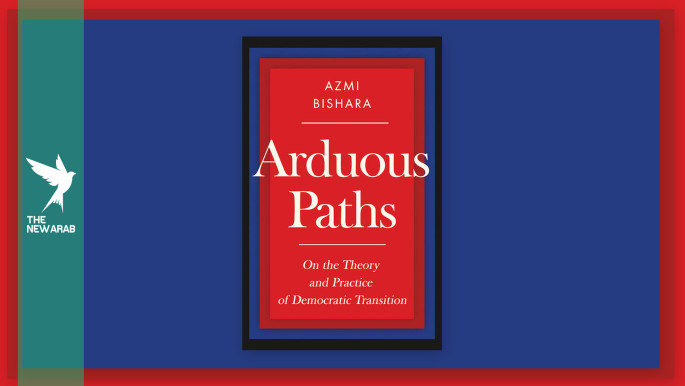
A new English-language book by prominent Arab intellectual Azmi Bishara examining the challenges of democratic transition in the Arab world has been published by Oxford University Press in partnership with Hurst Publishers.
Titled Arduous Paths: On the Theory and Practice of Democratic Transition, the volume brings Bishara’s influential scholarship on democracy to a wider international readership while offering a critical reflection on why democratic change has proven so elusive in much of the Arab world, made all the more urgent given the relevance of the transition to democracy for those living under authoritarianism.
Arduous Paths builds on Bishara’s substantial body of work on democracy through the lenses of civil society, state-formation processes and theories, secularisation, populism, and sectarianism.
The book is a revised and updated English translation of Bishara’s earlier Arabic study on democratic transition, first published in 2020 by the Arab Center for Research and Policy Studies.
The book sought to provide a distinctly Arab contribution to democratic theory, while moving beyond imported models of political change.
Indeed, Arab transition scholarship has often been confined to theory, reliant on models born of specific historical conditions, and uncritical of concepts of democratisation
In Arduous Paths, Bishara examines the theories underpinning democratic transition while drawing a crucial distinction between the factors that sustain an established democratic system and those that enable a society to transition to democracy in the first place.
He contrasts the gradual historical evolution of democratic systems in Western societies with the far more abrupt and complex process of attempting to move directly from authoritarian rule to democracy in contemporary contexts.
The book offers a critical reassessment of dominant transition theories, many of which are based on European, Latin American and Eastern European experiences.
While engaging with modernisation theory and acknowledging some of its insights, Bishara interrogates the extent to which such frameworks can explain the realities of political change in Arab societies.
Drawing on empirical evidence from the Middle East, the book examines the trajectories of countries that experienced revolutions or popular uprisings during the 2010–2011 Arab uprisings and the renewed protest wave of 2019.
In many cases, Bishara argues, regimes collapsed without producing a genuine democratic transition, while in others the transition process faltered.
Particular attention is given to the contrasting cases of Egypt and Tunisia.
While both experienced political openings after the 2011 uprisings, Bishara notes that Tunisia’s transition initially advanced further than Egypt’s.
His comparison highlights factors such as elite political culture, the role of the military, and the geopolitical position of states and the influence of external actors on transition processes.
The English edition also includes a new introduction written by Bishara specifically for international readers.
Running to roughly 450 pages, the new work is available through major retailers including Amazon and Waterstones, as well as academic booksellers and independent bookshops.