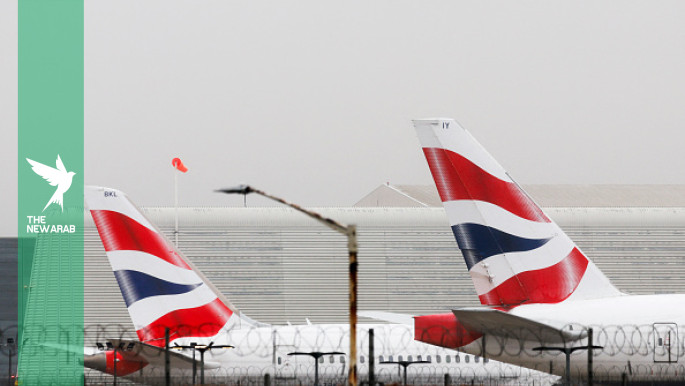
British Airways won’t fly to Abu Dhabi ‘until later in the year,’ it said [Getty/file photo]
Global travel continues to face disruption amid the US and Israeli assault on Iran and the subsequent crisis in the Middle East, with major airlines suspending and cancelling flights destined for the region.
British Airways announced on Tuesday it was suspending all flights to Amman, Bahrain, Doha, Dubai, and Tel Aviv “until later this month,” as well as Abu Dhabi “until later this year,” the airline said in a statement.
Flights bringing home those stranded in Muscat, Oman, will continue until Thursday and then halt, British Airways said, citing a reduced demand.
Other airlines have taken similar measures. Air Canada has cancelled flights to Tel Aviv until 2 May, and to Dubai until 28 March.
Air France has also cancelled flights to Tel Aviv and Beirut through 13 March, and to Dubai and Riyadh until 12 March.
Emirates and Etihad Airways have also said that they will limit their commercial flight schedule.
Dutch carrier KLM said it will halt flights to Dubai until 28 March.
Other carriers following suit include Lufthansa, Saudia Airways, and Malaysia Airlines.
The UK’s Foreign Office has warned against all but essential travel to the UAE, Bahrain, Kuwait, and Qatar, due to the escalation of conflict in the region.
On 28 February, the US and Israel began striking Iran, in their second war on the country in less than a year. Iran has been retaliating by launching strikes against US interests – chiefly military bases – across the Arabian Peninsula.
The attacks triggered the cancellation of flights and a subsequent disruption to travel, leaving thousands of tourists and expats in the Gulf, hoping to leave, stranded.
The spillover of the conflict in the Gulf has seen several people killed in Oman, Kuwait, the UAE, Bahrain, and Saudi Arabia.
On Wednesday, drones fell near Dubai airport, injuring four people. The incident forced the airport to close its airspace briefly.
Earlier in the escalation, Iran had struck Kuwait International Airport and had attempted to hit Doha Airport, though Qatar managed to shoot down the Iranian Su-24 bombers, reports said.
Meanwhile, major US airlines risk paying up to $11 billion for jet fuel this year following their decision not to hedge their expected purchases, leaving them facing soaring fuel prices as a result of the global energy crisis, triggered by the war in Iran.
The price of jet fuel in the US has skyrocketed to almost 60 per cent following the closure of the Strait of Hormuz. Jet fuel is among the most expensive components for airlines.