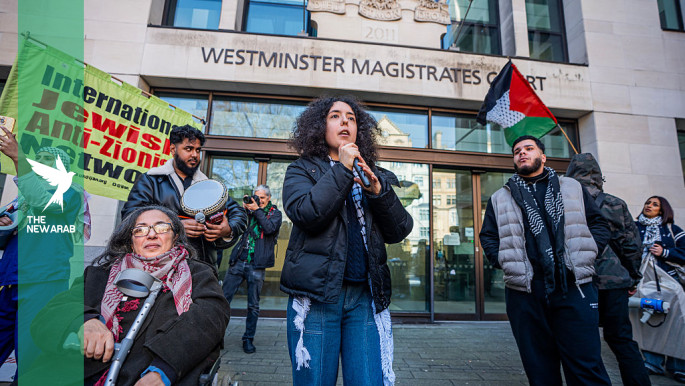
The court is scheduled to resume hearings on 16 March, when the prosecution will respond to the request. [Getty]
The Westminster magistrates’ court has given the British Crown prosecution seven days to consider whether to drop its case against two leaders of the Palestine Coalition.
The trial involves Ben Jamal, director of the Campaign for Solidarity with Palestine, and Chris Nineham, vice-chair of the Stop the War Coalition. They face charges of breaching the Public Order Act, violating protest restrictions, and inciting others to do so during a national march on 18 January 2025, denouncing Israeli crimes of genocide in Gaza.
If convicted, Jamal and Nineham could face prison sentences exceeding one year.
On the fourth day of the trial, 4 March, Mark Summers, lead defence lawyer, asked the prosecution to consider dropping the charges against Jamal and Nineham.
Judge Daniel Steinberg gave prosecutor Kevin Dent seven days to consider the request.
The defence argued, “There is no case to answer in law.”
The court is scheduled to resume hearings on 16 March, when the prosecution will respond to the request.
Legal experts and civil society groups say the case tests the legality of police powers to invoke alleged protection of the right to worship and claim societal cumulative impact as powers for broadly restricting protest rights.
At the start of the trial, Summers argued that in May 2025, the Court of Appeal had ruled that the powers used by British police to impose protest restrictions were unlawful.
The prosecution, however, insisted that the legal basis for the charges against Jamal and Nineham stems from their alleged breaches of police-imposed restrictions during the 18 January 2025 national march in London.
That march marked the 22nd demonstration in support of Palestine and against Israeli acts of genocide in Gaza since 7 October 2023.
During the 2 March hearing, the defence presented evidence suggesting that British police faced pressure from Jewish organisations to impose restrictions on protesters. The measures aimed to prevent demonstrators from marching to the headquarters of the BBC in central London to protest alleged bias in its coverage of the Gaza conflict.
Article translated from Arabic by Afrah Almatwari. To read the original, click here.