Shahd Alnaami did not write before the genocide. It was only after she lost a friend — one of the more than 70,000 people killed in Israel’s war on Gaza — that she began putting words to the page.
“It’s our duty to remember them and to make everyone remember them,” she tells The New Arab over Zoom, speaking from the roof of her uncle’s house in Gaza. Her family’s home next door was destroyed in the bombardment, and the rooftop has become the quiet place she escapes to.
“Writing is the weapon that we are able to hold.”
After Shahd showed her journaling to some university friends, they urged her to share her stories with the world.
The Palestinian writer, poet and translator began contacting anyone she could think of who might offer her an opportunity to publish her work.
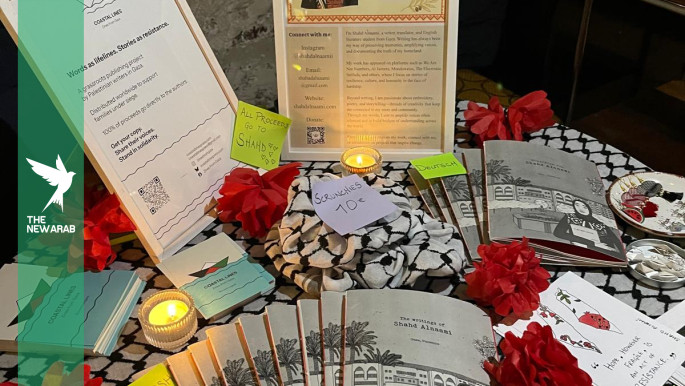
The call “reached far beyond my imagination,” and she received an email from Leila Boukarim, a Berlin-based children’s book author, who suggested that Shahd make a zine — a small, handmade art book, each one individually printed like a magazine, typically containing stories, essays, and poems.
The word is a shortened version of “fanzine” and can be traced back to short magazines published by science fiction fans in Chicago in the 1930s and 40s.
Leila edited Shahd’s half-letter-size collection of nonfiction and poetry. Shahd then reached out to a friend, Aude Abou Nasr, who volunteered to draw the cover illustrations, while Zeina Azouqah did the cover designs.
Zines as lifelines
Shahd received many messages from people who wanted to help distribute it for free, and in May, it went out into the world.
From this, the collective Coastal Lines Press was born. Those involved describe it as being like “vessels at sea”, travelling coast to coast and drawing lines of human connection and solidarity.
So far, the collective has published 21 zines in 13 languages, working with around 35 to 40 authors — most still in Gaza, alongside others abroad who are originally from there — with more publications already in the pipeline.
“Readers have said that this has changed their lives, that the zines have built bridges between their worlds and Gaza, which otherwise would not have happened,” Leila shares with The New Arab.
Of the 300 or so volunteer editors, translators, illustrators, marketers and others who work on the project, she adds, “This has been a lifeline for so many of us as well. A reason to get out of bed in the morning.”
The other writers who have published zines include medical student Abdelfatteh Fadel, who says he is “learning how to heal bodies while trying to write his way through the pain inside himself,” and Esraa El-Banna, who is studying English and publishes comics in hers.
Shahd, an English literature and translation student at the Islamic University, writes from the roof of her uncle’s house. The building has also been bombed, but it is still standing.
She begins in a notebook, jotting down her thoughts before later transferring them to her computer, even as the sounds of war continue in the background.
“It’s on the news that there is a ceasefire, but on the ground it’s not there,” Shahd continues. “We wake up every day to the sounds of guns and shooting and bombing.”
In her zine, Shahd writes about the daily realities of life in Gaza. Some are devastating — like losing her little sister and best friend, Rahaf, in December 2024. The two had swapped bedrooms just four days before Rahaf was killed.
But Shahd also writes about struggles that might seem small by comparison.
“For example, electricity,” she says. “Before the genocide, we had about eight hours a day, and we complained about it. Then the genocide came, and there was no electricity at all.”
Creatives who want to volunteer for Coastal Line Press don’t need to be professionals; they just need a big heart and to fill out a form on the site, Shahd explains.
Volunteers first share their details, after which Leila adds them to a Slack group. There, she announces a new writer and assigns volunteers to work with them, coordinating the process from draft to publication.
Each project eventually becomes two versions of the same zine: a physical booklet and a digital edition.
Because the format is open, volunteers anywhere in the world can print copies themselves. In this way, the collective sidesteps traditional publishing channels. The booklets can then be sold locally, with the proceeds sent directly to the writer through a QR code included in each zine, and all profits go back to the authors.
There’s “something very different about purchasing a physical zine, taking it home, putting it on your coffee table and having it there, reminding you to read it,” than there is with an online experience, Leila adds.
“There’s a need to take the time to sit with every piece, every word, every comma, and to process and allow yourself to be moved,” Leila continues.
“I feel like we will see more and more of this, of people escaping social media,” she shares, adding that AI is also forcing people to seek other avenues of learning, of education, and of art forms.
Each time a zine is sold, buyers are encouraged to reach out to the writer — and more often than not, they do.
From there, a conversation begins, Leila says. “I think that’s magic. It’s so damn necessary to form these human connections with people who have been so dehumanised by the media and by politicians who make it seem ‘okay’ to kill them.”
New volunteers sign up almost every day to help bring another zine to life, says the illustrator. And despite everything, the weekly virtual meetings Leila holds with the authors are not always heavy. “More often than not, we’re laughing,” she says — even amid the darkness.
She hesitates to call the work radical. Yet in today’s world, she says, it often feels that way. Recently, a volunteer told her something that stuck: Coastal Lines, they said, felt like “the opposite of ego.”
Solidarity across borders
In Berlin, a strong network of volunteers has formed around the project. Many have developed close relationships with the writers they work with, friendships that stretch across borders.
Leila says many of the volunteers “want this to be bigger than life,” and believes that what Coastal Lines Press has achieved so far is only the beginning.
“This is more than just a collective; it is a grassroots initiative,” Leila shares. “It feels more like a movement to me.”
For Shahd, her favourite subject is hope — a theme that says so much about the resilience of Palestinians living under genocide and occupation, who refuse to give up despite unimaginable circumstances.
“There is always hope in so many things, and the thing that helped me survive all the horrors we went through is hope, because I was always able to see the light,” Shahd tells The New Arab.
“Hope can get us through these moments, make us proud of ourselves, and give us the strength to carry on.”
She didn’t write before the genocide, but now she does — and she will continue to.
Amy Fallon is a journalist and media professional with two decades of experience working for several global media outlets
Follow her on X: @amyfallon