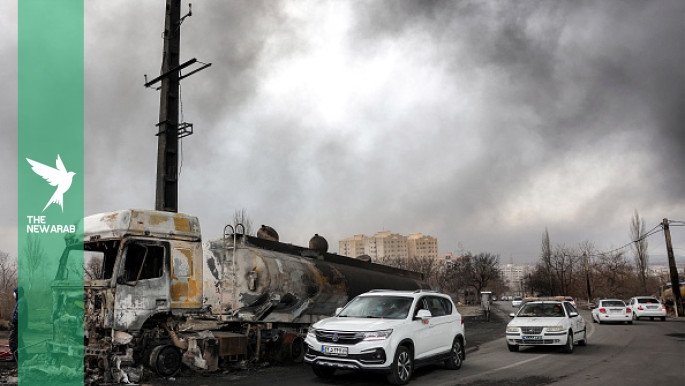
Iran’s Deputy Health Minister Ali Jafarian told reporters that the US and Israel were “carpet bombing” civilian infrastructure [Getty]
Iran’s President Masoud Pezeshkian outlined three conditions to end the ongoing war, as drone strikes on Thursday killed at least 10 people in the country, while Iranian forces continued to target Gulf countries.
Pezeshkian said the conditions were that Tehran’s legitimate rights must be recognised, reparations must be paid, and assurances given against any further aggression.
This comes as Iran said that joint US-Israeli strikes, which started in late February, have been targeting healthcare facilities and hospitals.
Iran’s Deputy Health Minister Ali Jafarian told reporters that the US and Israel were “carpet bombing” civilian infrastructure.
An Iranian Revolutionary Guards Corps (IRGC) chief, Ismail Dahkan, was killed in attacks on Thursday morning in the city of Arak, the Fars news agency reported. An additional seven people have been injured in Arak, two of them critically, the Mehr news agency said.
Since the start of the war, Iran has targeted American bases in the Middle East in retaliation, but has also hit civilian infrastructure in Gulf states.
Iran is believed to have targeted vessels in the Iraqi city of Basra, fuelling fears of major economic consequences for Iraq, with Baghdad forced to suspend operations at several oil terminals to assess the situation.
Also in Iraq, at least 27 members of Iraq’s pro-Iran Popular Mobilisation Forces (PMF) militia group were killed, and another 63 others wounded in airstrikes, believed to be by the US or Israel, targeting a brigade in Anbar province located near the Syrian border.
Iraq relies heavily on oil revenues to fund state services, and the country’s oil ministry says that a long disruption in output and exports as a result of the country being dragged into the US-Israeli war on Iran could have a major economic impact.
In the UAE, explosions were heard near downtown Dubai on Thursday, with eyewitnesses seeing clouds of smoke rising from buildings in the area. Dubai’s media office later issued a statement saying they are “dealing with the collapse of a façade of one of the buildings on the Sheikh Zayed Road, with no injuries reported”.
The fallout from the war has prompted many banks and other financial organisations to temporarily halt operations in the Gulf, with the latest being Citibank in the UAE, which stated it will close its branches from 12 to 14 March, citing precautionary measures.
Kuwait’s International Airport was also struck by several drones in an attack on Thursday, with the country’s civil aviation authority confirming material damage to the building but reporting no injuries.
Kuwait said at least six power lines were also shut down following drone attacks, while video footage showed the moment Iranian missile fragments fell and hit Zarqa in Jordan.
Meanwhile, Bahrain said it has intercepted over 300 drones and missiles since the start of the war, with the country’s defence forces confirming it intercepted more than 112 missiles, and almost 186 drones.
Saudi Arabia has shot down two drones over the Rub’ Al-Khali (Empty Quarter) desert in the south of the country, which were reportedly heading for the Shaybah oilfield.