Globally, reduced Gulf output is expected to sharply raise spot and long-term prices, affecting LNG-dependent Asia and Europe, disrupting supply chains, and increasing shipping insurance costs. [Getty]
In less than a week, the Gulf region has seen successive “force majeure” declarations in the energy sector.
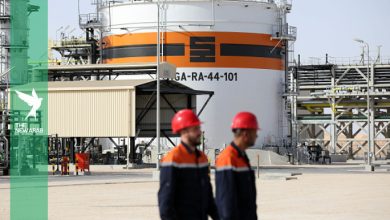
QatarEnergy issued a notice suspending liquefied natural gas (LNG) production and informing several buyers in Asia and Europe of the activation of force majeure following attacks on the Ras Laffan and Mesaieed facilities. This effectively suspends part of contractual obligations due to the ongoing war and its impact on infrastructure and shipping routes.
This disruption could sharply reduce supplies for weeks, according to Energy Now, a specialised energy platform. The platform noted parallel Gulf efforts to reassess the ability to meet contractual volumes amid the widening conflict.
These developments prompted market monitoring platforms, including Money Control, to warn that freezing part of Gulf exports could shift global gas market balances, especially in Europe, which is still recovering from the 2022 crisis, and in Asia, which relies heavily on Qatar for LNG imports.
Bloomberg reported yesterday, 11 March, that Qatar’s largest LNG export terminal has not shipped any cargo for five days, the longest uninterrupted period since 2008, threatening to drive fuel prices higher.
What is ‘force majeure’?
Legally, a “force majeure” clause in energy contracts allows a party to suspend or reduce performance if an event beyond its control makes performance impossible or very difficult.
Examples include war, closure of maritime routes, attacks on facilities, or government restrictions on production and exports.
The clause does not operate automatically, often requiring an event to be specified or measurable against a defined list of risks, proof that the affected party has made reasonable efforts to mitigate the effects, timely notification to the other party, and supporting technical and legal evidence of non-performance.
The disruption must be temporary; otherwise, contract termination or renegotiation provisions apply, according to the Harper James legal platform.
These conditions explain why energy companies and producing states quickly issue formal notifications when attacks or disruptions occur, specifying the scope of force majeure, whether it entails full suspension, partial reduction, or disruption at a specific port or facility.
A clear definition sets the boundaries of legal protection.
Compliance with clause procedures greatly limits liability for delays or failure to deliver. It offers a wide exemption from fines and contractual damages, although some ambiguities remain subject to dispute, as highlighted in the World Bank’s drafting guide on force majeure clauses.
In long-term LNG and oil contracts, invoking force majeure typically suspends delivery obligations according to set schedules. In contrast, the contract’s duration, pricing formula, and periodic price review mechanisms remain in effect.
Short-term disruptions may cause shipment rescheduling, but long-term interruptions can lead importers to seek contract renegotiation or price review clauses, especially if relying on a single supplier in a volatile region is considered commercially unacceptable.
Force majeure does not automatically entitle the buyer or seller to terminate the contract.
Legal instrument
Pascal Daher, a lecturer in economic judicial oversight, told The New Arab that, from the perspective of international commercial law and energy economics, force majeure in energy is an external, unexpected circumstance beyond normal means of control.
When conditions are met, a state or company is released from contractual obligations without penalties.
Daher explained that in the oil and gas industry, the concept includes armed conflicts, international sanctions, natural disasters, or major technical failures affecting production or transport, and provides a temporary exemption from financial liability if the event is external and unavoidable.
He described force majeure as a vital legal and strategic tool for states and companies, reflecting a complex intersection of law, economics, and international politics that influences production levels, contractual obligations, global energy prices, and supply chain stability.
Announcing force majeure primarily aims to avoid fines and compensation during emergencies, provided specific legal conditions are satisfied, including clear contractual clauses defining acceptable events, immediate notification to other parties, scope of exemption, and timelines for compensating delayed volumes.
International conventions such as UNCITRAL and the Vienna Convention on International Sale of Goods (CISG) recognise force majeure as a valid reason to suspend obligations if the event is sudden, external, and not caused by negligence or mismanagement.
Notification and evidence are essential, requiring immediate written notice to buyers with material proof of affected production or transport.
Delayed notification may forfeit legal protection, especially in international contracts.
Direct effects of declaring force majeure include partial or full suspension of production or deliveries, as in Qatar or Bahrain currently.
It temporarily halts contractual obligations until the cause ends, with the possibility of compensating quantities within 30 to 90 days, extendable by mutual agreement.
This provides legal protection from fines but can create significant economic repercussions, especially in long-term contracts that allow rescheduling without penalties, as reduced supply immediately affects global markets.
Globally, reduced Gulf output is expected to sharply raise spot and long-term prices, affecting LNG-dependent Asia and Europe, disrupting supply chains, and increasing shipping insurance costs.
Daher emphasised that force majeure must balance legal protection with direct economic impact.
Exemption from fines does not protect a state from financial effects if the event continues, as ongoing disruption puts pressure on state budgets through lost export income and rising global energy costs, which can worsen inflation and local expenditure.
The decision is a double-edged sword requiring careful political and economic risk management.
Direct impacts
Economist Rabie Badwani Makhlouf told The New Arab that the concept of force majeure is evident in current navigation disruptions through the Strait of Hormuz, which carries 20% of global trade.
Companies such as QatarEnergy declared force majeure after liquefaction operations were halted by attacks, immediately suspending LNG shipments to global markets.
Makhlouf observed that four elements are crucial for legal legitimacy: an external, uncontrollable event; unpredictability at the time of contract signing; impossibility of performance, not just difficulty; and the inability to reasonably mitigate the effects.
Long-term energy contracts, particularly LNG, specify triggering events such as military operations or sanctions, requiring the affected party to issue a formal notice detailing the reasons and the expected duration of the crisis to ensure enforcement of the clause.
Force majeure has three main effects: temporary suspension or reduction of production, as observed with Kuwait’s 2.6 million barrels per day; suspension of delivery obligations during the crisis; and risk redistribution, where buyers shoulder the burden of the supply shortage instead of producers.
Makhlouf highlighted Qatar’s heightened risk, as it represents 20% of global LNG trade, making any production halt a supply shock with immediate global repercussions.
Timeframes are contract-specific, allowing temporary suspension until the event ends, review after 30–90 days, or termination if performance becomes impossible.
Technical estimates suggest restarting halted liquefaction plants takes two to four weeks post-crisis, meaning supply disruption may outlast the military event, exemplified by the Iran war.
Legally, a declaration provides broad protection against non-delivery penalties and allows adjustments to the supply schedule. However, protection is not absolute and can be challenged if the event was predictable or avoidable.
Makhlouf concluded that the economic impact on Gulf states is twofold: a temporary decline in exports and disruption to the petrochemical supply chain, counterbalanced by partial recovery from record oil and gas prices.
Price increases near $100 per barrel could stabilise total revenues despite a potential 15% drop in production.
A prolonged force majeure could reshape global energy security and trigger new inflation, affecting Asian and European economies alike.
Article translated from Arabic by Afrah Almatwari. To read the original, click here.