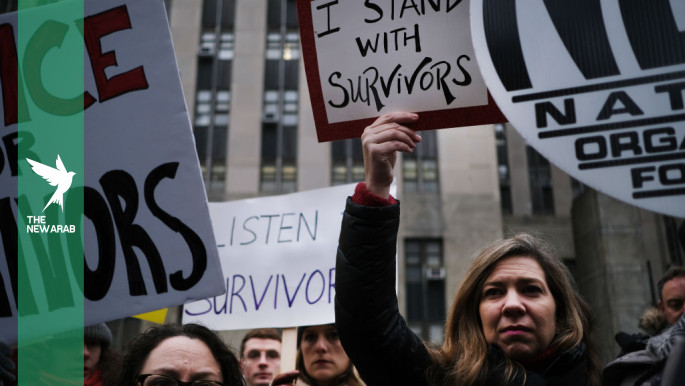
Survivors around the world are watching the headlines about the release of millions of documents linked to the Epstein case and asking where it the accountability? writes Nadine Tunasi. [GETTY]
Sexual violence is brutal, deliberate and intended to punish, terrorise and humiliate. Yet conviction rates for these crimes remain shockingly low. How can we expect, or even encourage, survivors to come forward when so few cases ever succeed?
At a time when there are more conflicts around the world than at any point since the Second World War, sexual violence is increasingly used as a tactic of war, torture and terrorism. Reports emerging from places such as Sudan, Israel and the Occupied Palestinian Territories and my home country, the Democratic Republic of Congo, are deeply alarming and harrowing.
Survivors of sexual violence face complex and lifelong consequences. Many endure long-term health conditions including reproductive and surgical complications, HIV and other infections and profound psychological trauma. Many have died.
Women are forced to live with unwanted pregnancies; mothers are excluded and rejected by their families and communities. Men and boys face immense health and legal barriers because of stigma and silence.
The impact is pervasive and destructive. And it does not end when the violence ends.
When you live in a country where there is no rule of law, where perpetrators of serious crimes can act with impunity, it can be impossible to feel safe. But even when survivors reach countries like the UK, where they hope to find protection and justice, the reality is disturbing.
Justice and accountability have become privileges afforded to too few survivors. That is a moral failure of our societies. And survivors deserve so much better.
Too often, survivors are asked, “Why didn’t you report it?” This question ignores the many valid reasons people do not go to the police: lack of trust in the justice system, fear of being dismissed or mistreated, serious concerns for their safety. For many survivors, people in authority are not figures of protection – they are figures of fear.
And look at what is happening right now. This is not only about survivors of sexual torture in conflict zones. It is about women and girls everywhere. Survivors around the world are watching the headlines about the release of millions of documents linked to the Epstein case and asking where it the accountability?
The message is chilling: time and again the system fails to protect, and perpetrators appear to be let off the hook.
We need legal systems that confront stigma in all its forms and treat survivors with dignity and care. Crucially, all survivors must receive the same compassion and support, regardless of gender, ethnicity, age or sexual orientation. No matter who we are or where we come from, we all deserve access to justice, protection and safety.
Justice is a powerful word for survivors. It is also a misunderstood one. Justice does not look the same for everyone. Effective justice is justice defined by survivors themselves –that recognises them as individuals with specific needs, priorities and boundaries.
What is needed is not complicated. First, there must be genuine commitment to listen to survivors and act on their recommendations. We are, sadly, experts by experience. Second, survivors need safe and protective spaces – places where engagement with the authorities does not expose them to further harm or trauma. Third, by empowering survivors to report what’s happened to them we begin to disempower the perpetrators and return shame and stigma to where it belongs.
Survivors are essential to this fight. Their voices are among our strongest tools for improving support services, strengthening justice pathways and building survivor centred systems that actually work.
Through my work at Freedom from Torture, I have met survivors from many different countries. People who have seen the worst of humanity but have not been defeated. I am always inspired by their resilience and determination. But this burden cannot rest on survivors alone.
All perpetrators must be condemned and held to account – regardless of geography, power or political importance. Survivors suffer profoundly, everywhere. They must not be left to suffer alone and in silence.
From conflict zones to courtrooms, from leaked documents to global headlines, survivors are watching closely to see whether governments are prepared to act. Justice delayed and denied is not accidental: it is a choice. And we can choose differently.
Survivors deserve more than sympathy. They deserve accountability to be delivered through effective investigations and prosecutions that go beyond mere lip service.
Nadine Tunasi is a leading advocate in survivor activism, dedicated to ensuring that the voices of survivors of torture and lived experiences of survivors are recognised as vital expertise in shaping the policies that affect them. At Freedom from Torture, she leads efforts to centre survivor experience in advocacy, policy development, and systemic reform. Nadine manages networks of torture survivors and individuals with lived experience of the UK immigration system, empowering them to influence and drive change towards a fairer, more compassionate system.
Have questions or comments? Email us at: editorial-english@alaraby.co.uk.
Opinions expressed in this article remain those of the author and do not necessarily represent those of The New Arab, its editorial board or staff.