Amid a lack of shelters in Arab majority areas of Haifa, residents are forced to rely on churches, schools and institutions for shelter [Getty]
Palestinian neighbourhoods in Haifa are facing a growing shelter crisis, with residents accusing Israeli authorities of pursuing policies that deepen discrimination and effectively exclude Palestinian communities from basic protection during wartime.
Haifa, a city of around 1.2 million people in northern Israel, has been subjected to heavy bombardment from both Iran and Hezbollah since the war began, with Palestinian-majority areas among the worst affected.
Many Palestinian citizens of Israel live in old houses that lack any form of protected space, forcing them to improvise when sirens sound.
Maurice Khoury, a resident of the city’s Wadi Nisnas neighbourhood, said the situation has become intolerable. “The war is very frightening”, he told The New Arab. “All of Haifa and all the neighbourhoods have been hit, whether here in Wadi Nisnas, in Hadar, or other areas”.
He continued: “This is a very old neighbourhood, and there are no shelters in the homes. Everyone rushes to the school shelter or the church, or they try to take cover under the buildings if possible. When we hear the siren we head directly to those shelters, but overall, there aren’t many”.
Residents say that what little protection exists often takes the form of reinforced concrete ‘safe rooms’ rather than purpose-built bomb shelters that meet official Israeli standards.
These rooms are usually above ground, small and overcrowded, offering limited protection beyond shielding from shrapnel.
Some locals, like Saeed Halloun, have even resorted to taking refuge in large industrial refrigerators during strikes, saying their main aim is to avoid shrapnel because a direct hit would be devastating even for those in shelters.
When sirens sound during the day, residents say the few available protected spaces quickly become overcrowded.
Shopkeepers, customers and visitors rush into small, fortified rooms that hold only a handful of people, while many others are left outside with no protection at all.
“The shelters are not enough, and we hope the municipality will provide more of them”, local resident Khaled Ragheb told The New Arab. He noted that many elderly people struggle to reach the limited number of shelters in time, and argued that more facilities closer to homes would make a critical difference.
In the absence of adequate state-provided shelters, churches, schools and some private institutions have opened their doors to residents.
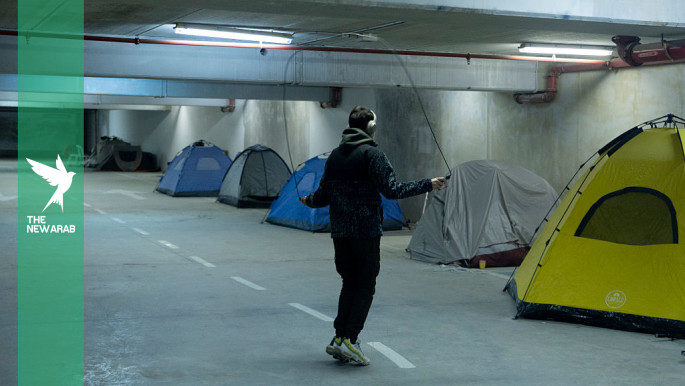
The Church of St. John the Baptist in Haifa, for example, has turned its underground parking garage into a makeshift shelter, hosting entire families who have fled unsafe homes.
Father Demetrios Samra, priest of the Greek Orthodox parish, said many residents have set up tents in the parking area and neighbours rush there whenever sirens blare because, as he said, “this area is old and lacks shelters”.
Alicia Qabian is a resident who has been taking refuge and sleeping in the church garage said since the war began.
“We come here because we are afraid. Our homes are not safe and have no shelters. We are here day and night—young and old”, Qabian said. “Many family members are here too, and several families sleep in the same place. We previously took refuge here during the time of Saddam Hussein and the first Gulf War”.
Israel’s discriminatory policies
Rights groups say the situation in Haifa’s Arab neighbourhoods reflects a broader pattern of discrimination in shelter provision across Israel.
Official data cited by civil society organisations indicates there are around 12,000 public bomb shelters in Israel, yet only 37 are located in Arab towns, a figure backed up by recent eyewitness accounts on nationwide shelter disparities.
Mixed cities with large Palestinian populations, including Haifa, are also affected by long-standing gaps in planning and investment.
Jaafar Farah, director of the Mossawa Center for the Rights of Arab Citizens in Israel, said the crisis in Wadi Nisnas is emblematic of structural neglect.
“We are talking about one of the largest and oldest neighbourhoods in Haifa, where around 9,000 people live, yet civil protection here is extremely limited—almost non-existent”, he told The New Arab.
Farah noted that proposed solutions have been on the table since at least the 2006 war, when three young men were killed and dozens injured by bombing in Wadi Nisnas.
“Since then, we have been saying that there are public spaces in the middle of the neighbourhood where shelters could be built. Here, for example, near the school and the church there is a square where a large shelter could be constructed underground to provide protection for residents—or at least for some of them”.
Farah argued that the failure to act stems from “government neglect and gaps affecting Arab society” and a security doctrine that effectively excludes Palestinian communities in Israel from the civil protection system.
He pointed out that in Wadi Nisnas, there is only one public school whose gym is used as a shelter, while the rest of the available spaces are in private institutions like churches that have converted their spaces into makeshift shelters.
Residents say this leaves many vulnerable residents, particularly people with disabilities and elderly people, without realistic access to safe havens during attacks. “That’s why some set up tents inside shelters, sleep in parking garages, and stay there in order to protect themselves”, Farah said.