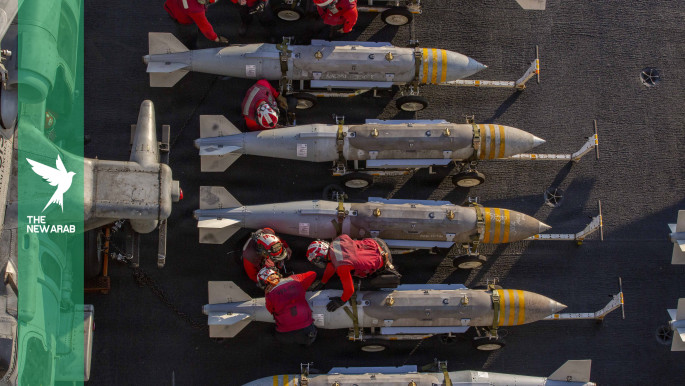
The US-Israeli air war on Iran has seen large numbers of missiles and precision-guided munitions used against Tehran’s ballistic and drone arsenals, as well as other targets related to the Islamic Republic.
Simultaneously, the unprecedented Iranian ballistic missile and drone attacks throughout the region in response have also seen US, Israeli, and Gulf Arab air defences put to the ultimate test.
Analysts estimate that if this war drags on for several weeks, as US President Trump has said is a possibility, there could be severe shortages of American cruise missiles and smart munitions as well as advanced air defence interceptor missiles in the US, Israeli, and Gulf Arab arsenals.
Replacing these spent munitions could take many years, as they are sophisticated, expensive, and take considerable time to produce.
Missiles, drones, and interceptors
Iran’s militia allies, particularly the Houthis in Yemen, have previously targeted Saudi Arabia and the United Arab Emirates (UAE) with missiles and drones. Iran directly launched ballistic missiles at an airbase hosting US troops in Qatar at the end of the 12-day war in June 2025.
However, since the present war started last Saturday, Iran has targeted all six Gulf Cooperation Council states directly with ballistic missiles and drones, an unprecedented move that threatens to engulf the whole region in conflict.
Most of the GCC states have advanced American-made air defence systems. Saudi Arabia and the UAE even operate the high-end Terminal High Altitude Area Defence, THAAD, system. The UAE has claimed very high successful interception rates against incoming Iranian munitions so far.
One possible way to get a rough estimate of how many interceptors these states have likely used is to count the number of known interceptions to date. Doing so, however, is not as straightforward as it might otherwise seem.
Analysts at the Armed Conflict Location and Event Data (ACLED), a conflict monitor specialising in real-time data and analysis, consulted by The New Arab, noted that their interception numbers are much lower than those presented by the Gulf states. They believe this may be related to the large number of interceptions over the Gulf or even inside Iran.
The analysts explained that their data comes from witness accounts of explosions in the skies over these respective countries. But the governments of these countries are only providing aggregate reports on the overall number of interceptions at the moment, which ACLED can’t record as individual events.
“Based on our methodology, if let’s say the UAE intercepts 50 drones as part of a wave of attacks, they will say they made 50 separate interceptions, but this will appear in our data as just one event,” the analysts told The New Arab.
“Per our methodology, multiple interceptions (even if in the hundreds) are coded as one event if we can’t disaggregate them based on location, which the official Gulf government unfortunately does not provide in these reports being circulated right now,” the ACLED analysts added.
“At this stage, we cannot quantify the exact number of projectiles being intercepted due to methodological limitations, and therefore, we cannot conduct an accurate assessment.”
Federico Borsari, a defence expert at the Centre for European Policy Analysis, noted there is “inevitable pressure” on interceptor stocks.
“The tempo and density of Iranian salvos have decreased significantly in the past couple of days compared to the initial phase of the US-Israeli operation due to relentless strikes against Iranian TELs (mobile launchers) and drone-launching trucks/positions and depots, which are poised to continue for days if not weeks,” Borsari told TNA.
“This has already driven down the expenditure of interceptors and should allow the US, Israel, and regional allies to start replenishing part of their stocks.”
While this will, of course, require time, the CEPA analyst noted that “in-depth interdiction” of Iranian launch platforms is a crucial step to “diminish launches and save interceptors,” a fact he said is often overlooked.
Freddy Khoueiry, a global security analyst for the Middle East and North Africa at the risk intelligence company RANE, estimates that Israel and several of the Gulf states can sustain high interception rates thanks to their multi-layered air defence systems and strong US support.
“The real constraint is not the capability of the systems but the depth of interceptor inventories,” Khoueiry told TNA. “Systems such as Arrow-3, THAAD, and Patriot PAC-3 rely on expensive, complex interceptors that are produced on relatively slow industrial timelines.”
Stockpiles and production capacity
Consequently, if Iran proves capable of maintaining a sustained tempo of missile and drone launches over the course of several weeks, the defending states will have to prioritise what they intercept more selectively. That would see them expending air defence interceptors only against incoming projectiles headed for critical infrastructure and population centres.
“There is a real risk that sustained high usage could push US interceptor inventories toward low levels. These systems were not designed for prolonged high-intensity missile exchanges with a country capable of firing large salvos,” Khoueiry said.
“Even if stocks do not run out, they could fall to levels that require careful rationing, such as in the final few days of the June 2025 conflict,” he added. “Replenishing these inventories can take years because production capacity is limited, and demand is already high across multiple theatres.”
In the two-month Operation Rough Rider last year, the US fired BGM-190 Tomahawk cruise missiles at the Iran-allied Houthis in Yemen. Three weeks into that operation, there were already concerns that the US was firing such missiles at an unsustainable rate. During Operation Midnight Hammer in June 2025, the US launched an estimated 30 Tomahawks against a nuclear site in Iran.
Such operations can see the US military fire more of these missiles in days or hours than are produced in entire years. The latest ongoing operation against Iran, codenamed Epic Fury, is no different.
“If the conflict continues at its current pace, it is very likely that the United States is using a significant number of long-range precision weapons such as Tomahawks and air-launched cruise missiles,” RANE’s Khoueiry said. “These are central to the US strategy of striking launch sites, command infrastructure, and military targets inside Iran.”
Furthermore, he noted, while the US maintains large stockpiles of such munitions compared to other countries, they remain critical to its deterrence plans in the Middle East.
“Sustained consumption in the Middle East could therefore create pressure on inventories and reinforce the need to expand production,” Khoueiry said. “The main consequence would not necessarily be immediate shortages but greater strain on global readiness planning.”
Additionally, during the June war with Iran, the US fired significant numbers of its THAAD interceptors against Iranian ballistic missiles along with naval SM-3 and SM-6s. All of these cost millions of dollars each and are also produced in small numbers, again because of their high price tag and sophistication.
“I think it’s plausible to expect some stock pressures regarding interceptor supplies in the current scenario. But US Industry has ramped up production in recent years, including for key systems like SM-3, SM-6, PAC-3 MSE, Thalon, though the latter’s stocks are still suffering from the very low procurement of the Biden administration,” CEPA’s Borsari said.
“We can assume that Israel has been preparing for this operation for many months and is unlikely to run out of interceptors in my opinion, especially since industry is heavily plugged into the country’s decision-making and has likely prepared the necessary stocks,” he added.
“Furthermore, we should always remember that air defence includes the use of aircraft with their own effectors (Sidewinder, etc), which increases the overall magazine depth for that mission set.”
Unless there are unforeseen developments, any supply delays in terms of procurement or contracts should be limited, the analyst said, even if they add to pre-existing backlogs.
Drones, meanwhile, will likely become the main threat in the coming weeks. Unlike ballistic or cruise missiles, drones allow for more dispersed launches and have a smaller logistical footprint, a much-needed advantage as Iran faces overwhelming US-Israeli air superiority.
“Therefore, the US and Gulf countries should focus on this mission set, for which there are plenty of solutions available and combat-tested already in the CENTCOM area of responsibility, such as the APKWS, and the LIDS/M-LIDS,” Borsari said.
Those systems can intercept drones at a much lower cost than traditional air defence or air-to-air missiles.
In Khoueiry’s view, the current conflict again demonstrates how missile and drone warfare is becoming a “contest of endurance” as much as technology.
“Iran does not necessarily need to penetrate defences at a high rate to impose pressure; simply forcing opponents to expend large numbers of costly interceptors can create strategic strain over time,” he said.
“For the United States and its allies, the challenge is balancing immediate defence of partners with the need to preserve inventories for other theatres,” Khoueiry added.
“This dynamic means the conflict is not only being fought on the battlefield but also in the military-industrial complex.”
Paul Iddon is a freelance journalist based in Erbil, Iraqi Kurdistan, who writes about Middle East affairs
Follow him on X: @pauliddon
Edited by Charlie Hoyle