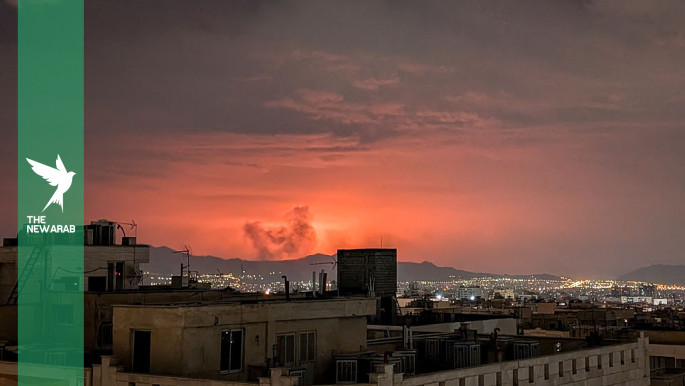
Across Tehran, Isfahan, Kermanshah, Qom, Tabriz, Bandar Abbas, and Bushehr, residents woke before dawn to explosions and rising smoke. [Getty]
In the early hours of Thursday 5 March, the war entered a sharper and wider phase. A new wave of airstrikes and missile attacks hit Tehran and a string of major Iranian cities, targeting military installations, command centres, and air defence infrastructure embedded within or on the edges of residential areas.
What distinguished this day from those before it was not simply the scale but the depth: strikes reached further into Iran’s urban geography, and their proximity to civilian neighbourhoods made the distinction between military and civilian impact increasingly difficult to sustain.
Across Tehran, Isfahan, Kermanshah, Qom, Tabriz, Bandar Abbas, and Bushehr, residents woke before dawn to explosions, rising smoke, and the sound of air defence systems attempting to intercept incoming aircraft and missiles.
Iranian authorities announced that most targets were military sites or command facilities, but the closeness of those sites to populated areas produced collateral damage to residential buildings and commercial premises, with windows shattered and walls cracked by blast waves across multiple districts.
In the capital, the day began with a series of powerful explosions in the western and northern districts, where Revolutionary Guard installations and air defence units are concentrated. Residents described coming onto their balconies and into the streets in the half-light of dawn, staring at a column of dark smoke rising slowly above an industrial district in western Tehran.
Hamed Farahmand, 42, an archivist, was woken by a violent shudder in his building. “It was not just the sound of a distant explosion. It was a feeling that the ground itself had moved beneath us. I went straight to the balcony and saw that several neighbours had already come out too.” Nobody spoke at first, he said to The New Arab.
“There was a heavy silence, as if everyone was trying to understand what had happened before asking any questions. On the horizon, a dark column of smoke was rising slowly above one of the industrial districts in western Tehran, and the dim light of dawn made the scene even stranger,” he added.
Within minutes the street below filled with people, many still in nightclothes. Ambulances began moving at speed along the main road.
“Every time an ambulance passed, people turned toward it automatically, as if they wanted to know where it was going and what had happened there,” Farahmand described.
A neighbour was trying to call relatives at full volume, getting no answer. A woman on the ground floor was holding her child and trying to calm him after he had woken up crying.
“In those moments you do not think about politics or analysis. You think about one thing only: is it over, or is something else about to happen?” he added.
Iranian authorities said the strikes targeted military infrastructure, but residents in districts close to the strike sites reported that blast waves were strong enough to wake sleeping families and cause buildings to shake, sending many households to lower floors or interior rooms.
Isfahan: air defences in the sky
In Isfahan, at the heart of Iran’s defence industries and close to nuclear-related facilities, the day brought a different kind of intensity. Residents reported hearing unfamiliar sounds in the sky before the explosions began.
Nazanin Sadeqi, 35, a translator, was working at her computer when she heard something she could not identify.
“At first I thought it was military aircraft passing over the city, but the sound was different. It was sharper, as if it was very close. Then I heard a powerful explosion that made me stand up immediately. The windows shook slightly and I understood that it was not just a plane going over,” she described.
Going onto her balcony, she saw rapid flashes of light on the horizon followed by what sounded like an aerial interception.
“I understood that the air defences were working,” Sadeqi said.
Neighbours came out of their homes or onto their balconies, asking each other what they had heard.
What stayed with her most was the children. “Some were crying loudly from the sudden noise while the mothers tried to calm them and get them inside quickly. One child was asking his mother in a loud voice why this was happening. She did not know what to say to him,” she told TNA.
Tabriz: a quiet city watching the sky
In the northwest, near the Turkish border and close to several air bases and military installations, Tabriz heard explosions from the direction of its military airport before dawn.
Kianoush Taheri, 24, an engineering student, was with his family when the sound came.
“At first we thought it was a plane taking off quickly, because that happens sometimes at night. But then the windows shook slightly and the sound was different from anything we had heard before. We looked at each other and understood that an explosion had occurred somewhere nearby,” Taheri said.
Messages spread quickly through university groups and neighbourhood chats, with friends reporting flashes in the sky before the blast and others describing the sound of a drone.
“The information was spreading fast but nobody knew the full truth,” Taheri said.
Through the night, the sound of aircraft came and went.
“It was not more explosions, but it was enough to stop a lot of people from sleeping,” Taheri added.
By the early hours, Tabriz’s normally busy streets were almost empty.
Kermanshah: a nurse in the emergency ward
In western Iran, Kermanshah: a city familiar with military proximity because of its position near the Iraqi border, sustained strikes on its outskirts that sent casualties to the city’s hospitals.
Maryam Kavousi, a nurse, was at home when she heard a powerful explosion from the direction of the city’s edges. Minutes later a colleague called and asked her to come in immediately.
“When I arrived at the hospital, the tension was visible. The medical staff were moving quickly and there were families waiting in the corridors with intense anxiety. Some people were trying to reach relatives on the phone. Others were sitting in silence watching the doors through which the wounded were being brought,” she said.
Most of the injuries, she said, were from shrapnel or glass shattered in homes near the blast site.
“But what affected me most were the children who arrived in a state of severe fear. Their injuries were not serious in most cases, but they were terrified by the sounds they had heard and by the chaos that followed,” Kavousi said.
She paused on what the hospital makes visible that news coverage does not.
“For people on the outside it may be just a news story or a headline on television. But for us it was the real faces of people who had lived through very difficult moments,” she described.
Qom: the holy city holds its breath
In Qom, Iran’s foremost religious centre and home to its major seminaries, explosions were heard at the city’s edges. Shops closed early. Residents stayed indoors.
Dariush Bakhtiar, 48, a merchant, was reading at home when he heard a distant blast from the city’s outskirts.
“The sound was not very close, but it was clear enough to make me stop reading immediately,” Bakhtiar described.
Minutes later cars were moving at speed in the street outside. Neighbours gathered in small groups, speaking quietly, trying to piece together what had happened.
In the morning, walking near the seminary district, he heard students debating the night’s events in the courtyards. “Everyone was trying to interpret what had happened in their own way, but the information was scarce and contradictory,” said Bakhtiar.
For a city that has rarely found itself in the immediate geography of military operations, the psychological impact was distinct. The damage inside Qom appeared limited compared to other cities, but the atmosphere of anxiety and caution was unmistakable.
Beyond Iran’s borders, the war expands.
Tehran launched missiles and drones toward targets across the region in what it described as retaliation. US military bases in Iraq were struck by drone attacks, adding another front to a confrontation that is becoming harder to contain within any defined geography.
The international concern increased over about the prospect of a wider regional war that could draw in a large number of states.
This story was published in collaboration with Egab.