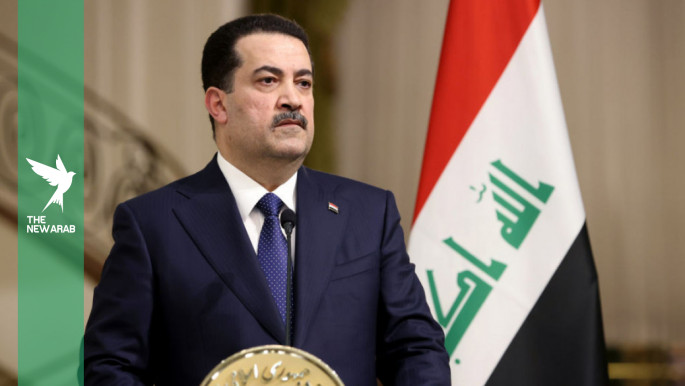
Iraqi PM Mohammed Shia al-Sudani has emphasised the need for vigilance to protect Iraq’s sovereignty and national interests. [Getty]
Iraq’s prime minister, Mohammed Shia al-Sudani, said on Wednesday the country would not be drawn into the war involving the United States, Israel and Iran, as authorities strengthened security measures following protests and militia activity.
Overnight, security forces clashed with armed faction supporters attempting to reach the US embassy in Baghdad’s Green Zone.
Hundreds of demonstrators gathered and advanced toward the gates of the Green Zone. Some protesters reportedly fired on security personnel, wounding several officers. Authorities detained three suspects.
The Joint Operations Command called the incident a “dangerous act” targeting security forces performing their constitutional duties. Officials stated that troops exercised restraint and did not use live ammunition. Reinforcements were deployed, and roads to the Green Zone were temporarily closed to prevent escalation.
Sudani, also commander-in-chief of the armed forces, visited the Joint Operations Command headquarters on Wednesday and chaired a meeting with senior military and intelligence officials to review the national security situation amid ongoing regional hostilities.
“Only the Iraqi state has the authority to decide on war and peace,” Sudani told commanders, warning against efforts to involve Iraq in the regional conflict.
He emphasised the need for vigilance to protect Iraq’s sovereignty and national interests.
The prime minister ordered strict accountability for security personnel found negligent during this sensitive period. Measures included restructuring the intelligence apparatus within the Nineveh Plains Operations Command, apparently in response to their failure to prevent Iran-backed militias from launching drone and missile attacks on the US Consulate General in Erbil and the Erbil International Airport.
Parliament will convene on Saturday to address escalating security challenges in Iraq and the region.
Tensions along the Syrian border
In Anbar province, a security source reported that Popular Mobilisation Forces (PMF) mobilised all combat capabilities after unidentified aircraft were seen over PMF positions along the Syrian border.
Political and public opposition in Iraq has intensified in response to repeated violations of national sovereignty, with warnings that the country risks becoming a battleground for regional rivalries or a launchpad for attacks on neighbouring states. Lawmakers stressed that silence in the face of attacks on security institutions and violations of Iraqi airspace would constitute “a betrayal of national trust.”
Separately, Iraqi security forces reported preventing a missile launch from Basra province toward a neighbouring country. Forces dismantled a launch site in the Salili area of al-Zubair district early Thursday, based on intelligence from Iraq’s National Security Service. The missiles had reportedly been prepared for cross-border firing.
The incident follows a sharp escalation after the United States and Israel carried out airstrikes on Iran on 28 February, reportedly killing several senior figures. Tehran responded with missile attacks on Israel and strikes on US military installations in several countries.
Since hostilities began, pro-Iran armed factions in Iraq have increased attacks on US interests, raising concerns that Iraq could become a secondary battlefield.
Diplomatic contacts intensified as tensions rose. Iran’s foreign minister, Abbas Araghchi, spoke with Kurdistan Region President Nechirvan Barzani about the consequences of US and Israeli military action against Iran. Both sides discussed enhancing cooperation, including a security memorandum of understanding to protect shared borders and prevent Iranian Kurdish opposition parties based in the Kurdistan region from infiltrating into Iran.
Iraq’s national security adviser, Qassem al-Araji, stated that additional Peshmerga forces have been deployed along the border with Iran.
Deadly strikes and increasing casualties
The Joint Operations Command reported that a Karbala Operations Command unit came under air attack and gunfire at dawn during a search mission between Karbala and Najaf provinces, resulting in one serviceman killed and two wounded. Some Iraqis claimed on social media that the clashes erupted with an Israeli force after an airborne operation in the Karbala desert.
In Babylon province, a senior Kataib Hezbollah commander, Abu Hassan al-Freiji, was reportedly killed in a missile strike targeting a Popular Mobilisation Forces vehicle. Another drone strike near Hilla reportedly killed two more people.
These attacks are part of a broader series of drone and missile strikes targeting armed faction positions in Iraq amid escalating confrontation involving Iran, Israel, and the United States.
The unfolding crisis presents a major test for al-Sudani’s government as it seeks to assert state authority, prevent Iraq’s involvement in regional conflict, and balance the right to peaceful protest with national security.