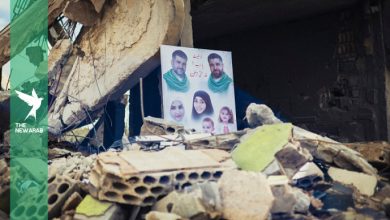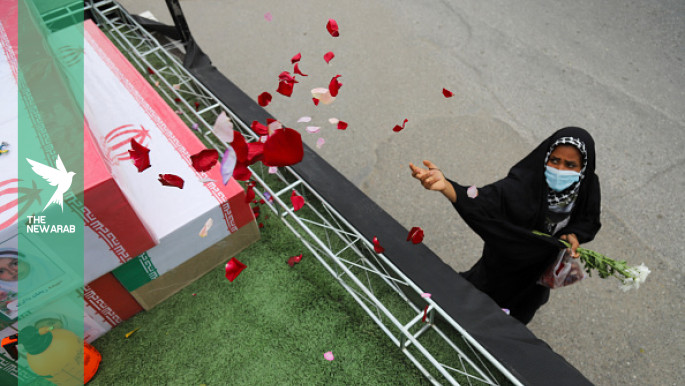
Two US officials told Reuters on 5 March that American military investigators now believe it is likely that US forces were responsible for the apparent strike on the Iranian girls’ school. [Getty]
Israel has sought to deflect blame for the bombing of a girls’ school in the Iranian city of Minab, after an air strike killed 168 students aged between seven and 12 and drew growing scrutiny in international media.
The Shajarat al-Tayyiba school was hit in southern Iran, an area where the United States is conducting military operations under what Israeli media describe as a coordinated division of roles with Israel.
Iranian officials say the blast, which struck during morning classes on the first day of the joint US-Israeli air campaign, has become the single deadliest attack on civilians since the start of the war, with funerals held this week for at least 165 victims, most of them schoolgirls.
Appearing on CNN early on Thursday, Israeli Prime Minister Benjamin Netanyahu’s political adviser, Ofir Falk, sought to deny responsibility for the attack and instead blamed Iran.
“Iran itself carried out the massacre,” Falk said. “This also happened in Gaza.”
He appeared to be referring to Israel’s claims following the 2023 explosion at Al-Ahli Arab Hospital in Gaza, which killed hundreds of Palestinians; at the time, Israel said the blast was caused by a misfired rocket launched by Islamic Jihad, an allegation that has been widely disputed.
Falk also claimed Israel “considers any harm to civilians a tragedy” and insisted that both Israel and the United States were doing everything possible to avoid civilian casualties.
“I am 100 percent sure the US military did not intentionally kill civilians,” he declared. “From what I understand, it was the result of failed Iranian launches, and this happens with 30 percent of their missiles.”
The CNN correspondent challenged Falk on the claim, noting that the United States had not said Iran was responsible for the strike and that neither Washington nor Tel Aviv had presented evidence to substantiate the misfire allegation.
The interview came two days after the US military said it was reviewing reports that the school had been hit during ongoing military operations.
Captain Tim Hawkins, a spokesman for US Central Command (Centcom), said the US was “aware of reports of civilian casualties resulting from ongoing military operations”.
“We take these reports seriously and are reviewing them,” he said.
US Secretary of State Marco Rubio said the Pentagon would investigate whether the strike had been carried out by US forces, adding that Washington “would not deliberately target a school”.
However, two US officials told Reuters on 5 March that American military investigators now believe it is likely that US forces were responsible for the apparent strike on the Iranian girls’ school, although the inquiry has not yet reached a final conclusion.
Reuters reported that investigators have not disclosed what evidence contributed to the preliminary assessment, what type of munition was used, who authorised the strike or why the school might have been targeted.
Subsequent reporting in The New York Times, based on satellite imagery and verified video, said the Shajarat al-Tayyiba primary school in Minab lies next to a base belonging to the Islamic Revolutionary Guard Corps (IRGC), which was also struck during the same wave of attacks.
The paper reported that at least 175 people, predominantly children, were killed in the blast, describing it as the deadliest single strike so far in the American-Israeli bombing campaign, while noting that neither country had claimed responsibility.
Israeli news website Ynet reported that the unofficial division of operations between Israel and the United States in the war launched against Iran assigns Israeli forces targets in western Iran, while the US carries out strikes in the south and east of the country.
The school bombing occurred in southern Iran, the report said, placing it within the area where US forces are operating.
US officials have repeatedly declined to comment on operational details but have stressed that any civilian harm would be examined under Pentagon procedures, with rights groups warning that the pattern of strikes hitting civilian infrastructure points to systematic failures in targeting.
International reaction has hardened as the scale of the killings has become clearer.
The Guardian cited local officials and Iran’s Mizan news agency as saying that at least 100 to more than 160 children were killed at the Shajarat al-Tayyiba girls’ school, with many others missing, describing scenes of parents rushing back to the school as air raids began.
Unesco condemned the bombing as a “grave violation” of international law and a “serious breach” of the protection owed to educational institutions in conflict, calling for an independent investigation and accountability for those responsible.
Iranian President Masoud Pezeshkian accused the United States and Israel of jointly targeting the school and a nearby hospital, saying that “attacks on schools target a nation’s future” and vowing that Iran “will not remain silent or yield to these crimes”.
State media broadcast images of mass funerals in Minab, where mourners marched behind rows of small coffins draped in Iranian flags, some bearing photographs of young girls in school uniform.
Hossein Kermanpour, a spokesman for Iran’s health ministry, referred on social media to “young child martyrs”, while the head of the Iranian Red Crescent said the Minab school disaster was “incomparable to any other event”.
Fact-checking outlets have pushed back against online claims that the attack was staged by Tehran.
An investigation by France 24‘s “Truth or Fake” unit confirmed that the strike hit the Shajarat al-Tayyiba girls’ school, which has been physically separated from adjacent IRGC barracks for nearly a decade, and found no evidence to substantiate claims that an Iranian rocket misfire caused the blast.
Instead, open-source analysts highlighted craters and blast patterns consistent with an air-delivered munition, while noting that the precise provenance of the strike could not yet be conclusively established.
Israeli opposition leader Yair Lapid also commented on the incident in an interview with the Russian opposition channel Dozhd.
Asked whether he could confirm or deny Iran’s claim that the school had been bombed by Israeli or US forces, Lapid said the incident “was a mistake”.
“This is war, and in war there are always casualties among the population,” he said. “It is horrific when children suffer—children who should not die when adults are fighting.”