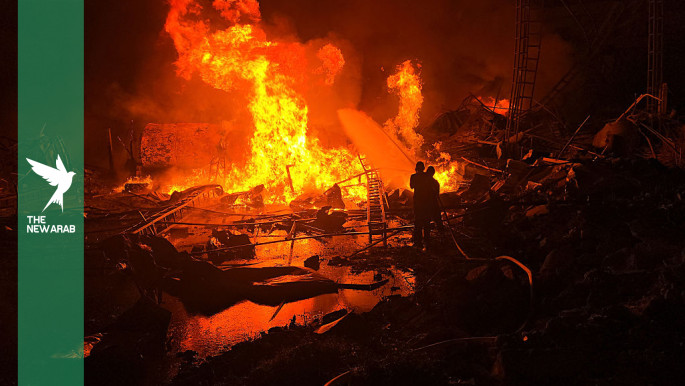
Residents of Beirut’s southern suburbs evacuate homes following Israeli warnings amid intensifying military strikes. [Getty]
Since Monday, 1 March, Israel has implemented a field strategy focused on issuing evacuation warnings across large areas of Lebanon. The alerts began in the south before extending on Thursday, 5 March, to Beirut’s southern suburbs and several Bekaa villages to the east. The measures caused large-scale displacement, marking a serious and unprecedented development in the recent confrontations between Israel and Hezbollah.
Thursday’s alerts targeted the neighbourhoods of Bourj Al-Barajneh, Al-Hadath, Haret Hreik, and Chiyah in Beirut’s southern suburbs. These densely populated areas, home to more than one million people, comprise families from various religious sects but are predominantly Shia. They also host communities affiliated with the Syrian Nationalist Party, the Communist Party, and the Amal Movement, led by Nabih Berri. Hezbollah, however, remains the dominant presence, with the area considered one of its main ‘strongholds’ in Lebanon.
The alerts followed a statement from Israeli Finance Minister Bezalel Smotrich, who said Beirut’s southern suburbs could soon resemble Khan Younis in Gaza. The comment indicates Israeli intentions to displace residents, expand destruction, create a buffer zone, and convert areas “affiliated” with Hezbollah into military targets.
Residents of the threatened areas quickly evacuated their homes, leading to severe traffic congestion. Some spent the night on city streets, while others travelled to relatives in villages outside Beirut. The Ministry of Health, in coordination with relevant organisations, evacuated patients from hospitals, during which two women died during transfer.
The Israeli army intensified airstrikes on the southern suburbs of Beirut, continuing through Thursday night. It also escalated attacks in other regions, particularly border villages and southern and eastern Bekaa areas.
On demographic and military developments, retired Brigadier General Ali Abi Raad told The New Arab that the southern suburbs constitute approximately 28 to 29 per cent of Beirut’s total area. They extend from Khaldeh in the south to Al-Janah and the Tyre roundabout in the north, including the Sports City area and the Kuwaiti Embassy, then east to Ain El-Rummaneh along the Camille Chamoun highway up to Saint Therese, Shouifat, Kfarshima, and Al-Hadath.
Abi Raad noted that at the end of 2016, the population numbered around one million to 1.07 million, excluding Palestinians in Bourj Al-Barajneh, Sabra, and Shatila Palestinian refugee camps. The southern suburbs remain Hezbollah’s main stronghold, particularly Haret Hreik, hosting the group’s Shura and leadership councils. It serves as its economic and political centre.
While Shia residents make up the majority at around 87 per cent, Sunni and Christian populations also live there. Political diversity exists with the Syrian Nationalist Party, Communist Party, Amal Movement, and Hezbollah.
“These attacks have both psychological and military motivations. Beyond displacement and spreading fear among civilians, there are attempts to provoke Hezbollah’s environment. Israel was surprised by Hezbollah’s response, which disrupted its plan to enter Lebanon by land. Indicators include the deployment of Israel’s 91st Division in northern occupied Palestine, reinforced with a special forces brigade, and the movement of the 146th Division to the Lebanese border. Leaks to the Lebanese government and statements from Israeli political and military leaders about entering Lebanon and establishing a buffer zone also signal intentions. The aim is to secure Israeli positions up to 10 kilometres inside Lebanese territory, creating a buffer extending west from Naqoura to Mount Hermon, through Kfar Shuba and the Shebaa hills,” he added.
Abi Raad said Hezbollah’s pre-emptive strike and subsequent military operations shocked Israeli society and leadership. Hebrew media expressed anger. The response came 15 months after Israeli strikes destroyed Hezbollah facilities. Despite Israel’s full air superiority, Hezbollah carried out operations, inflicting losses and engaging in ground combat in Al-Khiyam, forcing Israeli troops to withdraw to Tal Al-Hammam, which Israel censored.
The strikes drew Israeli resentment and placed the occupation in a difficult position, prompting threats and harsh raids on Lebanese territory.
“Israel, reacting to Hezbollah’s actions and to compensate for inflicted losses, is likely to commit war crimes as it did in Gaza, targeting schools, hospitals, universities, buildings, and infrastructure. The worst can be expected, with more rounds of violence, unless international intervention occurs,” he concluded. “The Lebanese state must act to protect vital facilities in the area, including Beirut airport, the Lebanese University complex, institutions, fuel and gas storage, and other key infrastructure.”
Article translated from Arabic by Afrah Almatwari.