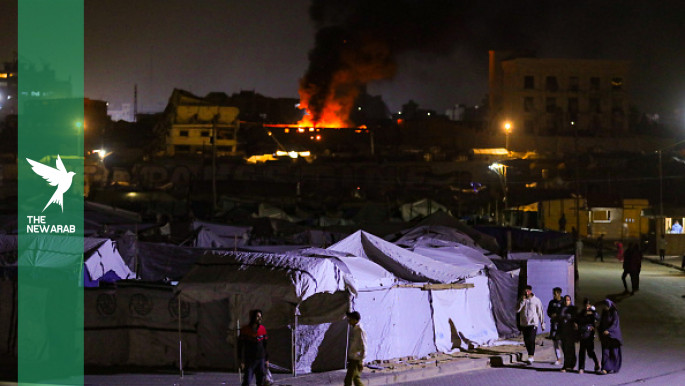
Tents burned in a Gaza displacement camp after an Israeli strike in Gaza City [Getty]
An Israeli strike sparked a major fire in a displacement camp on Wednesday evening, after a building in Gaza City’s Ansar area was targeted, burning tents of people forced to flee their homes amid the genocidal war.
Israeli warplanes carried out several strikes on a government building in Gaza City, after issuing an evacuation warning, Turkish news agency Anadolu reported, triggering a fire that spread to tents sheltering displaced people in the surrounding area.
According to Gaza’s civil defence authority, firefighting teams managed to bring Wednesday’s blaze under control, but dozens of families have been left without shelter, although there were no reports of casualties.
The tents were housing Palestinian families who had fled their homes during the nearly three-year military campaign on the Gaza Strip.
It came amid a UN warning that fuel shortages were threatening the delivery of aid, which Israel has severely restricted.
Israeli attacks on the devastated Gaza Strip have continued since the start of the US-Israeli campaign against Iran on 28 February, with Israeli forces killing several Palestinians over the past two weeks.
Since October 2023, Israel’s indiscriminate bombing campaign has targeted hospitals, schools, and residential areas, killing more than 72,000 people and reducing most of the Gaza Strip to ruins, displacing the vast majority of its population of 2.4 million.
Around 1.9 million people in Gaza are still displaced and living in harsh conditions, while tens of thousands are living in worn-out tents lacking even the most basic necessities.
A ceasefire agreement technically ended the war in Gaza last October, but Israel has violated this on a regular basis, killing over 640 Palestinians since it was signed and continuing to prevent the entry of food, medicine, fuel and construction supplies into the enclave.
Living conditions for the people of Gaza have not significantly improved, despite the truce.
Humanitarian organisations have urged Israel to fully implement commitments under the deal to allow the entry of agreed quantities of food, humanitarian and medical aid, as well as shelter materials such as tents and mobile housing units.
On Tuesday, United Nations spokesperson Stephane Dujarric warned that Israeli restrictions on Gaza’s border crossings are severely hampering humanitarian operations, with fuel shortages threatening to halt essential services across the besieged territory.
Citing the Office for the Coordination of Humanitarian Affairs (OCHA), Dujarric said at a press briefing that “all crossings except Karem Abu Salem are still closed”, describing the closures as among the “many persistent challenges” facing aid workers.
Dujarric said only 1.4 million litres of fuel had entered Gaza since Tuesday.
“We need more than 2 million litres of fuel every week to avoid interruption or reduction in our services,” he said.
The world body’s representative also warned that the fuel shortage is hampering waste removal operations across the enclave.
Aid teams have so far cleared only “3,000 cubic metres of solid waste out of more than 350,000 cubic metres of accumulated waste”, according to Dujarric.
“Just to note that this pace is significantly below the anticipated schedule due to challenges with fuel availability and insecurity,” he added.
Shelter operations are also facing major obstacles.
Dujarric said Israeli restrictions on so-called “dual-use” materials, including “toolkits, heavy equipment, timber and cement”, are limiting humanitarian response efforts. He urged officials to allow the “reopening of additional crossings” and ensure a “sustained and predictable flow of diverse critical supplies” into Gaza.
The key Rafah border crossing with Egypt – the only exit point for people in the Strip, including those who desperately need medical attention abroad – was closed by Israel on 28 February as a “security measure” following the start of US-Israeli strikes on Iran.
It had only been open for one month before, with a very limited number of people allowed to enter and leave Gaza.
Gaza had already been under blockade before the start of the genocidal war, with Israeli authorities strictly controlling the entry of goods into the territory.