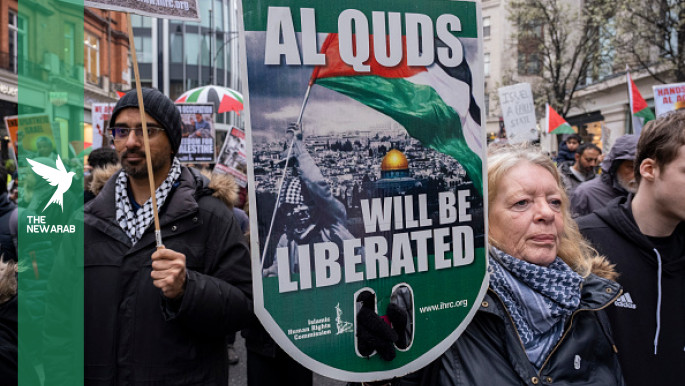
Quds Day is an annual global event to protest the Israeli occupation oppression of Palestine [Getty]
UK police approved an annual demonstration to commemorate Quds Day on Sunday in London, amid tight security measures and strict warnings against displaying certain pro-Palestinian slogans.
The approval comes as the UK Supreme Court prepares to rule on an application filed by the Islamic Human Rights Commission (IHRC) seeking a judicial review of the Home Office’s decision to ban the annual march.
The IHRC, the march organisers, said that Sunday’s demonstration will be a static protest and will take place as a “challenge” to the government’s decision to ban the annual event that has been held since 1979.
Home Secretary Shabana Mahmood had approved a police request to impose a ban on the march, citing concerns raised by “intelligence and police reports” about the possibility of incidents that could violate public order laws.
In a public statement late on Wednesday, Mahmood also referred to developments in the US–Israeli war against Iran.
In a statement late on Saturday, the IHRC said Mahmood’s decision “came after an orchestrated hate campaign by pro-Israel politicians and media designed to thwart the annual event”.
The statement revealed that the commission had already filed a lawsuit against the decision and expressed hope that the case would be considered “in the coming days”.
It added that it was “unfortunate” the government decision was “deliberately timed to forestall the possibility of a successful High Court challenge allowing the march to proceed as originally planned”.
The IHRC repeated that the ban was imposed on “vague and spurious grounds of risk” to public order.
Organisers said the ban on the Quds Day march, which had been scheduled to proceed from outside the Home Office headquarters to the government offices at 10 Downing Street, had only increased interest and support for Quds Day.
They predicted a “large turnout” for Sunday’s demonstration.
Meanwhile, the Metropolitan Police warned that they would take “decisive action” if banners, flags, or chants that “break the law” appear during the Quds Day demonstration.
A police spokesperson told The New Arab that officers on the ground “will act decisively” and “be briefed on placards, flags and chanting that will cross the line into hate crime or support of a proscribed organisation”, in reference to the Hamas and Hezbollah.
“As set out previously, we will also take action where we see chants calling for intifada,” he added, noting that these words “have consequences”.
Anticipating a large turnout for Sunday’s protest, Assistant Commissioner Ade Adelekan, the Met’s public order lead, predicted a “difficult public order weekend”. However, he confirmed that London police have “resources from across the country to help officers”.
In a police statement, Adelekan pledged to “continue to have a visible police presence around places of worship, community venues and embassies”.
At the same time, police have allowed a pro-Israel counter-demonstration to take place.
Both demonstrations were permitted because “there is no law preventing stationary protests”, police said.
In its statement, the police assessed that a static protest would be “easier to police and prevent the two sides from coming together”.
It was decided that the Quds Day protest would be held on Albert Embankment, on the south side of the River Thames, while its opponents will assemble on Millbank, on the north side of the river. However, police did not completely rule out the risk of confrontation.
A clear warning was issued that anyone who marches or incites others to march “will face arrest”.