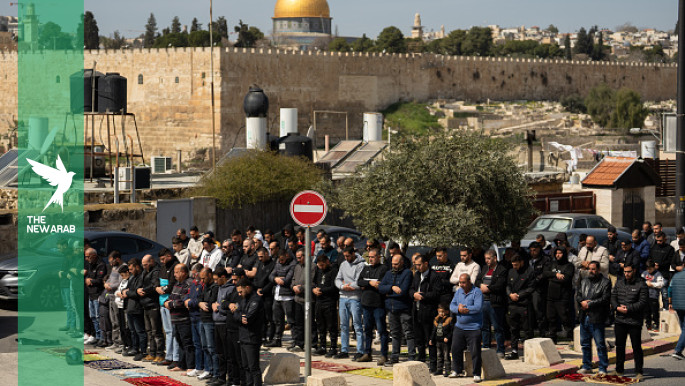
Al-Aqsa closure forces Palestinian worshippers to pray outside the mosque during the final days of Ramadan [Getty]
Israel’s closure of Jerusalem’s Al-Aqsa Mosque has forced Palestinian Muslim worshippers to pray outside the holy site during the final ten nights of Ramadan.
The situation marks a stark contrast with previous years, when tens of thousands would normally gather at Al-Aqsa, particularly for Friday prayers, during the sacred Islamic month of Ramadan.
However, since the start of the US-Israeli offensive against Iran on 28 February, Israeli forces have imposed strict restrictions on worshippers, preventing access to Jerusalem’s Old City and its holy sites, under the pretext of “security” measures linked to the ongoing US-Israeli war against Iran.
Despite the restrictions, worshippers have sought alternative ways to perform their prayers in an act of resilience and devotion amid the final days of Ramadan.
This is particularly significant ahead of the night of the 27th Ramadan, traditionally believed to be Laylat al-Qadr (the Night of Power),the holiest night in Islam, when Muslims believe the Quran was first revealed.
Worshippers now gather to perform the obligatory Maghrib and Isha evening prayers, followed by the Ramadan Taraweeh nightly prayer, at the nearest accessible point near Bab al-Sahira – a key gateway used by residents and worshippers travelling to and from the Al-Aqsa Mosque compound.
Ikrima al-Husseini, a 65-year-old Jerusalem resident who says he has not missed Taraweeh prayers at Al-Aqsa Mosque for 50 years, described this Ramadan as one of the most difficult he has experienced.
“For half a century I have tried to perform Taraweeh prayers at Al-Aqsa every Ramadan,” he told The New Arab. “But this year the situation is very different because of the restrictions around the mosque.”
According to him, the final ten nights of Ramadan are usually the most important time of the month at Al-Aqsa.
“Normally we spend these nights inside the mosque in worship alongside thousands of people. Praying outside during these nights makes many feel that something very precious has been taken away.”
He said Al-Aqsa Mosque represents the spiritual heart of life for many Jerusalem residents, especially during Ramadan when its courtyards are usually filled with worshippers.
Meanwhile, 40-year-old Jerusalem resident Rami Mohammad told The New Arab that he has seen “dozens, sometimes hundreds, of people spreading prayer mats on the ground outside the Old City and praying together”.
He emphasised that praying outside the mosque during the final ten nights of Ramadan carries a heavy emotional weight.
“Even though they cannot enter the mosque, they still want to remain as close as possible to it,” Mohammad added.
He further described the atmosphere during the Maghrib, Isha and Taraweeh prayers outside the mosque as emotional but determined.
“These nights are very special for Muslims, and we usually spend them inside Al-Aqsa. Being forced to pray outside makes people feel a deep sense of loss, but it also strengthens their determination,” Mohammad said.
He continued: “There is sadness because people cannot pray inside the mosque, but at the same time there is a strong sense of solidarity. Everyone stands together in prayer in the streets, and it feels like people are trying to hold on to their connection to Al-Aqsa.”
On Wednesday, Israeli forces prevented Palestinian worshippers from completing their prayers near Bab al-Sahira, according to the Wadi Hilweh Information Center, a local human rights organisation in Jerusalem.
According to the group, Israeli forces searched several worshippers, assaulted some of them, and prevented others from entering both Al-Aqsa and Jerusalem’s Old City.
The organisation said such incidents had occurred repeatedly both that evening and on previous occasions, adding that the searches took place despite the absence of warning sirens.
Mohammad told The New Arab that he had witnessed Israeli forces stopping and searching worshippers at the entrances to the Old City.
He said: “In some cases people were turned back at checkpoints or prevented from approaching the mosque. These kinds of restrictions have happened several times during the closure.”
While such a closure may be the first of its kind since 1967, Israeli restrictions on access to the site predate the start of the US-Israeli war on Iran.
Last month, Israeli authorities announced that no more than 10,000 Palestinians from the occupied West Bank would be allowed to enter the mosque compound for the first Friday prayer of Ramadan.
This represented only a fraction of the numbers that traditionally attend, with Al-Aqsa usually accommodating up to half a million worshippers during the holy month.
Al-Husseini also told The New Arab that when he attempted to reach the mosque earlier in Ramadan, before the latest restrictions were imposed, he encountered multiple checkpoints and strict security procedures.
“Sometimes only a limited number of people are allowed through, and sometimes worshippers are turned back completely.”
Meanwhile, the Jerusalem Waqf – the Jordanian-appointed body responsible for administering the Al-Aqsa compound under the long-standing status quo arrangement – reported that in the run-up to Ramadan this year, five of its staff had been placed in administrative detention by Israel’s internal security agency, the Shin Bet.
The Waqf added that 38 staff members had been banned from entering the site, while six mosque imams had also been denied access.
Arab and Muslim-majority countries have since condemned Israel’s closure of Al-Aqsa.
In a statement published on Wednesday, the foreign ministers of eight Arab and Islamic countries said Israeli restrictions on Palestinian access to Old City and its places of worship constituted a “flagrant violation of international law, including international humanitarian law, the historical and legal status quo, and the principle of unrestricted access to places of worship”.
The statement added that the entire Al-Aqsa Mosque compound was “exclusively” for Muslims and that the Jerusalem Endowments and Al-Aqsa Mosque Affairs Department, affiliated with the Jordanian Ministry of Awqaf and Islamic Affairs, is the “legal entity with exclusive jurisdiction”.
It also urged the international community to compel Israel to halt its “ongoing violations”.
“The Ministers called on Israel, as the occupying Power, to immediately cease the closure of the gates of Al-Aqsa Mosque, remove access restrictions to the Old City of Jerusalem, and refrain from obstructing Muslim worshippers’ access to the mosque,” the statement continued.
While restrictions on Palestinian access to Al-Aqsa remain in place, the Palestinian Authority’s Jerusalem Governorate has warned of a dangerous escalation in incitement by extremist settler organisations targeting the holy site.
The governorate confirmed on Thursday that Israeli authorities had decided to keep Al-Aqsa Mosque closed and prevent worshippers from entering on Friday to perform the final Friday prayer of Ramadan.