By ‘Wale Sadeeq, NAN —
Once upon a time, the Peoples Democratic Party (PDP), one of the political parties that heralded the return to democracy in Nigeria in 1999, held sway as a political party of choice.
PDP, at the zenith of its popularity and relevance, prided itself as the largest political party on the African continent. And indeed it was!
The political party produced Presidents and Commanders-in-Chief, Governors, Senate Presidents, Speakers of the House of Representatives and other major political office holders across the country.
It also controlled no fewer than 24 states between 1999 and 2003, with the then All Peoples Party (APP) and Alliance for Democracy (AD) having seven and five respectively.
PDP’s fortune later received a major boost to the extent that as of 2007, it had a total of 30 states in its kitty as well as the highest number of National Assembly and State Houses of Assembly members.
So powerful was the party in the country’s political landscape that its then National Chairman, Chief Vincent Ogbulafor, boasted that PDP would rule Nigeria for 60 years.
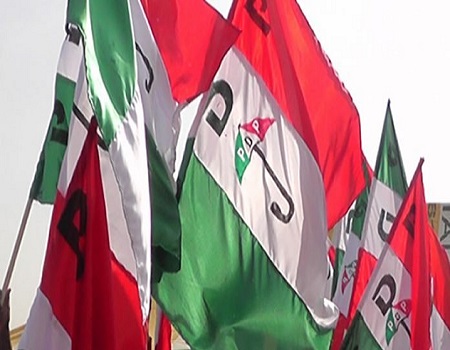
“Some time ago, I used to read in the newspapers that the umbrella of the PDP is torn.
“Each time I read that, I would laugh and then say to myself that the umbrella is still strong and very intact, and ready to accommodate more people.
“The PDP is a party for all and it is set to rule Nigeria for the next 60 years.
“I don’t care if Nigeria becomes a one-party state. We can do it and the PDP can contain all,” an excited Ogbulafor had said.
And in fact, with the party in firm control of the presidency, the National Assembly and other sub-national political structures, it was the toast of every politician, with majority of them struggling to be on board.
The political party also boasted of some political bigwigs, thus boosting its confidence of being at the country’s political centre-stage for a very long time.
With political heavyweights like the then President Olusegun Obasanjo, Vice-President Atiku Abubakar, Bamanga Tukur, Alex Ekwueme, Solomon Lar, Barnabas Gemade, Vincent Ogbulafor, Audu Ogbeh and others, the party saw itself as firmly rooted in Nigeria’s politics and governance.
Today however, the story has changed, as PDP, which ruled Nigeria for consecutive 12 years, is now a complete shadow of its former self.
The party, whose fortune started nose-diving with the coming into the country’s political scene of All Progressives Congress (APC) in 2013, is now fast heading into extinction.
So serious is its free fall that today, PDP, which could still manage to control 10 states as at the conclusion of the 2023 general elections, now has only two states – Oyo and Bauchi – under its control.
Between 2025 and now, a total of six PDP governors – Sheriff Oborevwori (Delta), Umo Eno (Akwa Ibom), Peter Mbah (Enugu), Duoye Diri (Bayelsa) and Siminalayi Fubara (Rivers) – have dumped the party and defected to the ruling APC.
The latest in the series of defections from the once ruling party was that of Gov. Dauda Lawal of Zamfara, who cited the deepening internal crisis within PDP and the need to build stronger unity to address Zamfara’s security and development challenges as reasons for his action.
Political analysts have traced the party’s misfortune to lack of internal cohesion, its inability to manage the country’s political intricacies and mis-governance.
For Laolu Afolabi, a political analyst, PDP was plagued by weak discipline, thin ideology and power struggles managed largely by elite consensus rather than internal democracy.