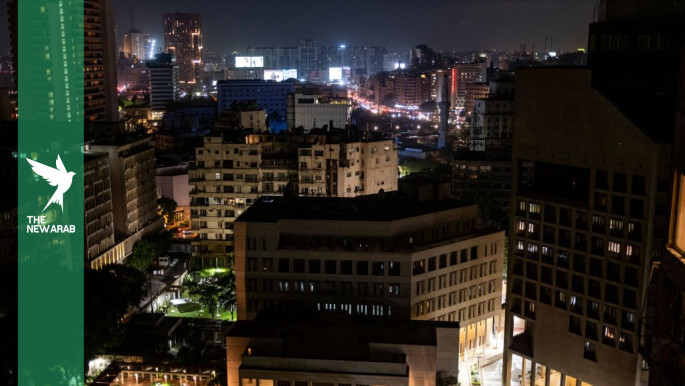
This picture taken on 25 October 2022 shows a view of the US embassy headquarters (foreground) in the Garden City district of Egypt’s capital Cairo, with the central Tahrir Square seen in the background. [Getty]
An Egyptian political activist is trying to rally public support behind his demand to kick the ambassadors of the US and Israel out of Egypt over their war on Iran.
Mamdouh Hamza, a vocal critic of Egyptian President Abdel Fattah al-Sisi, has posted a petition on Facebook, calling on public figures and ordinary people to sign and support his call to expel the ambassadors of the two states from Cairo.
He justified his demand to expel the two diplomats by citing the rise in local fuel prices resulting from Iran’s closure of the Strait of Hormuz, a critical passageway for a sizeable share of oil supplies from Gulf oil-producing nations to the international market, including to Egypt.
The Egyptian government raised fuel prices by 17-30% on 10 March, citing a surge in international energy prices due to the war on Iran.
The reaction to Hamza’s petition has been massive, with hundreds of people commenting in support within a few hours, reflecting growing public anger at the latest fuel price rise, which comes at a tough time for tens of millions of consumers in this economically struggling country, economists said.
The same reaction also throws light on growing public anger against Israel and the US for igniting the current war, political observers said.
“The policies of the US and Israel are having a toll on regional stability and security,” political activist Kamal Abu Eita told The New Arab.
He added that the US-Israel war on Iran has especially caused harm to the Egyptians, having negatively affected the local economy, something that is reflecting on the living conditions of people on the streets.
“Egyptians are all aware that the US and Israel are responsible for this regional unrest,” Abu Eita said.
Growing fury
Public sentiment has been a little-covered aspect of Egypt’s overall reaction to the US-Israeli war on Iran.
Egyptians have been growing sympathetic with Gulf nations caught in the crossfire of the war, including because of the presence of millions of Egyptian migrant workers in Gulf countries.
The same sympathy also finds its roots in shared cultural, language and religious affinities with Gulf countries.
However, Egyptians’ fury with the US and Israel for starting the war appears to be much stronger, especially arising from fears of the effects the war will have on their daily life and economic conditions, which were already strained.
The war on Iran is worsening Egypt’s economic conditions, prompting the flight of billions of dollars in foreign assets, which causes the Egyptian pound to lose value against foreign currencies and consequently weakens its purchasing power.
The same war is bringing about deeper economic fears, threatening to deprive the national treasury of Suez Canal revenues, especially if the Iran-backed Houthis in Yemen jump into the fray by staging attacks against international shipping in the Red Sea, and the prospect of disrupting the flow of foreign tourists into Egyptian tourist sites looms large.
“The Suez Canal expects to be the most negatively affected by the war, with the possibility of Red Sea unrest appearing on the horizon,” Alia al-Mahdi, an economics professor at Cairo University, told TNA.
She hoped the war would not drag on for long, expecting a protracted conflict to have devastating ramifications for the national and global economies.
The effects of the war have already started hurting the wallets of ordinary people in a country where poverty is rampant, and successive regional and international geopolitical tensions have been giving it one painful blow after another.
The 10 March government decision to raise fuel prices is likely the first in an expected series of ominous economic developments.
The same decision has already caused commodity prices, which were already high before the war, to surge even further, stoking public anger and threatening to trigger a security or political backlash.
The feeling among ordinary consumers is that they are being swindled by a government that has little regard for them.
Public fury over price surges also points to something serious brewing in this country, especially as more people put their fears aside and openly criticise the government and Sisi for mismanagement.
A group of young activists has already issued a stern warning to the government, threatening to take action against the decision to raise fuel prices if it does not retract it within 48 hours.
Strategic dilemmas
This growing public anger shows regional and international geopolitical tensions cutting through internal conditions, raising speculation about whether they may destabilise Sisi’s regime, some analysts said.
In dealing with the US-Israeli war against Iran, Egypt faces a series of dilemmas at the official level, the same analysts added.
The repercussions of the war, especially Iranian attacks against fellow Arab states in the Gulf, are putting Egypt on the spot, particularly with some people in the same states asking about the role Egypt, which has the most powerful Arab military, can play in preventing those attacks.
At the same time, Egyptian fears of the war opening the door for Iran’s collapse and consequently changing the regional balance of power in Israel’s favour cannot be hidden or underestimated, analysts said.
“Iran’s defeat in the current showdown will turn Israel into a regional hegemon that finds it easy to implement its regional agenda,” Mervat Zakaria, a researcher at the Iran Studies Unit in the think tank Arab Centre for Research and Studies, told TNA.
This, she added, would harm and come at the expense of traditional regional powerhouses, such as Egypt, Saudi Arabia and Turkey.
Hamaza did not return calls for comment on his petition.
Nonetheless, in replying to one of his followers, he said he needs a million signatures to his petition so that he can officially submit a request to the Egyptian government to expel the Israeli and American ambassadors from Cairo.
He added that expelling these ambassadors would ensure that Egyptian oil imports from the Gulf would cross the Strait of Hormuz without problems.
In saying this, he echoes pledges by some Iranian officials that ships from countries that expel US and Israeli ambassadors would enjoy safe passage through the strait.
Egypt and Israel signed a peace agreement in 1979, which has so far helped put a lid on hostilities between the two countries and serves as a guarantor of considerable security and intelligence cooperation, despite ongoing frictions.
Washington and Cairo also enjoy good relations, with Egypt playing a vital role in brokering peace between Israel and the Palestinians and functioning as a cornerstone of regional stability.
Nevertheless, for the activists backing Hamza’s call, the need to dismiss the US and Israeli ambassadors is not about economic benefits, but about principles.
“Throwing out the ambassadors of these countries now would send a message that Egyptians are against injustice,” Abu Eita said.
“All Egyptians know that the US and Israel stand behind all the wars and conflicts that erupt in this region,” he added.