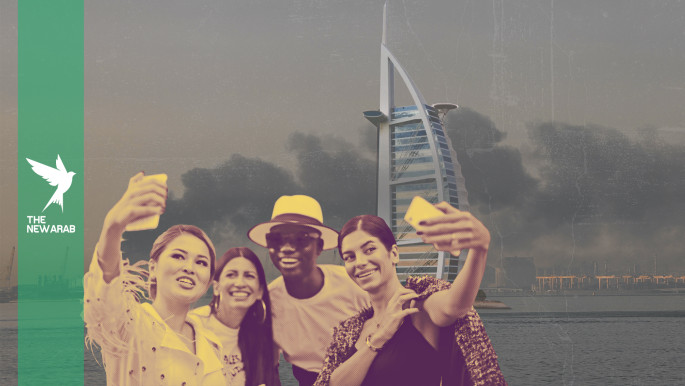
War, genocide, and gender apartheid have long been something that happens “over there.” In Gaza, in Sudan, in DR Congo, in Afghanistan, in Iran. For Western content creators, it’s distant and algorithmically filtered, writes Olivia Hooper. [TNA]
“That was meters away from us, that’s the Fairmont Hotel,” said white British fitness influencer Will Bailey in an Instagram video to his 122K followers, standing at the poolside in a crisp white shirt, club music pumping in the background, as he watched smoke plume Dubai’s sky on Saturday evening after an Iranian missile hit.
The moment came as Iran fired the first round of its retaliatory missiles at US-Israeli defense bases in several Gulf countries, including the United Arab Emirates. The attacks were prompted by the US and Israel’s killing of Iran’s former Supreme Leader Ayatollah Ali Khamenei on Saturday.
Fitness fanatic influencer Will’s slightly sunburnt face showed some sort of shock and dismay at the missile explosion, but not quite enough to stop him from taking a quick reel that has now gained over 13.3 million views. Since then, he has posted a further 12 videos giving “updates” on the situation. A stark contrast to his normal content, shameless topless mirror selfies, gym sessions, and expensive cars.
Dubai is no stranger to the thriving social media influencer-type of visitor or resident. It’s hardly surprising when you look at the superficial level of lifestyle it offers, with the gleaming hotels, which are usually #gifted, and the tax-free salary. It is a magnet for those who live according to the algorithm.
For many, when the missiles hit over the weekend, this was not a moment of political reflection but content. Shaky Instagram stories captioned, “It’s not meant to be happening here,” said Louise Starkey, an Australian immigrant residing in Dubai, to her 16K followers on Instagram.
The emphasis, of course, was on the word here.
War, genocide, and gender apartheid have long been something that happens “over there.” In Gaza, in Sudan, in DR Congo, in Afghanistan, in Iran. For Western content creators, it’s distant and algorithmically filtered. But when conflict entered their skyline, it became personal; their ignorance changed form, it became about them, and deserved a global audience.
Jujitsu injuries
These are the same influencers who rarely, if at all, speak about the structural violence underwriting their luxury lifestyles.
On Monday morning, under 48 hours after the missiles hit Dubai, newly relocated former British reality TV star Miles Nazaire said, “I haven’t slept this bad in a very long time, I tweaked my neck yesterday in jujitsu,” to his 444K followers in an Instagram story while walking around his glossy apartment, topless as always.
In a follow-up story post, topless again, Miles told everyone how he is taking his glimpse of war as a time for character-building.
“I’m exhausted from barely sleeping, my neck is in bits, and there are missiles flying above my head, yet I’m still working on my passion and surrounded by the most beautiful people in my life […] when life feels hard, don’t fear it, move through it,” he gushed.
The advice “to move on when life feels hard” is most certainly unthinkable for the less fortunate amid the recent attacks, like parents of the over 165 children killed in the joint US-Israeli attack on an Iranian elementary school in Minab a day before Miles’ jujitsu injury.
Western influencers’ selective outrage
It is the same Dubai that Miles and thousands of others market as their playground that operates within a regional and global system deeply entangled in conflicts, including support for the Rapid Support Forces (RSF), a Sudanese paramilitary group. The RSF is playing a major role in the ongoing genocide in Sudan, with over 11 million people displaced since 2023.
These are the topics Dubai influencers neglect, as human rights and international law only seem to trend when a missile is physically in the influencer’s phone camera’s sight.
Selective outrage is deeply embedded in Western influencer culture. The UAE is riddled with human rights abuses that target the most vulnerable people while lining the rich “expat” pockets or feeding their lavish lifestyles.
On any given day in 2021, there were 132,000 individuals living in modern slavery in the UAE, the seventh highest prevalence globally, according to the Global Slavery Index. Dubai’s iconic skyline was largely built by migrant workers on 18-hour shifts, living in make-shift camps, made to work for almost nothing, the BBC reported.
Those same buildings layered with injustice are the backdrop to the videos we now see plastered across social media, with influencers selecting their own narrative on a crisis. This illustrates how in the Western world, proximity dictates empathy; it only appears shaken when instability threatens its comfort, investments, or curated lifestyle.
This is not simply about influencers behaving badly. It is about the spectacle of war, the hierarchy of whose suffering counts, and the persistent colonial mindset that treats the region as an aesthetic location, that is, until it interrupts brunch.
Olivia Hooper is a British journalist based in Morocco specialising in humanitarian and gender-based topics, writing for Middle East Eye and Al-Monitor, among others.
Have questions or comments? Email us at: editorial-english@newarab.com
Opinions expressed in this article remain those of the author and do not necessarily represent those of The New Arab, its editorial board or staff.