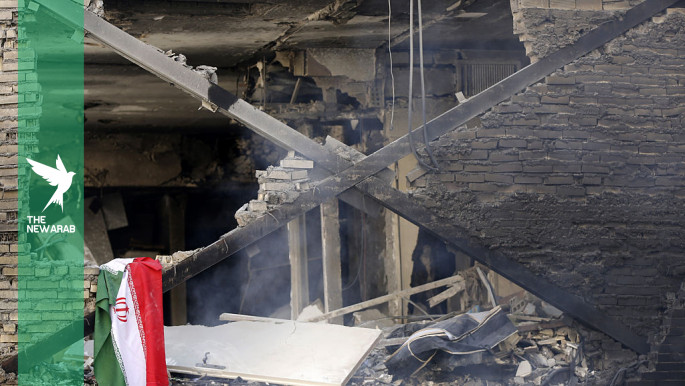
The question that consumed thousands of Tehran families in the first hours of the US-Israeli bombardment was not how much they had lost. It was simpler and more urgent than that: where do we go now?
With roads out of the capital gridlocked, official evacuation plans absent, and the internet reduced to almost nothing, the answer came not from the state but from a phone screen.
Across Tehran’s northern and eastern districts, where explosions had been closest, residents opened Telegram and Instagram and began posting offers.
A spare room in West Tehran. A vacant flat that could take a family of four. A house with an independent entrance, available until the situation stabilised.
Within hours, informal shelter networks had formed across the city, operating through closed social media groups, shared spreadsheets, and direct messages between strangers.
What emerged was not an organised humanitarian response. It was something older and less formal: a city reaching for the concept Iranians call hamsa’yegi — neighbourliness — at the moment when everything else had failed.
Maryam Hosseini, a 42-year-old housewife and mother of three in the Narmak neighbourhood, had been awake watching her district’s Telegram groups when she noticed the volume of messages from foreign students whose accommodation had been declared unsafe and who were asking, with increasing urgency, where they could go.
She had a guest room with its own small bathroom. She looked at it and made a decision.
“I wrote a clear post: an independent room, temporary stay, priority for students whose housing had been damaged. Within an hour, my phone was full of messages. I felt confused at first — I did not want to act on emotion alone,” Maryam tells The New Arab.
She called her husband, then checked with the building management to make sure there were no security or logistical objections.
She asked applicants to send their location and a photo showing the damage to their housing. “Not out of suspicion, but to make sure the place would go to someone who genuinely needed it,” she added.
Maryam chose two students because the space allowed no more. When they arrived, she noticed they were trying to hide their tension. She prepared a simple dinner and sat with them to explain the house rules: no complicated restrictions, only mutual respect.
The following day, one of them helped her fix a shelf in the kitchen. “I felt that the house was no longer just a place for survival. It had become a space of human sharing. For me, this is not a story of heroism. It is a natural response to an unnatural crisis.”
The architecture of improvised solidarity
What distinguished these networks from simple acts of generosity was their rapid development of internal organisation.
The early posts were spontaneous, but within days, the groups had imposed their own rules. Some required identity verification: a photograph of a national ID card sent to group administrators before any match was made.
Others created shared spreadsheets updated in real time, listing available spaces by neighbourhood, capacity, duration of stay, and any specific conditions.
The self-regulation reflected real concerns about exploitation and, in a politically tense environment, about security infiltration.
Reza Kazemi, a retired civil engineer in the Sadeghiyeh neighbourhood, approached the process with the methodical logic of his profession.
He had a furnished flat that he normally rented short-term and immediately took it off the market. His post read less like an appeal than a technical specification: square footage, number of beds, an emergency water reserve, a secure locking system, the nearest first-aid point.
“I did not write an emotional post. I wanted applicants to know exactly what was waiting for them,” the 55-year-old told The New Arab.
He arranged a brief phone call with each applicant before confirming, then sent them a printed file with emergency numbers and a plan of action in case of a new alert.
A Ugandan student and an Arab family visiting Tehran on a short trip took the flat. Reza briefed them on the building’s safety procedures and showed them the nearest emergency services on a map. In the evenings, they discussed the meaning of individual responsibility in times of crisis.
“I did not feel I was doing someone a favour. I was applying a principle I had always believed in: unused resources must be deployed when there is a public need,” Reza shared.
Thirty-seven-year-old English-language teacher in the Tehranpars neighbourhood, Leila Moradi, took the organisational dimension further.
Watching offers circulate without coordination in her district’s group, she proposed a centralised spreadsheet listing requests and offers together, cross-referenced by geography, to prevent several families from arriving at the same building at once.
She also offered a room in her own home. Two Ugandan students arrived visibly exhausted.
“On the first day, I did not ask them many questions. I just provided space for rest,” Leila told The New Arab.
By the second day, she had prepared a daily schedule: time for online lectures, calls home, and light household tasks. She asked her children to teach the students basic Persian phrases.
“The anxiety gradually turned into cultural and human interaction. For me, the organisation was not just an administrative measure. It was a way of protecting everyone’s dignity,” Leila added.
The guests
The students who moved through these networks came from Sudan, Uganda, Senegal, and other countries, a reminder that Tehran’s universities host significant numbers of international students whose institutional support had effectively evaporated with the first strikes.
Ahmad Mohammad Abdullah, a 23-year-old Sudanese mechanical engineering student, was on the fourth floor of his student residence reviewing thermodynamics when an explosion nearby shook the floor and shattered glass in the corridor. The power cut within minutes.
There were no clear instructions, only an urgent request to vacate the building. He left with a backpack containing his passport, laptop, and a few clothes.
He spent two hours in the street looking for a stable internet connection to reassure his family in Khartoum.
“The communications were intermittent, and my mother was crying on the phone, asking me to leave the city immediately. But the roads were congested and dangerous,” Ahmad told The New Arab.
When he saw Maryam Hosseini’s post, he read it several times before writing to her. “I was afraid of the idea of depending on people I did not know,” he shared.
When he arrived, her husband met him at the door and helped carry his bag. He was given a room of his own and a calm explanation of the house rules. His first act was to call his mother on video and show her the room.
“Only in that moment did I feel my chest begin to settle.”
Salma Naluboga, a 21-year-old Ugandan medical student, had been in a shared flat when an explosion left visible cracks in the walls and brought part of a suspended ceiling down in the corridor. No one was injured, but the building owner recommended immediate evacuation pending an engineering inspection. She packed only essentials, with no guarantee of return.
“What hurt most was the feeling of helplessness. I study medicine. I understand crisis management in theory. But when you are inside the crisis, everything is different,” she told The New Arab.
On her way to Leila Moradi’s home, she was shaking, she said, not only from fear but from psychological exhaustion. By the third day, Leila asked her to teach her children basic first aid.
“The anxiety turned into a positive activity. I felt I was recovering my role as a medical student, not just a displaced person looking for shelter,” Salma shared with The New Arab.
Mustafa Ndiaye, a Senegalese master’s student in international relations at the University of Tehran, had been working on a research chapter about human security when the water supply to his shared flat was cut after pipes in the surrounding area were damaged.
With intermittent electricity and no running water, staying had become impractical. He and two other students agreed to split up and go to separate families so as not to place the burden of three people on a single household.
The family who took him in had converted their home office into a sleeping space.
“What struck me most was the organisation: a list of emergency numbers, a first-aid kit, a clear plan in case of a new warning,” the 26-year-old said.
In the evenings, they discussed experiences of solidarity across different countries. He was given a small desk to continue writing his thesis, and the family made sure the hours around his study time were quiet.
“I felt they did not see me as a passing guest, but as someone with an academic project that had to continue despite the circumstances. That sense of respect was enormously important to me,” Mustafa added.
Meanwhile, 22-year-old Maryam Hassan Idris, a Sudanese pharmacy student, was alone in her flat near her university when her building shook, and plaster fell from the ceiling.
Uninjured but unable to sleep, she sat by the door until morning and then contacted Fatima Karimi, a retired woman living alone in the Yaft Abad neighbourhood, who had offered the room of her son, who works abroad.
Fatima had prepared the room carefully before her guest arrived: clean sheets, a reading lamp, and a few books in English.
“I did not want her to feel she was in a temporary place without a soul,” the 60-year-old told The New Arab.
That evening, they prepared food together, and Fatima asked about her studies and plans after graduation. When Maryam called her family on video and showed them the room, she said, the relief on their faces was visible for the first time in days.
During her stay, she helped Fatima organise her medications and explain some dosages. “My presence turned from a potential burden into something useful,” the young student said.
For Fatima, the exchange carried its own meaning. “I have lived alone for years, and this house is usually quiet. Solidarity, as I now see it, is not a one-directional act. It is a mutual relationship that gives safety to both sides.”
The limits of improvisation
The networks were not without their difficulties, and trust was the central challenge. Bringing strangers into a home during a security emergency posed real risks to hosts and guests alike.
Some participants reported isolated cases of deception — people claiming to need shelter to request money, or providing misleading information about their situation.
The fear of surveillance or legal accountability pushed some groups to operate with very restricted membership, requiring a personal invitation to join.
Legally, Iran has no framework regulating emergency civilian shelter between private individuals outside official channels.
In past natural disasters — the Bam earthquake of 2003, the Kermanshah earthquake of 2017 — the Iranian Red Crescent managed official shelters.
In the current crisis, with its military character, the formal state response focused on security and military operations rather than organising the internal displacement of civilians.
That institutional gap was precisely what the informal networks filled.
Hussain Rezaei, 50, the owner of a supply company in the Shahara neighbourhood, navigated these tensions by keeping his network deliberately small.
He had a two-storey building that had been used as an office, moved the furniture out, and set up folding beds and additional curtains for privacy. He did not post publicly but worked only through trusted contacts, requiring a personal recommendation before accepting anyone.
“The goal was not exclusion. It was to protect the space and the people in it,” Hussain said.
He took in five students of different backgrounds, organised the kitchen on a rotation system, designated one area for shared use and another for quiet study, and set up a small fund for emergency expenses with contributions made entirely voluntary.
“This experience changed my relationship with the space. It was no longer a commercial office. It had become a living space of solidarity,” he concluded.
As US-Israeli strikes on Iran continue, the death toll since the assault began on Saturday has reached at least 1,045 according to Iranian state media, with countless more displaced. In the face of such devastation, community solidarity has become more vital than ever.
Neighbours opening their doors, sharing resources, and organising support have become lifelines, a reminder that even amid escalating conflict, human compassion and hamsa’yegi endure.
Mahmoud Aslan is an Iranian journalist based in Tehran
This story was published in collaboration with Egab