In the squares of Iran’s capital, where the sound of explosions has become the backdrop to daily life, ordinary people have become the city’s only emergency service.
There are not enough government teams and no official infrastructure.
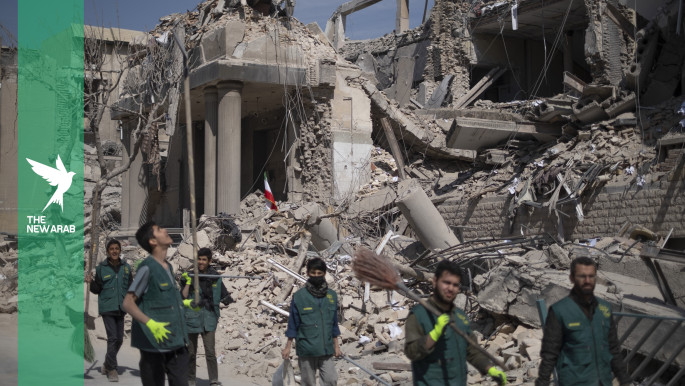
In Tajrish Square in the north of the city and Enghelab Square at its centre, the pavements and streets have been repurposed as triage corridors, rescue grids, and makeshift clinics, staffed entirely by volunteers working through rubble, smoke, and continuous bombardment.
What has emerged, out of necessity, is something between a civil defence system and a collective act of survival.
A grid drawn in rubble
Tajrish Square, normally choked with traffic and ringed by commercial buildings, was among the first to be transformed.
After a series of explosions destroyed several surrounding structures, volunteer rescue teams divided the square into small working zones, each assigned a specific area to search for casualties, clear debris, and manage evacuation routes.
Temporary markers made from whatever materials were available — wooden boards, boxes, adhesive tape — traced paths through the wreckage.
Movement within each zone was deliberate: every step calculated, every advance preceded by a rapid assessment of which walls might fall and which passages would hold.
The upper floors of buildings bordering the square sustained ongoing damage, making work at ground level a constant negotiation with the threat of collapse.
Equipment was almost entirely improvised. Bed covers served as stretchers. First aid kits were assembled from gauze and torn clothing.
Hand tools — shovels and hammers — were the primary means of extracting people from beneath debris.
Casualties were transported in taxis and private cars, shuttling between the square and nearby hospitals that were filling faster than they could be emptied.
Coordination ran through informal networks of mobile phones and radios, with teams continuously updating each other on the location of casualties, the stability of structures, and which evacuation corridors remained passable.
Every move is a decision
Enghelab Square presented a similar picture, complicated further by its density of high-rise buildings and the volume of traffic that continued to move through it.
Pavements became transfer corridors. Volunteers from the civil defence established temporary assembly points at the corners of the square — each containing a triage area, a first-aid station, and a fast-track route for critical cases.
The system operated on strict prioritisation: the most severely wounded were moved first; those with lighter injuries waited at assembly points for basic treatment.
Teams rotated to manage exhaustion, working in small groups that cycled through shifts without any formal relief structure.
In the absence of any state intervention, field solutions multiplied: wooden beams used as temporary supports for unstable structures; any available open space converted into an emergency treatment area; vehicles moving in continuous loops between assembly points and hospitals to keep the flow of casualties from collapsing into chaos.
“The noise never stops,” says Kourosh Naderi, a 41-year-old civil defence team leader from the Sohanak neighbourhood.
“Buildings are collapsing around us, and the screaming fills every space in the square. Every decision is made fast, without precise information — just instinct and years of experience.”
Kourosh was leading an evacuation from a school that had been struck when debris began falling around his team.
He kept moving, directing volunteers through the most viable path.
“Every volunteer knows that any moment could be their last,” he says. “And still, no one steps back.”
‘I won’t leave you’
For the medics and first responders working these squares, the psychological weight is as heavy as the physical one.
Bahman Nouri, a 38-year-old civil defence volunteer from the Niavaran neighbourhood in north Tehran, describes running between corners of the square carrying casualties, applying first aid with sterilised gauze and whatever plastic sheeting was available.
He remembers a girl trapped beneath the rubble of a collapsed building, her blood on his hands as he worked to pull her free.
“I felt a terrible helplessness,” he shares with The New Arab.
“But we couldn’t stop. My colleagues signal to me in silence — we all know that any mistake could be the end. Every new explosion shakes the ground beneath our feet.”
Behnam Taheri, a field paramedic working in Tajrish, recalls sitting on the ground beside a young man wounded by shrapnel, the man’s hand trembling in his.
“His body was shaking from the pain and the fear. I felt completely responsible for his life. I kept repeating: I’m here, I won’t leave you,” the 32-year-old tells The New Arab.
Behnam describes how teams developed new signals under fire, a non-verbal shorthand built from experience, where roles are understood without a word being spoken.
“Every mistake can cost someone their life,” he says. “Every breath you save feels like a small victory over death.”
For Sina Moradi, an emergency doctor volunteering in northeast Tehran, the hardest moments come in the overlap between the medical and the human.
The 29-year-old held the hand of a child with a head wound while the boy’s mother screamed beside him, and a nearby building exploded again, sending debris raining down around them.
“We try to save as many as possible,” he says. “We work as one body. Each of us knows their role, and the ability to improvise in each situation is what saves lives.”
The war is stronger than any government capacity
Hamid Velayati, a 35-year-old civilian paramedic and volunteer from west Tehran, puts it plainly: “The situation is out of control. The war is stronger than any government capacity. We are the ones providing help.”
His team has entered buildings threatening to collapse to reach people trapped inside, equipped with little more than ropes and wooden planks.
He remembers extracting a woman and two children from beneath the rubble of one building — the only tools available were those ropes, those planks, and the strength of the people holding them.
“The psychological pressure is constant,” he shares with The New Arab.
“We see death in front of us and try to overcome it. The support between volunteers is what keeps us going. We invent solutions in real time and become the only support the wounded have.”
He pauses. “But the smile of a child after you save them makes every exhaustion worth it.”
Civil society as a last resort
What Tajrish and Enghelab squares have become is a portrait of a city managing catastrophe without a state.
The volunteers and civilian responders who fill these spaces are not substitutes for a system — they are the system, assembled from necessity, sustained by coordination and improvisation, and held together by something that resists easy description.
The rubble, the ongoing threat of collapse, the heat from burning vehicles and buildings: all of it forms a working environment that, as the volunteers describe, tests the body and the mind simultaneously.
Shifts stretch for hours. Basic equipment runs short. The threat of a new explosion or a sudden structural failure is permanent.
And yet the teams keep moving — dividing squares into grids, marking safe corridors, triaging casualties, rotating through exhaustion.
They are performing, under continuous bombardment, what amounts to a complete emergency management operation with almost nothing to work with.
“Here, between the rubble and the smoke, every moment is a test of humanity,” says Bahman.
“And every breath we save makes us feel we are capable of facing death itself.”
Mahmoud Aslan is an Iranian journalist based in Tehran
This story was published in collaboration with Egab