Terrorists turning commercial drones into weapons in North-East, Nigerian Military uncovers

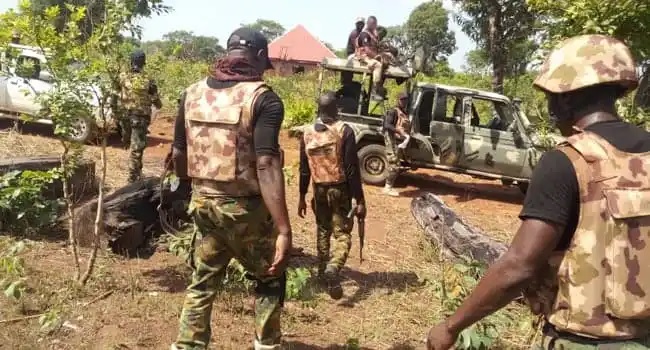
Fresh intelligence by the Nigerian Armed Forces has revealed a dangerous shift in insurgents’ tactics in the North-East, with terrorists increasingly deploying weaponised commercial drones for aerial attacks.
Security sources said investigations are also uncovering possible sponsors and external technical collaborators behind the growing use of the devices by extremist groups.
According to intelligence officials who spoke to PRNigeria, factions of Islamic State West Africa Province and Boko Haram are now modifying commercially available drones—originally designed for photography and filmmaking—into improvised aerial weapons.
The revelation follows a major counter-terrorism operation in the Malam Fatori axis of Borno State, where troops carried out a coordinated decoy ambush that led to the killing of two top ISWAP commanders and 84 fighters.
In the aftermath of the operation, security operatives reportedly recovered what sources described as a “treasure trove” of intelligence materials.
These include mobile phones undergoing forensic analysis, handwritten diaries containing operational maps and attack plans, and technical manuals detailing how commercial drones are modified for combat use.
Sources familiar with the investigation said preliminary findings have provided “compelling evidence” linking certain sponsors and external technical advisers to the insurgents’ evolving drone warfare strategy.
“There are clear indications that these modifications are deliberate and coordinated. We are tracking supply routes, technical inputs and financial backers supporting this shift,” one source said.
Further findings suggest a network of collaborators may be aiding the procurement, modification and deployment of the drones used by insurgents operating in the region.
Military experts, however, clarified that the devices in use are not advanced military-grade unmanned aerial vehicles (UAVs), but widely available commercial drones procured from open markets.
According to the sources, the drones are fitted with locally fabricated explosive payloads and triggering mechanisms, enabling remote-controlled aerial strikes on both strategic locations and civilian targets.
Despite the emerging threat, the military said it has stepped up counter-measures to contain the situation. These include enhanced intelligence gathering, upgraded counter-drone capabilities and sustained offensives against terrorist enclaves.
As part of the response, troops have intensified the deployment of electronic warfare systems alongside coordinated ground operations aimed at detecting, disrupting and neutralising hostile drones.
“One of the key strategies currently in use is frequency jamming, which disrupts communication between the drone and its operator. Once the signal is interfered with, the drone loses control and crashes before reaching its target,” a military source explained.
In addition, troops have undergone specialised training to detect and track hostile drones, with improved coordination to neutralise aerial threats through ground fire.
The development underscores the evolving nature of insurgency in the North-East, as security agencies continue to adapt to new tactics employed by terrorist groups.