To misdiagnose the conflict as religious is to calcify identities, deepen polarisation, and drain diplomacy of its legitimacy, writes Sari Hanafi. [GETTY]
In the crucible of conflict, narratives are forged with haste. They glide across television screens, seep through the veins of social media, and echo in the corridors of political power, shaping how entire societies come to understand the chaos unfolding before them—and why it must be so.
Among the tales resurgent in current discourse surrounding the confrontation with Iran is the notion that this is, at its core, a religious war: a clash of civilizations, a collision of faiths, a theological reckoning dressed in the armour of geopolitics.
In recent days, religious symbolism has been wielded with theatrical prominence in the rhetoric surrounding the US-Israeli imperial posture toward Iran. Israeli Prime Minister Benjamin Netanyahu has invoked the spectre of holy war, casting the Iranian regime as Amalek—that ancient antagonist of Jewish scripture, the people whose memory Israel was commanded to “erase.”
He quoted the liturgical verse, “Remember what Amalek did to you, and act,” a passage from Deuteronomy traditionally recited before the festival of Purim, draping contemporary state policy in the vestments of ancient prophecy.
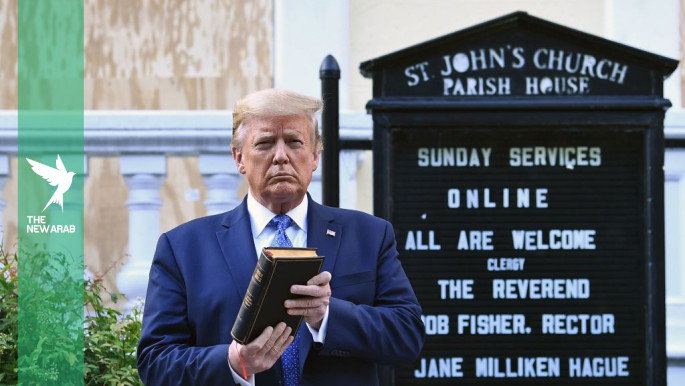
Meanwhile, former President Donald Trump accepted the blessings of his church within the White House itself, framing his decisions as divinely anointed. His Secretary of Defence, Pete Hegseth, has become entangled with symbols of militant faith, including tattoos that evoke the Crusades—”Deus Vult” (“God wills it”) and the Jerusalem cross—emblems historically steeped in the fusion of sword and scripture. These images seem choreographed to summon support for war through the incantations of the sacred, painting conflict in the hues of destiny, duty, and divine will.
Yet this theatre is not new. Throughout modern history, political actors have draped themselves in holy vestments to sanctify struggles whose roots lie in soil far more earthly. During the Cold War, American leaders often cast the struggle against communism as a defence of faith against godless ideology. But the Cold War was not a crusade; it was a geopolitical contest for power, systems, and spheres of influence.
Similarly, the 2003 invasion of Iraq was clothed in the language of moral necessity and civilizational mission, yet historians and political scientists recognise it as a war born of colonial residue, security anxieties, regional ambition, and strategic miscalculation—not theology.
The danger of mirroring religious rhetoric
Should those ensnared by this US-Israeli imperial-religious framing answer in the same tongue? The excesses of identity politics—too often entangled with the Islamophobia of the far right and, regrettably, of what I term “symbolic liberalism”—threaten to deepen conflict and entrench prejudice. To respond with Judeophobia or Christianophobia is equally perilous and self-defeating.
Some invoke Quranic verses like: “You will surely find the most intense of the people in animosity toward the believers to be the Jews and those who associate others with Allah” (Al-Ma’idah 82). But selective citation is a betrayal of the text’s depth. It ignores verses that command restraint and recognise moral complexity, such as: “They are not [all] the same; among the People of the Book is a community standing [in obedience], reciting the verses of Allah during periods of the night and prostrating [in prayer]. They believe in Allah and the Last Day, and they enjoin what is right and forbid what is wrong and hasten to good deeds. And those are among the righteous” (Al-Imran 113–114); and: “And among the People of the Book is he who, if you entrust him with a great amount [of wealth], he will return it to you. And among them is he who, if you entrust him with a [single] dinar, he will not return it to you unless you are constantly standing over him” (Al-Imran 75).
The verses warn against sweeping condemnation and urge a discernment rooted in historical awareness—a recognition that scripture must be read not as eternal verdict, but as revelation embedded in context.
The American sociologist Rogers Brubaker, in his work Ethnicity without Groups, reminds us that ethnic and religious dynamics rarely arrange themselves into neatly opposed groups. Even as U.S. rhetoric strives to conjure a Judeo-Christian “bloc,” there exists no corresponding monolithic Muslim entity—only colonized peoples, fragmented and dominated.
To read the conflict through a strictly religious lens is to risk obscuring its deeper architecture.
Colonialism and geopolitics
Though religious rhetoric colours the discourse, the structure, motivations, and alliances defining this confrontation tell a different story. The present war is not, in its essence, religious. It is a struggle rooted in settler colonialism and geopolitics—a contest over economic resources, power, influence, and the reshaping of Middle Eastern order.
To misdiagnose the conflict as religious is to calcify identities, deepen polarisation, and drain diplomacy of its legitimacy.
Even if the Iranian regime aligns with violent actors—the most brutal of regimes, like Assad’s Syria, or sectarian militias in Iraq and Yemen—this does not render the war fundamentally religious. The root cause remains the unrelenting settler colonization of Palestine and the refusal to accept either a two-state or one-state solution. The revanchist impulses targeting Iran and its allies in Lebanon are historically myopic and strategically perilous.
Were this imperial war against Iran truly religious in nature, alliances would follow the contours of creed. The European wars of religion in the sixteenth and seventeenth centuries offered a historical template for such patterns. But the Middle East today tells a different tale.
The United States maintains deep strategic ties with numerous Muslim-majority nations. Israel has cultivated diplomatic and security cooperation with Arab states under the so-called Abraham Accords. Iran itself collaborates with actors whose primary motivations are strategic, not sectarian.
The war is propelled by military deterrence, nuclear ambition, and the struggle for control over strategic corridors—all in service of sustaining the Israeli settler-colonial project and securing regional economic dominance.
The genocide in Gaza, the wars on Lebanon, Venezuela, and Iran—these may well be the harbingers of a new imperial (dis)order rising from the ruins of the old. To reduce such conflicts to civilizational clashes is to erase internal diversity and license collective blame.
Recognizing that the wars against Gaza, Lebanon, and Iran are fundamentally colonial and geopolitical does not deny religion’s continued presence in public life. Faith still shapes identity, social norms, and moral imagination.
But analytical clarity demands a distinction: between religion as discourse and religion as structural cause. In this conflict, religion functions chiefly as a rhetorical instrument, not as the engine of state behaviour. To treat it otherwise risks legitimizing violence, freezing identities into hostility, and diverting gaze from the Israeli apartheid regime and its settler-colonial project, and the geopolitical realities that truly define this struggle.
Sari Hanafi is Professor of Sociology, Director of the Center for Arab and Middle Eastern Studies and Chair of the Islamic Studies program at the American University of Beirut. He was the President of the International Sociological Association (2018-23). He was also the editor of Idafat: the Arab Journal of Sociology (Arabic) (2017-2022), and author of Studying Islam in the Arab World (2023).
Follow Sari on X: @hanafi1962
Have questions or comments? Email us at: editorial-english@newarab.com
Opinions expressed in this article remain those of the author and do not necessarily represent those of The New Arab, its editorial board or staff.