The US-Israeli offensive against Iran has placed Europe in an uncomfortable position. While the assault triggered mixed reactions across Europe, highlighting the continent’s deep political divisions, Iranian retaliation against Gulf infrastructure and US military facilities has also created direct risks for European interests.
Despite growing rhetoric against the conduct of the war and its consequences, European governments remain largely hamstrung.
Like theGulf Cooperation Council (GCC) states, they are wary of escalation for economic and security reasons, but remain dependent on Washington’s defence umbrella.
The war has threatened global energy markets, maritime trade routes and regional stability in areas where European states maintain military and economic interests. Traffic in the Strait of Hormuz is reportedly down around 90%, while gas prices in Europe surged by up to 70%, showing the immediate economic impact on European states.
The European Union’s official response has emphasised “maximum restraint” and respect for international law. Yet this rhetoric has also revealed inconsistencies; Brussels has remained largely silent on the initial US-Israeli strikes and attacks on civilian areas in Iran, while only condemning Iranian retaliatory attacks.
There is also the issue of political relevance. The United States and Israel carried out the initial strikes without meaningful consultation with the EU or European governments, leaving Europe largely reactive as events unfolded.
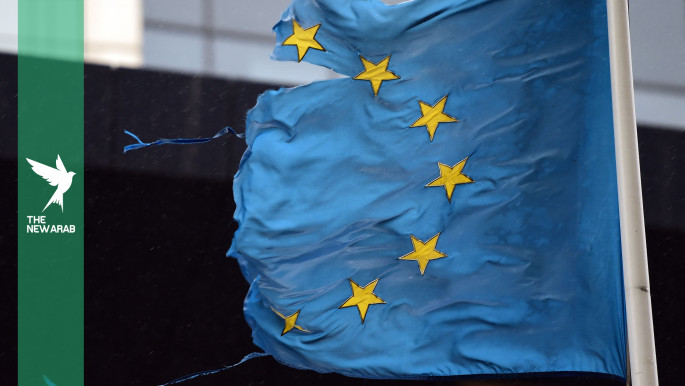
Although emergency discussions in Brussels have stressed unity, the bloc has struggled to articulate a coherent policy.
“Member states are acting separately, whether by deploying military assets to Cyprus or organising individual evacuations of their nationals,” Roderick Kefferpütz, a non-resident senior fellow at the Atlantic Council’s Europe Centre, told The New Arab.
“We are seeing 27 parallel responses rather than a single coherent European approach.”
The political divisions are stark. Spanish Prime Minister Pedro Sánchez described the US–Israeli bombing as “unjustified” and “outside international law” and said Madrid would not allow US forces to use Spanish military bases. In response, President Donald Trump threatened to suspend “all trade” with Spain.
Germany took a contrasting position, with Chancellor Friedrich Merz firmly backing the campaign and describing Iran’s leadership as “a terrorist regime responsible for decades of oppression of the Iranian people,” while expressing support for US and Israeli efforts to “end this regime’s terror.”
France and the United Kingdom have shown more ambiguity. Both have called for de-escalation while broadly aligning with Washington. British Prime Minister Keir Starmer initially resisted allowing the US to use the Diego Garcia base in the Indian Ocean, though London has since moved closer to supporting Western defensive operations in the region.
Starmer’s stance has attracted criticism from both domestic anti-war voices and more hawkish voices in Washington, with Trump claiming Starmer is “not Churchill.”
France has emerged as a particularly significant actor in this context. President Emmanuel Macron has criticised the US-Israel offensive as falling outside the bounds of international law, yet Paris has simultaneously expanded its military presence in the region.
The aircraft carrier Charles de Gaulle has been deployed to the Middle East alongside additional naval assets, while French forces have reinforced defensive positions in Cyprus and participated in maritime security operations in the Red Sea.
French officials have also emphasised the importance of protecting the Strait of Hormuz, through which around 20% of global oil passes. Paris has advocated broader multinational cooperation to safeguard the route, primarily framing the issue in terms of global economic stability rather than direct participation in offensive operations.
Macron has linked the crisis to wider debates about European strategic autonomy. Doubts about the reliability of US security guarantees under President Trump have revived discussion about Europe’s own deterrence capabilities, including whether France’s nuclear arsenal could play a larger role in protecting European allies.
Moreover, France’s calls for Israel not to expand its war on Lebanon, along with providing armoured vehicles for the Lebanese Armed Forces, reflect the efforts of Paris to pursue a more autonomous regional posture and its aspirations to play a diplomatic and security role in the eastern Mediterranean.
This posture reflects France’s own long-standing strategic ambiguity: rhetorical commitments to greater autonomy, balanced with a compulsion to operate within the US-led security framework.
Militarily, Europe’s involvement remains officially limited to defensive measures. The United Kingdom, France, and Germany, the so-called E3, have signalled readiness to take “necessary and proportionate” action to protect their forces and partners from Iranian missile and drone attacks.
In practice, this support has included defensive deployments: the UK sent Typhoon jets to Qatar and an air-defence destroyer to Cyprus; Italy provided missile-defence to Gulf partners; Spain, Greece, and the Netherlands contributed naval or air assets to protect infrastructure and shipping routes.
Europe’s role may be limited compared with Washington’s military dominance, but it has still sought to play a supporting role for Gulf partners.
“Europe is certainly limited compared to the US. But Europe can act as an important force multiplier and provide psychological support in what, for the Gulf states, is a crisis of unprecedented magnitude,” Andreas Krieg, senior lecturer at King’s College London, told The New Arab.
However, across the EU, responses vary widely.
Although European powers initially tried to act as an interlocutor between Washington and Tehran, relations between Europe and Iran have deteriorated sharply in recent years.
The collapse of nuclear negotiations in 2022, Tehran’s crackdown on anti-government protests and its military assistance to Russia in Ukraine, and the E3’s triggering of snapback sanctions in September 2025, which effectively ended the 2015 nuclear deal, have all contributed to this animosity.
“There’s certainly no degree of affection in European capitals towards the Iranian regime, especially as it now threatens their interests and partners in the region,” Naysan Rafati, senior Iran analyst at the International Crisis Group, told The New Arab. “But nor is there likely to be much desire to see a prolonged conflict.”
However, the picture across Europe remains mixed. Switzerland’s Defence Minister Martin Pfister stated on 8 March that the US-Israeli strikes had violated international law, highlighting the growing divide within Europe between governments aligning closely with Washington and those calling for restraint and de-escalation.
Between these poles lies a larger group of European governments attempting to balance alliance loyalty with calls for de-escalation. Italy and Luxembourg have condemned Iranian retaliation while urging restraint from all sides, seeking to preserve diplomatic channels without openly criticising Washington or Tel Aviv.
These divisions show significant structural challenges facing Europe. Although the continent maintains strong connections with the United States through NATO and intelligence sharing, many European governments are cautious about becoming involved in another conflict in the Middle East.
The result is a fragmented policy landscape in which individual states respond according to their own security priorities and political calculations rather than through a unified European strategy.
Still, European states have gradually become more critical of the war. On 11 March, Italian PM Giorgia Meloni described the conflict as a “growing and dangerous trend” of unilateral actions “outside the scope/perimeter of international law”, including condemning the bombing of a girls’ school that killed over 160 children, which she described as a massacre.
Germany’s Chancellor Friedrich Merz, despite his strong pro-Israel position, also cautioned that there was “no apparent joint plan” to end the war, criticising Trump’s decision to temporarily ease oil sanctions on Russia to bring down surging prices.
Yet despite the shifting rhetoric, partly driven by economic shocks and support for Gulf stability, the fragmented nature of Europe, along with its security alignment with Washington, is likely to prevent the continent from acting as a meaningful counterbalance.
Like other crises before it, the war has highlighted the limits of Europe’s influence in shaping events in the Middle East.
While European states will certainly bear many of the economic and security consequences of the conflict, their key strategic decisions continue to be reactive rather than influential. This involves strengthening Gulf defences, protecting shipping routes, and attempting to contain the wider fallout.
Yet as the conflict intensifies, pressure on European governments to clarify their position will only grow.
Jonathan Fenton-Harvey is a journalist and researcher who focuses on conflict, geopolitics, and humanitarian issues in the Middle East and North Africa
Follow him on Twitter: @jfentonharvey
Edited by Charlie Hoyle