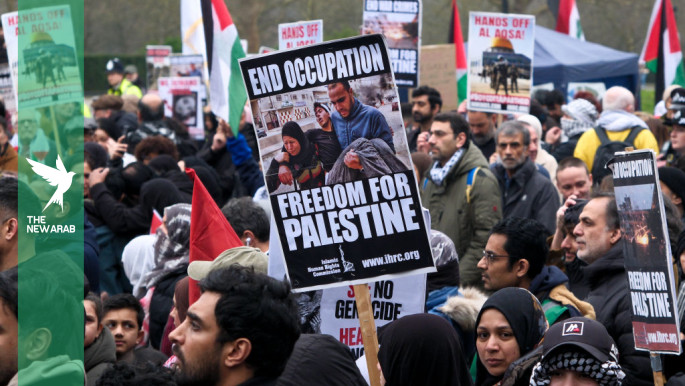
The Quds Day march has taken place in London in previous years without incident [Getty]
The UK High Court is to conduct an urgent judicial review of the Home Office’s decision to ban this year’s annual Quds Day march, The New Arab understands.
Informed sources also said that there were contacts between the Islamic Human Rights Commission, which is one of the organisers of the march, and the police regarding the possibility of holding a “static demonstration” instead of the usual march that had been scheduled to begin from outside the Home Office and head to the UK Prime Minister’s residence at 10 Downing Street on Sunday.
Home Secretary Shabana Mahmood announced on Wednesday that the march would be banned following a request from the police.
In an official statement, she said she was “satisfied” that banning the march was “necessary to prevent serious public disorder, due to scale the protest and multiple counter-protests, in the context of the ongoing conflict in the Middle East.”
The Metropolitan Police Commissioner, Sir Mark Rowley, justified the request to ban the march by saying that “intelligence assessments and professional judgment” indicated that protests and counter-protests were “creating such a risk of violence that those marches needed to be banned”.
The Police said the ban applied to the Al Quds march and any counter-protests would be in place for one month starting last Wednesday.
On Friday, Faisal Bodi, head of the IHRC’s media office, confirmed to The New Arab that the group would not cancel the annual event, adding that arrangements were continuing according to the original plan for the protest.
“We will demonstrate one way or another,” he said, saying that this was in order to exercise the right to protest and “freely express our opinion”.
He described the Home Secretary’s announcement of the ban through the media—without notifying the commission or consulting it—as “a big surprise to us.”
He added that, given the history of communication and cooperation between the IHRC and police regarding the Quds Day march, “we expected them to inform us of their concerns so we could discuss them”.
Bodi stressed that his organization has always been flexible in dealing with police and had shown understanding for their concerns.
He said that the IHRC had already agreed with police in October on the details of the march, which has been held in London since 1979. Communications over the years “usually involved agreements on logistical arrangements, handling counter-protests, and the march route”, Bodi noted.
Sources told The New Arab that the latest meeting between police and representatives of the IHRC to discuss the march took place on 11 February.
Rowley said that the Quds Day march “has got more tricky in recent years,” adding that “its history is it’s a construct of the Khomeini regime in Iran”, which he argued creates “a unique threat and provocation in the UK”.
The Met Police Commissioner added that counter-protests are equally complex, saying that “we’ve taken the unique step of going to the home secretary” as a result, to request a ban.
In response, Bodi expressed surprise at the commissioner’s remarks, saying the march had taken place peacefully for the past forty years. He described it as “an international demonstration in support of Palestinians and all oppressed people around the world.”
Hundreds of thousands of people participated in last year’s Quds Day march in central London, while dozens attended a pro-Israel counter-demonstration. Only one person was arrested on suspicion of violating public order laws.