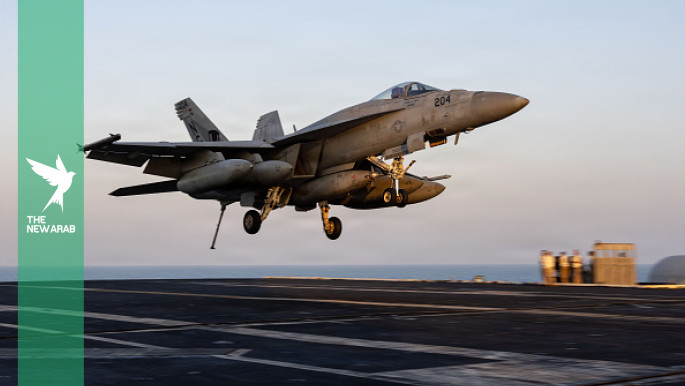
The intelligence reports doubts even a large-scale war effort could overthrow Iran’s layered regime [Getty]
A classified US intelligence assessment has concluded that even a large-scale American military assault on Iran would be unlikely to topple the country’s entrenched clerical and military leadership, raising doubts about Washington’s ability to reshape the country’s political order through war.
According to The Washington Post, the report by the National Intelligence Council (NIC) found that Iran’s governing institutions would likely survive even if the country’s supreme leader were killed during the conflict.
The findings were confirmed to the newspaper by three people familiar with the report’s contents, who spoke on condition of anonymity as they were discussing classified material.
The assessment was completed roughly a week before the United States and Israel launched their war against Iran on 28 February.
According to the report, succession mechanisms within the Islamic Republic are designed to ensure continuity of power in the event of the death of Supreme Leader Ayatollah Ali Khamenei.
Officials familiar with the document told The Washington Post that Iran’s clerical and military establishment would respond to such a scenario by following protocols intended to preserve the regime’s structure and authority.
The report also assessed that the likelihood of Iran’s fragmented opposition taking control of the country was “unlikely”.
The National Intelligence Council produces strategic intelligence assessments that reflect the combined analysis of the US’s 18 intelligence agencies.
The report raises questions about President Donald Trump’s repeated declarations that the US could dismantle Iran’s leadership and potentially install a new ruler in Tehran.
Trump has said Washington intends to “clean out” Iran’s leadership structure and has suggested the US could influence the selection of the country’s next leader.
“We want them to have a good leader. We have some people who I think would do a good job,” Trump told NBC News.
The succession process for Iran’s supreme leader is formally overseen by the Assembly of Experts, a powerful clerical body responsible for appointing the country’s highest authority.
However, members of the Islamic Revolutionary Guard Corps (IRGC) and other figures within Iran’s security establishment also play a significant role in shaping political outcomes during leadership transitions.
Speculation has intensified over whether Mojtaba Khamenei, the son of the late supreme leader, could emerge as his successor, though no official announcement has been made.
According to a Western security official cited by The Washington Post, the IRGC has been pushing Mojtaba Khamenei’s candidacy but has faced resistance from influential political figures, including Ali Larijani, the secretary of Iran’s Supreme National Security Council.
Experts say the intelligence assessment reflects long-standing analyses of how Iran’s political institutions operate.
Suzanne Maloney, an Iran scholar and vice president at the Brookings Institution, said the report appeared consistent with existing research on the resilience of the Iranian system.
“It sounds like a deeply informed assessment of the Iranian system and the institutions and processes that have been established for many years,” she told The Washington Post.
Current and former US officials told the newspaper that there is little evidence so far of a mass uprising inside Iran or significant fractures within the country’s ruling establishment that could lead to regime collapse.
Analysts also note that Iran’s security forces have historically demonstrated a willingness to suppress internal dissent, including during major protests in recent years.
Holly Dagres, a senior fellow at the Washington Institute for Near East Policy, said Iran’s clerical leadership is unlikely to capitulate to external pressure.
“Bending the knee to Trump would go against everything they stand for,” she told The Washington Post.
Experts say that while military pressure could weaken Iran’s regional capabilities, the intelligence assessment suggests it may not be enough to fundamentally transform the country’s internal power structure.
“There’s no other force within Iran that can confront the remaining power that the regime has,” Maloney told The Washington Post.
“Even if they’re not able to project that power very effectively against their neighbors, they can certainly dominate inside the country.”