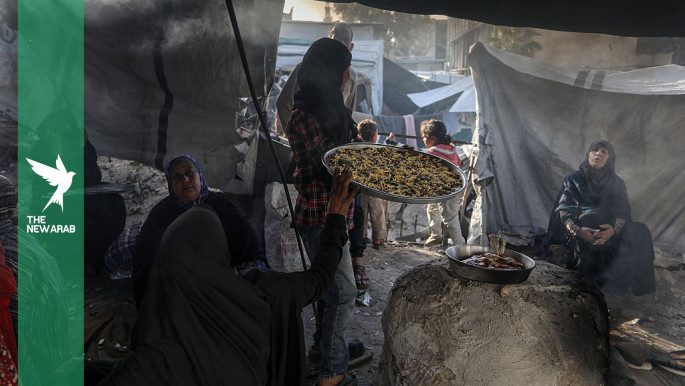
Palestinians cook food using a clay oven fueled with cardboard and wood due to fuel shortages during Ramadan in Khan Yunis, southern Gaza Strip, as the closure of the Rafah border crossing deepens humanitarian concerns on 4 March 2026. [Getty]
Inside Abu Jabara Shopping Center in western Gaza City, the shelves no longer appear to be mere displays for goods, but mirrors reflecting a collective anxiety that grows with every breaking news alert about the war by Israel and the United States on Iran.
At the entrance to the grocery section, a mother stands before a shelf completely emptied of flour, running her hand across it as if to confirm what she is seeing with her own eyes.
She asks the employee in a low voice, “Is it all gone?” He nods apologetically.
A few meters away, a father pushes a cart filled with various goods, including five bags of sugar at once. He calculates the cost in his mind, aware that his salary cannot bear such an expense, yet he murmurs, “No one knows what might happen in the coming days.”
He is not buying out of immediate need, but out of fear of a possible disruption that revives memories of bread lines and bakery doors shut tight.
Near the cooking oil shelf, voices suddenly rise. A brief altercation breaks out between two customers over the last remaining bottle of frying oil, each insisting they reached it first. It is not merely about a bottle of oil, but about a deep sense that time is narrowing, and that whoever does not stockpile today may find nothing tomorrow.
In those moments, the shopping center turns into a space of tension, where anxiety overtakes purchasing power, and distant regional escalation becomes a tangible food panic between the aisles.
The outbreak of the US-Israeli war on Iran on 28 February coincided with Israel’s closure of the crossings leading into the Gaza Strip until security conditions improve, before reopening them on the morning of 3 March. This directly impacted market behavior in Gaza. As the intensity of strikes and military statements increased, so did the pace of shopping inside stores. Citizens began stockpiling quantities of essential goods far exceeding their actual needs, fearing supply disruptions or renewed crossing closures.
This sudden and intense demand placed direct pressure on available stock, leading to signs of shortages in certain items, followed by noticeable price increases. Thus, the regional war transformed into both a psychological and economic factor, pushing people to buy out of anxiety, while the market reacted to that anxiety with rapidly escalating prices.
Painful collective memory
Mohammed Makhaymer, a 39-year-old father of six from Gaza City, told The New Arab that the state of panic in the markets cannot be separated from a collective memory burdened by experiences of hunger and siege.
“We are not acting out of fear alone,” he said, “but out of the experience of hunger we endured harshly during the peak of the war on Gaza. We saw how goods could disappear from the markets overnight, and how obtaining a bag of flour or a bottle of oil became a daily struggle.”
He explained that the experience of famine during the last war remains vivid in people’s minds, saying, “We went through days when we could not find food for our children. At that time, the price of one kilogram of flour reached about $50, even though its normal price under ordinary conditions does not exceed one dollar. Sometimes we returned home without bread. That memory does not vanish; it lies dormant and resurfaces with the first sign of escalation.”
Makhaymer noted that previous supply disruptions left a deep mark on citizens’ behavior, explaining that any announcement of crossing closures triggers immediate concern.
“When Israel announces the closure of crossings into Gaza, we immediately understand it as meaning doubled prices and the disappearance of essential goods,” Makaymer said.
He concluded, “We are not stockpiling out of greed, but out of fear of repeating the hunger scenario. Anyone with children thinks of the worst and tries to get ahead of the crisis before it imposes itself.”
For her part, Abeer Hasaneen, a 41-year-old resident of western Gaza City, told TNA while shopping at a popular market in central Gaza that fear of what lies ahead drove her to purchase large quantities of essential food items. She said she allocated about $1,300 to buy large amounts of sugar, flour, frying oil, and other goods to stockpile and secure the needs of her five-member family.
“It was not luxury or exaggeration,” she said, “but a deep sense of responsibility toward my children. Every time I heard about escalation between Israel, the United States, and Iran, and the risk of crossing closures, I felt we might not receive food supplies and that we would return to the days of queues and long waits at bakeries.”
She explained that within minutes of the war on Iran erupting, the prices of some goods doubled, noting, “For example, the price of one kilogram of onions was 5 shekels and became 13 shekels, while potatoes rose from 4 shekels to 15 shekels per kilogram. A 25-kilogram sack of flour increased from 10 shekels to 70 shekels—and then disappeared from the market entirely.”
Hasaneen accused Gaza’s traders of exploiting political and military events to reap excessive profits by hoarding goods and withholding them from the market while raising prices excessively.
Buying beyond need
Grocery trader Hamid Abdelall told TNA that the massive rush by citizens to purchase goods in quantities exceeding their actual needs disrupted the flow of merchandise to markets. He explained that the sudden and intense demand over just a few days depleted goods from shelves at an unusual speed.
Abdelall added that this behavior does not reflect a genuine shortage in overall stock, but rather a general state of anxiety that has driven people toward preemptive stockpiling.
He stated that warehouses in Gaza contain large quantities of essential food items sufficient for several months, according to estimates by traders and suppliers.
He noted that the problem lies in the accelerated pace of purchasing within a short period, creating a temporary gap between supply in stores and the ability of supply chains to restock at the same speed.
He stressed that market stability depends on returning purchasing behavior to normal levels and avoiding excessive stockpiling.
Economic expert Ahmed Abu Qamar told TNA that what Gaza’s markets are witnessing is a “natural reflection of a sudden shock in supply and demand.”
He explained that the heavy buying of essential goods led to temporary shortages in certain items, especially those relied upon daily by citizens.
He added that even if this shortage is limited in duration, it creates the perception of a deeper crisis, prompting more citizens to stockpile and thereby intensifying the cycle.
Abu Qamar pointed out that the rapid price increases are directly linked to this wave of abnormal demand, in addition to limited inventory and the fast turnover of goods in a market already suffering from fragile supply chains.
He noted that some traders exploit this moment to raise prices excessively, taking advantage of public anxiety, which increases the burden on consumers.
He stressed that action by local authorities to regulate the market and prevent hoarding is crucial to containing the crisis, emphasising the need to intensify inspections and impose deterrent penalties on violators to preserve price stability and protect citizens’ purchasing power.
Inspection campaigns
In response, inspection teams from Gaza’s Ministry of Economy carried out inspection campaigns to monitor commodity prices, during which dozens of traders were detained and shops were closed to suppress any attempts to exploit the war on Iran.
Mohammed Barbach, Director General of Policies and Planning at Gaza’s Ministry of Economy, told TNA that the price-control campaign carried out across Gaza’s governorates resulted in the detention of 72 traders working in essential goods and frozen food sectors for violating decisions prohibiting hoarding and price hikes.
Barbach explained that the detentions followed intensive inspection tours conducted by ministry teams in response to rising citizen complaints about price increases in essential goods.
He confirmed that legal measures were taken against violators, including temporary closure of some establishments and referral of several traders to competent authorities to complete legal procedures.
Regarding increased demand for goods such as sugar, flour, and frying oil, Barbach attributed it to citizens’ fears over regional developments, affirming that official statistics indicate sufficient food supplies to meet the Strip’s needs for approximately one month.
He added that warehouses under ministry supervision contain adequate stock despite damage to part of the storage capacity during the war, noting that the private sector has rehabilitated significant storage capabilities.
He stressed that continued reopening of crossings remains the fundamental guarantee for stabilising supply chains and maintaining market stability.