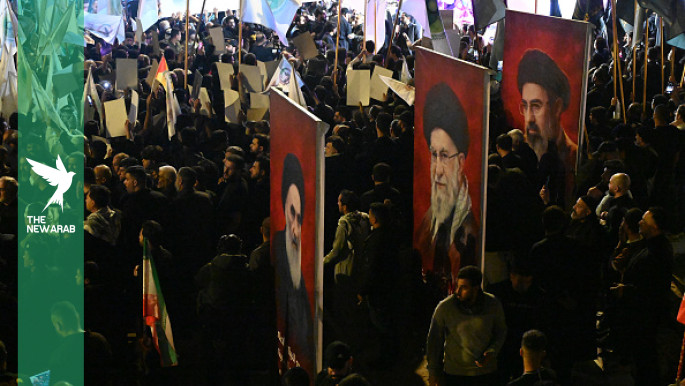
Residents gathered across Iraq for Quds Day and to lament the deaths of the militia leaders [Getty]
US airstrikes targeting leaders of Iran-linked Iraqi factions in Baghdad early Saturday have raised fears of a dangerous escalation in Iraq, potentially pushing the country toward further confrontation between Washington and armed groups aligned with Tehran.
Local Iraqi news outlets reported that two separate airstrikes struck targets linked to powerful militia groups in the capital.
According to the reports, the first strike targeted a house in the Arsat area in central Baghdad at dawn that was being used as a headquarters by Iraq’s Kataeb Hezbollah. The attack killed two people and wounded several others.
The strike caused significant damage to the house and neighbouring homes, while members of the factions sealed off the area and prevented people from approaching as they removed the dead and wounded.
A second strike targeted a vehicle belonging to a militia member in the Nahrawan area of Baghdad, burning it completely and killing those inside.
Figures close to the militias circulated condolence messages saying that Abu Hussein al-Muhammadawi, secretary-general of Kataeb Hezbollah, had been killed. They also reported the death of Rahif Ali Qasim, described as the commander of the missile and rocket system in the Badr Organisation.
Qasim, who is Lebanese, had reportedly travelled to Iraq to supervise rocket attacks.
However, the posts announcing the deaths were later deleted and the identities of those killed have not been officially confirmed.
Leaders and members of the factions have refrained from providing information about the strikes, while Iraqi security officials have also declined to comment, suggesting there may be instructions to keep details confidential.
Iraq’s government Security Media Cell condemned the attacks but did not confirm who had been targeted.
“In the strongest terms of condemnation, we denounce this dangerous and unprecedented development represented by targeting citizens and carrying out strikes inside densely populated residential neighbourhoods,” the body said in a statement.
It added that the strikes represented “a blatant violation of all humanitarian values and a complete breach of international conventions”.
Security analysts say the attacks suggest a shift toward a strategy of targeted “aerial assassinations” against senior leaders of armed factions, rather than the earlier focus on military infrastructure such as depots and bases.
An Iraqi security source told The New Arab’s sister outlet Al-Araby Al-Jadeed that the attacks represent a new phase in the domestic confrontation and in the US and Israel’s war on Iran .
“The attacks are no longer limited to military sites,” the source said, adding that despite the precautions taken by militia leaders “the attack shows the precision of the execution and that those plans are not sufficient to protect them”.
The source added that there were indications the campaign of assassinations could expand, particularly as factions continue to carry out attacks against US interests and there appears to be little chance of negotiations.
Earlier this month, an airstrike killed Ali Hussein al-Furaiji, a senior field commander in Kataib Hezbollah known as “Abu Hassan”, after a strike targeted his vehicle in the Jurf al-Sakhar area of Babil province.
In response to the latest killings, Iraqi factions launched an attack targeting the US embassy in Baghdad.
Footage circulated online showed smoke rising above the embassy compound after a drone struck the complex.
The escalation comes as the Iraqi government struggles to contain attacks by armed factions, which have used drones and rockets to strike targets both inside Iraq and beyond.
Some of those attacks have also hit civilian targets and Iraqi infrastructure in the Kurdistan region and other provinces, increasing pressure on Baghdad, which appears unable to prevent them.