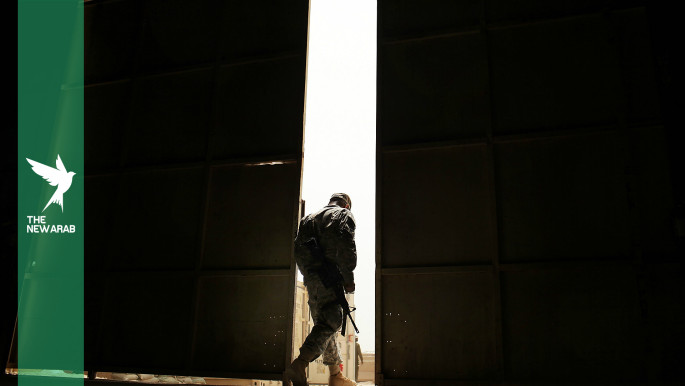
The first two weeks of the joint US-Israel war on Iran has been one fought primarily from the air, something that has not directly affected the lives of most Americans, but that could change if a ground invasion were to be launched.
Boots on the ground would bring home the war in a way that Americans haven’t experienced since the 2003 invasion of Iraq. US casualties quickly led to a drop in support of the war, which, like the Vietnam War, became synonymous with US military overreach and misadventure.
“With boots on the ground, it would be over for the Trump administration,” David Frank, a professor of rhetoric and political communication at the University of Oregon, told The New Arab.
He was referring to the November 2026 midterm election, in which Democrats are expected to win back the House and possibly the Senate, which would essentially make Donald Trump a lame duck president with congressional checks on his power.
“The Vietnam War ended when people saw body bags coming home,” he said.
Around two weeks into the war, at least 11 US military members have died and 140 have been wounded.
A recent New York Times poll found that 41 percent of Americans support the conflict, making it the most unpopular foreign war in modern US history. Far more Americans oppose a ground invasion of Iran – around 74 percent, according to a Quinnipiac University poll in early March.
A ground invasion might sound premature at this point, however, there have been indications this could be a real possibility.
A classified hearing on Tuesday left several Senate Democrats unhappy with what they saw as a lack of transparency or a coherent plan for the war in Iran, which they worry could mean ground troops being deployed.
“We seem to be on a path toward deploying American troops on the ground in Iran to accomplish any of the potential objectives here,” Richard Blumenthal of Connecticut, told reporters after the meeting.
Ohannes Geukjian, associate professor of political studies and conflict resolution at the American University of Beirut, told TNA that for now he doesn’t expect US ground forces in Iran, although there is a possibility of limited special operations, depending on the situation with the Kurds.
“Currently, sending ground troops is unlikely. It may become likely if the Kurdish and other minorities mobilise,” a possibility that has been suggested by the US administration.
In addition to the question of ground troops, some have raised concerns over the possibility of a military draft, a policy that ended with the Vietnam War due to public pressure.
Earlier this week, White House press secretary Karoline Leavitt refused to rule out a military draft or a ground invasion in Iran, leading to widespread criticism from both parties.
Longtime Trump supporter-turned-opponent Marjorie Taylor Greene has been warning that the Republicans could lose the midterms over the war in Iran, particularly if it escalates to a ground invasion or a draft.
“It would be a disaster if we continue to not learn from history,” said Frank. “There’s no plan for the day after.”