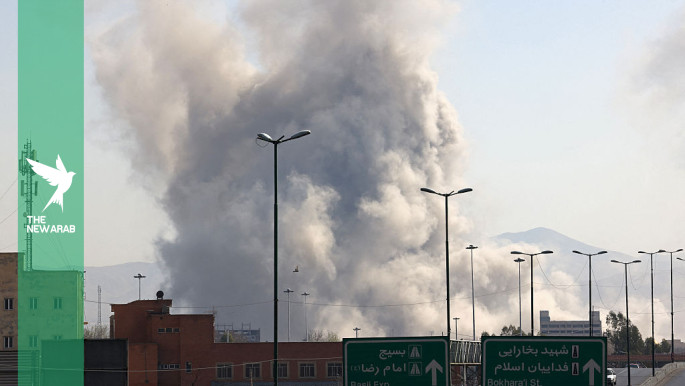
Some countries are mulling joining the war sparked by Israeli and US strikes on Iran [Getty]
Canada is the latest country to mull taking a military role in the war in the Middle East as US and Israeli strikes on Iran continue, despite Tehran warning European leaders against joining the conflict which has destabilised the region.
Canadian Prime Minister Mark Carney said on Thursday: “One can never categorically rule out participation,” after he was pressed on whether there was a scenario where his country could get involved.
“We will stand by our allies…we will always defend Canadians,” he continued.
However, he also added that the US and Israel “acted without engaging the United Nations or consulting with allies, including Canada”.
The remarks come after he said days earlier that the US-Israeli strikes on Iran were “inconsistent with international law”.
Carney confirmed that he was not informed, nor asked to participate in the attack on Iran.
Other countries have also suggested possible participation, with Pakistan’s foreign minister, Ishaq Dar, saying on Tuesday that Islamabad may join the Iran war due to the mutual defence pact signed with Saudi Arabia, which has seen several Iranian missile strikes since the war began.
Both France and Germany have called for negotiations, but also suggested they are open to the possibility of striking Iran, after Tehran struck their personnel, with a German army camp in Jordan being targeted.
“The mullah regime is a terrorist regime responsible for decades of oppression of the Iranian people,” Germany’s Chancellor Friedrich Merz said on Sunday.
“We share the interest of the United States and Israel in seeing an end to this regime’s terror and its dangerous nuclear and ballistic armament,” he continued.
The UAE, Qatar, Kuwait, Bahrain, Oman, Saudi Arabia, Jordan, Lebanon, and Iraq have all been affected by the war, with Iranian strikes also hitting the UK’s Akrotiri base in Cyprus.
France has sent antimissile and anti-drone systems to Cyprus following the Iranian strike, with the UK also sending a warship to defend its bases there.
Despite Iran’s Lebanese ally Hezbollah launching strikes on Israel, and Israel launching deadly strikes on Lebanon, Yemen’s Houthis have been reluctant to get involved so far, but are believed likely to intervene at some point in support of Iran.
Many commentators believe that if the Houthis deem the threat against the Iranian regime to be existential, they are prepared to fully engage in war.
Despite some Western countries hinting that they could get involved, there has been a mixed response in Europe.
Spain has drawn scorn from US President Donald Trump after evicting US military aircraft from its bases. The move prompted Trump to threaten to “cut off all trade” with the country.
Greece’s government also appears to be making moves, with the government dispatching four of its most sophisticated F-16 Viper fighter aircraft and two frigates to help defend Cyprus from any additional drone attacks.
Meanwhile, European Commission President Ursula von der Leyen has pressed for de-escalation and the “definite halt to both the [Iranian] nuclear and ballistic programmes, and an end to destabilising activities in the region”.