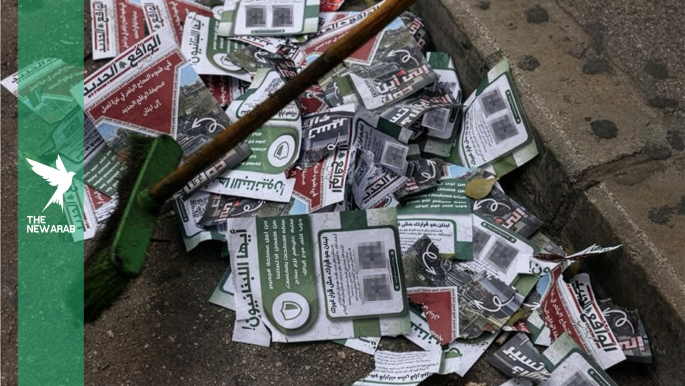
The Israeli army dropped a large number of leaflets over the Lebanese capital Beirut on Friday, some of which call on citizens to demand the disarmament of Hezbollah and insist that the decision should be in their hands rather than others’.
Others were designed to resemble a newspaper, carrying the headline: “In light of the great success in Gaza, the New Reality newspaper arrives in Lebanon… Where is our state heading?”
The move comes as fighting between Israel and Hezbollah continues to intensify, with Israel rejecting diplomatic overtures from Beirut amid the ongoing conflict, according to reports on the Israel-Hezbollah war escalation.
The leaflets, which include incitement against Hezbollah, contain QR codes that the Lebanese army and cybersecurity experts have warned people not to scan or access through their phones. They said doing so could expose devices to hacking or make them traceable, allowing data and personal information about the user to be collected.
The risk also lies in opening channels of communication with the Israeli military. In a statement, the Lebanese army said an Israeli aircraft had dropped printed leaflets over Beirut containing QR codes linking to WhatsApp and Facebook platforms to communicate with the Israeli army’s human intelligence unit, known as “Unit 504”, which is responsible for recruiting informants.
The leaflet drop comes amid escalating Israeli military operations across Lebanon, including Israeli strikes on Beirut’s southern suburbs and other areas of the country. The war has displaced large numbers of civilians and prompted grassroots relief efforts, with volunteers assisting people displaced by Israel’s war on Lebanon.
Alongside its military campaign, Israel has also intensified psychological warfare targeting civilians. This includes threatening phone calls and text messages sent randomly to large numbers of people, spreading widespread panic. Such messages have even reached official premises, ministries, public administrations and courthouses, which were quickly and temporarily evacuated amid fears they might be targeted by air strikes.
Israel has also relied on evacuation warnings since launching its latest offensive on Lebanon on 2 March, a campaign widely covered as part of the escalating Israel-Lebanon conflict. These warnings often target residents in Beirut’s southern suburbs and southern Lebanon without specifying timeframes, heightening fear and confusion while widening the scale of displacement.
‘Do not scan QR codes’
Abd Qataya, director of the media programme and internet governance project at the digital rights organisation SMEX, told The New Arab that the leaflets claim to direct citizens to pages on platforms such as Facebook and WhatsApp, though these may not always be genuine pages.
Even when they do lead to those platforms, users may first be redirected to intermediary pages capable of collecting data.
He said scanning the code and entering the page could reveal information such as the type of phone, browser, screen size and network details, including whether the connection is through Wi-Fi or mobile data. Such information, he noted, is valuable for Israeli intelligence operations. He added that these pages may also download cookies, enabling user behaviour to be tracked.
“Simply scanning a link that leads to WhatsApp, for example, could reveal the person’s phone number to the Israelis along with other information stored on the device,” he said.
“Similarly, if the link directs to a Facebook page, even without interacting with it, the application may automatically begin displaying similar pages during browsing.”
Qataya noted that Israel could have disseminated such messages via social media instead of dropping them from aircraft, but the aim was to create a psychological atmosphere that goes beyond online campaigns. He advised people not to scan the code or access the websites. If someone opens the link accidentally or out of curiosity, they should immediately check whether anything has been downloaded in the background and clear their cookies. Any Facebook pages reached through such links should also be blocked or reported.
Separately, SMEX, which is a non-profit organisation that says it works to defend digital rights in West Asia and North Africa, has explained in several reports how threatening calls and messages operate.
Lebanese users’ data, it said, can easily be purchased for advertising and promotional purposes. In addition, citizens’ data are already widely available through records held by the Traffic Management Authority and public electoral lists. As a result, a citizen may receive a threatening message simply because their phone number is listed within a targeted geographical area.
The organisation also noted that technology is used to make some calls appear as though they originate from Lebanese numbers, concealing their true source. Many automated voice messages are also sent through international telecommunications companies, giving the impression that the calls originate from “friendly” countries. I
It further warned that Israeli drones operating over Lebanon are capable of intercepting signals exchanged between antennas and mobile phones. Through this process, they can collect all phone numbers within a given coverage area and send calls or messages to them.
SMEX urged citizens to remain calm when receiving threatening calls or messages and to avoid spreading information widely before verifying it. It advised contacting the relevant security authorities to report and verify any threats, avoiding sending messages to suspicious numbers, refraining from calling back unknown numbers, and attempting to record conversations for verification with the relevant authorities.