As Israel’s bombardment of Lebanon forces hundreds of thousands from their homes and deepens an already catastrophic humanitarian crisis, Palestinian refugees in the country find themselves once again on the front lines of regional upheaval.
Many live in overcrowded camps that have long depended on the United Nations Relief and Works Agency for Palestine Refugees (UNRWA) for education, healthcare, and basic services.
But as war and displacement place even greater pressure on the agency, a quieter controversy inside its classrooms has begun to shake the fragile trust many Palestinians place in the institution meant to sustain them.
At the start of this year, students in Palestinian refugee camps across Lebanon took to the streets and burned their textbooks.
The reason — the omission of the word ‘Palestine’.
In supplementary geography textbooks provided by UNRWA, the UN Relief and Works Agency for Palestine Refugees, ‘Palestine’ was replaced by ‘Gaza’ and ‘the West Bank’ on a map of the region.
“The idea of removing the name of Palestine is to destroy a people,” Tarik, a Palestinian who grew up in Beirut’s Shatila camp, told The New Arab.
UNRWA’s Beirut office said its schools follow the local Lebanese curriculum and that the textbooks it developed were “intentionally left open-ended to encourage discussion and active exploration in the classroom.”
“This approach allows students to think critically, investigate, and identify geographical information themselves,” the agency told The New Arab.
Now in his mid-twenties, Tarik, whose name has been changed to protect his identity, studied at a school run by UNRWA, which was established to provide humanitarian assistance to Palestinians displaced during the creation of the state of Israel from 1947 to 1949.
“I remember studying the history of Palestine in fifth or sixth grade; the map of Palestine, the Palestinian flag, what the country is famous for, its heritage, its importance, everything,” he said.
“[Now], the history of Palestine is forbidden in schools. They’re even forbidden from talking about Palestine,” Tarik said.
That change has taken place over the past few years, he alleged, especially since Israel’s genocide in Gaza began after 7 October 2023, killing more than 75,000 people.
Israel’s bombardment has included attacks against UNRWA and its buildings after accusing its staff of having ties to Hamas, which the agency denies. Benjamin Netanyahu’s government has banned it from operating inside the country, and in January demolished its compound in East Jerusalem — condemned by UNRWA and others as a breach of international law.
In a show of support for Israel, the UN’s biggest donors, including the United States, have drastically cut their funding to the agency. That has left it facing a severe financial crisis, with a projected shortfall of approximately $220 million in 2026, according to UNRWA’s Beirut office.
Tarik accused UNRWA, which has the word Palestine in its name, of undermining his people’s identity.
“This new decision to remove the name of Palestine from the geography textbook is evidence of the erasure of our history, our land, and our dignity,” he shared.
“I used to trust UNRWA. Now, because ‘Palestine’ was removed, that trust has changed a bit,” he said.
The agency told The New Arab that it “reaffirms its deep respect for the national identity and history of Palestine Refugees, and its commitment to protecting their dignity and rights.”
Despite his frustration with the books, Tarik recognised that UNRWA is critical to the Palestinians’ survival.
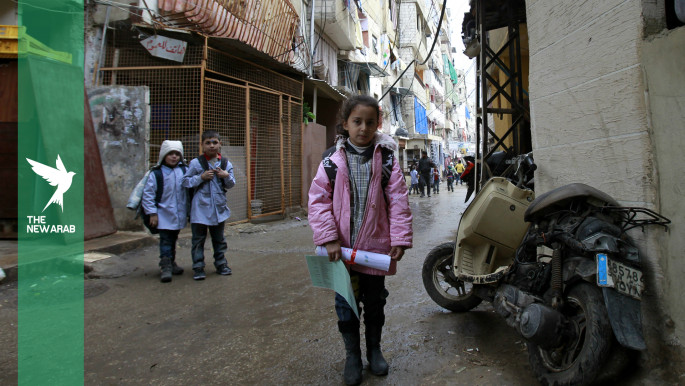
His home, Shatila, is a densely packed refugee camp on the edge of the southern suburbs of the Lebanese capital.
Crammed houses stacked one atop the other rise above the streets, packed so densely that sunlight barely reaches the ground. Flags of various factions fly above narrow alleyways, swaying above the noise.
Living in limbo
Originally set up by UNRWA for Palestinian refugees fleeing their homes in 1949, Shatila now houses more than 14,000 people — some estimates go up to 30,000 — and has become little more than a slum.
The agency provides essential services in Shatila and 11 other camps across Lebanon — including housing, infrastructure, education, and social protection — that the state would normally handle.
But Palestinians are essentially stateless in Lebanon, prohibited from buying property, working freely, or accessing basic services.
Without it, Tarik said, “our community will be destroyed.”
Tarik was the only person from the camp willing to speak to The New Arab. Current students and their families were too afraid to talk about their experiences, fearing they could be expelled from school or cut off from UNRWA’s vital services.
“We have a toxic relationship with UNRWA,” said Basma El Doukhi, a Palestinian scholar with a PhD in migration studies who is now based in the UK.
Basma grew up in Rashidieh camp in southern Lebanon, where she, like nearly all Palestinians in Lebanon, used UNRWA’s services.
She highlighted the agency’s unique role in preserving Palestinian identity, even though it is part of the UN, which recognises Israel as a member state.
With no international recognition, she said UNRWA is “carrying the flag of Palestinians everywhere. It’s keeping the Palestinian cause alive.”
Basma explained that Palestinians cling fiercely to their identity because of their long history of displacement, a bond that is even stronger in Lebanon, where they face a deeper marginalisation than in Jordan or Syria.
This explains the outrage over ‘Palestine’ being omitted from the textbooks.
“It’s not only about a physical map, or a page in a book,” she said. It is “stripping their identity, even while they are living in exile.”
‘We are in an existential struggle’
The crippling cuts to funding have coincided with a devastating new war. Since early March, Israeli strikes across Lebanon have killed nearly 700 people and displaced around 800,000 others.
While Israeli forces say they are attacking areas associated with Hezbollah, the Iran-backed militia that operates out of Lebanon, their strikes have hit private homes, upscale neighbourhoods, and public beaches.
This, combined with Lebanon’s precipitous economic crisis, has left the Palestinians, who were already struggling, fighting for survival.
“Unfortunately, we are in the position as Palestinians that we should protect this agency, because it supports us and provides work and relief to us,” she said.
“But now we are in an existential struggle. […] UNRWA keeps our cause alive, but we can’t support it if it erases our belonging, identity, and dignity.”
Basma encouraged the agency to listen more closely to Palestinians and their issues, and urged it to reflect and reform.
“At the end of the day, these are the people that you are serving, not the donors. Figure out the opportunity that you have,” she said.
Ultimately, UNRWA needs to recognise how essential identity and history are to the Palestinians.
“I know my people,” she continued. “We will not die from hunger. We will die if we lose our dignity and identity.”
Ali Abbas Ahmadi is a multimedia freelance journalist based in Beirut. He covers migration, human rights, and Lebanon, Syria and Palestine, and previously worked at the BBC and The New Arab