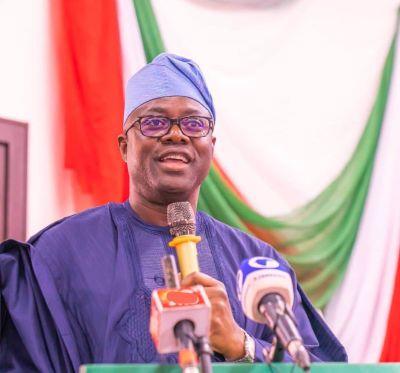
The Oyo State Governor, Seyi Makinde, has urged Nigerians not to allow the country to become a one-party state ahead of the 2027 elections.
Governor Makinde made the demand of Nigerians in his Newsletter, which he shares regularly with those who are subscribed to it.
The Engineer cum politician said this following what he described as developments within the Peoples Democratic Party (PDP) and African Democratic Congress (ADC), and the positions taken by the Independent National Electoral Commission (INEC) on the issues.
He said these are not just political issues as they concern anyone who believes in the future of democracy in Nigeria.
Makinde wrote: “I am also aware that many of you are watching closely as we approach a transition period in Oyo State.
“And that you have questions about continuity, leadership, and the future direction of our State.
“We have engaged with a number of credible individuals as part of a deliberate transition process, and I will communicate a decision in due course, one that reflects both the progress we have made and the future we must secure.
“But beyond this, I believe there is a broader conversation we cannot afford to ignore – Nigeria devolving into a one-party State.
“This has led to some people beginning to withdraw quietly from conversations about our future because they feel their voices no longer matter.
“A healthy democracy depends on balance; on the presence of credible alternatives, strong institutions, and the confidence citizens have in the process.
“Today, voices that speak up against Nigeria devolving into a one-party State are being openly threatened. Opposition is being fragmented, constrained, or pushed to the margins.
“Whether one agrees with this concern or not, it is not something we should dismiss lightly. Because when opposition becomes ineffective, accountability weakens.
“And when the government cannot be held to account, the everyday challenges we face become harder to resolve.
“I do not believe Nigeria has reached a point of no return.
“But I do believe we are at a point where silence, indifference, or withdrawal could take us in a direction we may later struggle to reverse.
“Democracy is not built on agreement.
“It is built on plurality, on the presence of different voices, including those we may not agree with because that is what keeps a system open, accountable, and responsive.
“This is not a call for panic.
“But it is also not a time for complacency.
“It is a call for awareness and a call for all of us, leaders and citizens alike, to remain engaged in protecting the democratic space that gives meaning to our collective future.
“In the coming days, I will be engaging with people across different sectors to listen and reflect on how we can strengthen our democratic space in a way that is inclusive, lawful, and sustainable.
“Nigeria has come too far for us to become indifferent.
“Our democracy will not be protected by silence, it will be protected by those who stay engaged, ask questions, and insist that our institutions work for the people.”