At 22, this cybersecurity graduate is building an anti-piracy creator platform with his father

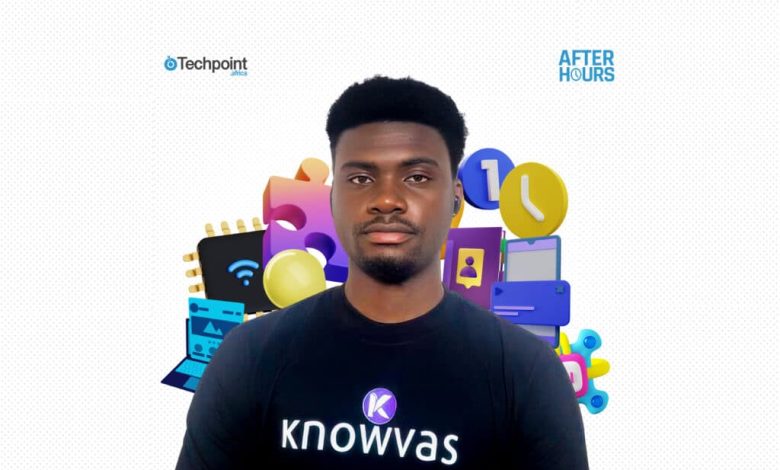
Twenty-two-year-old Adeyemi Akitoye wants to bridge the gap between security and the African creator economy. From teaching himself penetration testing while studying cybersecurity at the university to building a startup alongside his father, Akitoye offers a look into the life of a Gen Z engineer.
In this edition of After Hours, the co-founder of Knowvas shares his journey from playing games on his parents’ computer as a four-year-old to building a Netflix-style protection layer for African authors and artists.
Early interactions with technology
My first real encounter with technology goes all the way back to when I was about four or five years old. We had a computer at home. Actually, both my parents were quite exposed to the Internet and computers at the time, so I had early access. Most of what I did then was play video games, even though my dad wasn’t exactly a fan.
But it wasn’t just games. I was also introduced to some tutoring software, and that’s where my curiosity started to grow. I began wondering how these things actually worked and what was happening on the backend.
I didn’t start coding seriously until much later. During my early university days, I began learning HTML, JavaScript, and a bit of Python. That was really the beginning of my journey into building things.
From cybersecurity student to startup founder
I studied cybersecurity at Dominion University, Ibadan, Nigeria, after starting in a direct-entry program.
Choosing cybersecurity was very intentional. At the time, I felt like it was a relatively new field, especially in Nigeria, and one that would soon become highly in demand. Looking at how companies and digital infrastructure were evolving, it just made sense to me that security would become critical.
School, however, was mostly theoretical. I had to take responsibility for my own practical learning. I taught myself how to set up environments like VirtualBox and Linux, and I learned penetration testing on my own. What I learned at school was more on the business and risk-management side of cybersecurity, such as understanding systems, threats, and frameworks. It did not necessarily involve how to execute in real-world scenarios.
So, I realised that to truly secure systems, I needed to understand how they were built from the ground up. I started teaching myself software development. No tech bootcamps or formal training, though. I downloaded courses online and just kept learning.

Victoria Fakiya – Senior Writer
Techpoint Digest
Make your startup impossible to overlook
Discover the proven system to pitch your startup to the media, and finally get noticed.
The deeper I went, the more I realised how much there was to learn. But even while I was still learning, I was already thinking about how I could use what I knew to build something real. That’s why I decided to build something. That something has grown into Knowvas.
Building Knowvas as father and son
Knowvas was born out of the simple observation that it was difficult for African creators, especially in Nigeria, to distribute their digital work while maintaining control over it.
Many creators worry about piracy, and most available platforms don’t always protect their work effectively. Once someone downloads your content, you lose control over it. They can resell it, share it, or undervalue it, and that didn’t sit right with me.
So I wanted to build something that enables authors, comic artists, audiobook narrators, even podcasters, to publish their work confidently, knowing it’s protected and that they can earn fairly from it.
The idea also came at a time when a platform called Okada Books had shut down. My dad and I saw that gap in the market and recognised it as an opportunity. That’s really how we started working together on Knowvas.
From a technical standpoint, I built the entire system with security in mind from the beginning. Content isn’t distributed in raw downloadable formats. Instead, it’s accessed through controlled rendering systems within our app, similar to how streaming platforms work. You can access content, but you can’t freely distribute it.
Creators also have full control even after publishing. They can update their work, adjust pricing, and manage access at any time. That flexibility is something many existing platforms don’t offer.
We started building in 2024 and officially launched in October 2025. I currently serve as Chief Technology Officer, while my dad occupies the CEO position, providing guidance, onboarding creators, and even securing infrastructure credits that have helped keep us running.
Working with him has honestly been a positive experience. He understands the vision, which is rare. Most people I’ve tried to explain this to don’t really get it, but he does.
Before university, I was already working. I learned graphic design, video editing, and motion graphics, and I worked with a few companies, including a YouTube-based news channel and a media production company.
Even while building Knowvas, I’ve had to take on freelance work, mostly web development, to sustain myself. It’s not easy to build a startup without a steady income.
Everyday life with technology
As a cybersecurity engineer and a startup founder, I rely on technology constantly, not just for work, but for thinking, creating, and solving problems.
AI, especially, has changed a lot of things. I don’t think I can go a day without using it. What used to take weeks of writing and testing code can now be done in hours; AI has removed a major bottleneck in building.
That said, I’m also careful about how I use it. I don’t let it take away my ability to think. It should enhance our work, not replace us. I’ve seen people become so dependent on AI that they can’t think independently anymore, and that’s something I try to avoid.
If I had to name the most impactful things technology has given us, I’d say the Internet and then AI right above it.
One platform I use the most is X (Twitter). It’s raw, unfiltered, and highly interactive. If you’re on the right side of it, you can learn a lot, connect with people, and stay updated on what matters.
I also subscribe to newsletters to keep up with new technologies, but I mostly rely on X (Twitter).
One of the biggest challenges I face with technology is poor Internet connection. It sounds basic, but it affects everything.
Beyond that, there’s also the overwhelming nature of being constantly connected. I take breaks from social media quite often. Sometimes I just log off for a few days to reset. It’s not about stopping communication; it’s just about disconnecting from the noise. It’s balancing productivity with the noise.
As an introvert, technology hasn’t really changed how I communicate physically. That still depends on how comfortable I am with the person.
Online, though, it’s different. Sometimes I use ChatGPT to draft responses or better understand messages. It’s like having a second layer of clarity when communication feels unclear.
I’m optimistic about the future of technology in Africa. With AI lowering the barrier to building, more people can now create solutions to real problems. And Africa has no shortage of problems to solve.
In the next five to ten years, I believe we’ll see significant progress, especially in places like Nigeria. Technology has made it easier than ever to build, and I think that will translate into real impact.