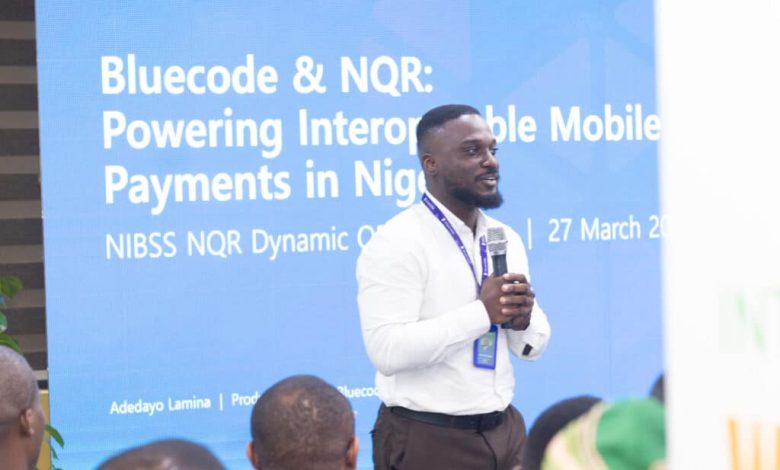
Nigeria’s push toward a cashless economy has moved past the question of whether consumers will adopt digital payments. The more pressing challenge now is whether the infrastructure underpinning those payments can actually talk to each other. That question was front and centre at the NIBSS NQR Dynamic QR Demo Day held in Lagos in March 2026, where Bluecode Africa joined financial institutions, fintechs, and payment scheme operators to showcase the current state of payments interoperability in Nigeria.
The highlight of Bluecode’s participation was a live demonstration showing a consumer complete a payment at a Bluecode-accepting merchant using an NQR-enabled bank app with a single scan, no new app download, and no additional merchant integration. The transaction was processed within seconds at the point of sale, bridging two payment schemes that had previously operated independently.
Adedayo Lamina, a product manager at Bluecode Africa, led the demonstration. Lamina has spent the last three years working on the rollout of what the company describes as Africa’s first interoperable contactless payment scheme, coordinating delivery across engineering teams, institutional partners, and Nigerian banks, including Tier-1 institutions. His work has contributed to a network that now spans more than 70,000 merchants and over one million enabled wallets. His contribution to this project positions him as one of the more technically grounded product operators in the space and suggests an ability to move between API-level delivery and ecosystem-level negotiation without losing focus on either.
The institutional groundwork behind the demo involved coordination with NIBSS, Chamsswitch, and an expanding group of Nigerian banks. That kind of multi-stakeholder alignment is often where infrastructure projects of this nature stall, and the fact that the demonstration ran without friction in a live setting was itself a meaningful signal. Odin Krismayr, Managing Director of Bluecode Africa, has been the driving force behind the company’s Africa strategy, anchoring its partnerships with national infrastructure operators and positioning the company within Nigeria’s regulated payments ecosystem. Under his direction, Bluecode has pursued an integration-first approach, building on existing rails rather than asking merchants or consumers to adopt parallel systems.
That philosophy was visible in the demo. Rather than introducing a new consumer-facing product, the Bluecode NQR integration extends the utility of infrastructure Nigerians already use. For smaller merchants, especially the company’s static QR deployment offers a low-cost, printable acceptance option that does not require complex hardware or ongoing technical maintenance, a meaningful consideration in a market where the economics of merchant acceptance remain a barrier to broader financial inclusion.
Bluecode Africa’s participation at the NIBSS event reflects a wider pattern in the Nigerian payments space: the shift from building standalone products to building connective tissue between them. Whether that approach translates into durable commercial scale will depend on continued adoption across the banking sector. But the Lagos demonstration suggested the technical foundation is further along than many in the market may have assumed.