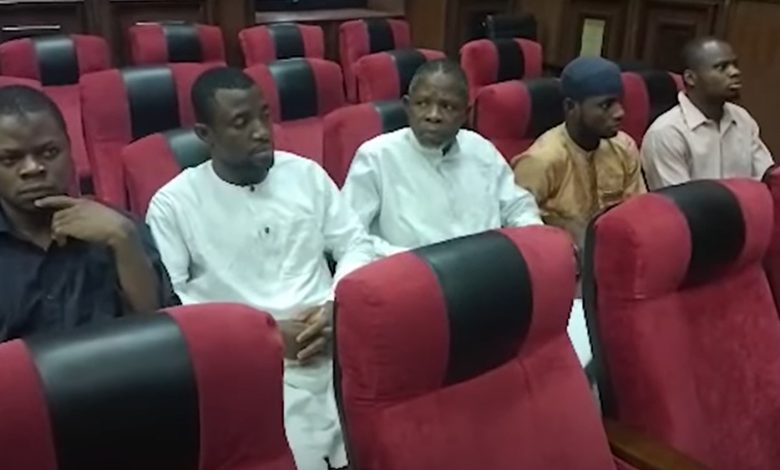
The Federal Government on Tuesday commenced the mass trial of 227 suspected terrorists before various divisions of the Federal High Court in Abuja, as part of ongoing efforts to prosecute individuals linked to terrorism-related offences.
The trials are part of a broader exercise involving about 500 suspects, according to the Attorney-General of the Federation and Minister of Justice, Prince Lateef Fagbemi (SAN).
The proceedings, which are traditionally held in Kainji, Niger State, were moved to Abuja because the Federal High Court is currently on Easter vacation.
The vacation, which began on April 7, will end on April 13, 2026, with normal court sittings expected to resume on April 14.
Despite the break, ten justices of the Federal High Court were assigned to handle the terrorism cases.
Speaking after the proceedings, Fagbemi commended the judges for prioritising the trials during the holiday period.
“They have prioritised the trial of terrorism suspects to underscore the importance that is attached to this trial,” he said.
He added that the exercise is part of Phase 9 of the terrorism trials, which involves about 500 suspects and is expected to continue until Friday or Saturday.
At Tuesday’s proceedings, Justice Binta Nyako convicted several suspects after they pleaded guilty to terrorism-related offences.
The first defendant, Hamat Modu, 20, pleaded guilty to four counts of assisting members of Boko Haram, a proscribed terrorist group. He was sentenced to 10 years’ imprisonment on each count.
Similarly, another suspect, Isah Ali, who admitted supplying food to Boko Haram members in Borno State, was also sentenced to 10 years in prison. The court ruled that his sentence would take effect from the time of his arrest three years ago.
Justice Nyako further ordered that the convicts be held in designated detention facilities under the Ministry of Interior and undergo rehabilitation and deradicalisation programmes after serving their jail terms.
Another defendant, Hamza Yahuza, a father of six, was sentenced to seven years imprisonment for supplying drugs, Indian hemp and cigarettes to Boko Haram fighters in Monguno Local Government Area of Borno State.
Yahuza admitted committing the offence in 2023 and pleaded for leniency, attributing his actions to poverty.
However, the judge rejected the plea. The court ruled that the sentence would run from March 6, 2023, the date he was arrested.
Man Jailed 20 Years For Selling Goats To Insurgents
In another ruling, Shehu Bukar, a father of three, was sentenced to 20 years imprisonment for supplying goats to Boko Haram fighters.
Bukar, who was charged with five counts, admitted guilt to one of the charges in court.
Following the plea, the prosecution withdrew the other counts, leaving the defendant to face sentencing on the remaining charge.
Justice Nyako held that supporting terrorist groups in any form remained a serious criminal offence that must not be tolerated.
Meanwhile, another 20 suspects were also arraigned before Justice Emeka Nwite on similar terrorism-related charges.
Other judges participating in the trials include Justice Musa Liman and Justice Akpan Ekerete, among others.
Security was significantly tightened around the Federal High Court complex in Abuja, with heavily armed personnel deployed and roads leading to the court blocked during the proceedings.
Speaking after the proceedings, the Director-General of the Legal Aid Council of Nigeria, Aliyu Abubakar, who represented several of the defendants, said many of the suspects admitted to the charges.
He explained that some were convicted for financial or material support to Boko Haram, including paying “Zakat” or providing farm produce to the insurgent group.
“When you pay money or give farm produce to Boko Haram by way of appeasing them, it is considered terrorism financing,” he said.
Abubakar added that while many suspects had been convicted, a few had been discharged and acquitted, noting that the process showed a level of transparency.
“You can imagine someone who has been in detention for four or five years being discharged and acquitted. It shows that the trial has some level of transparency,” he said.
He added that the trials would continue until later in the week, as part of the government’s ongoing efforts to address terrorism-related cases.