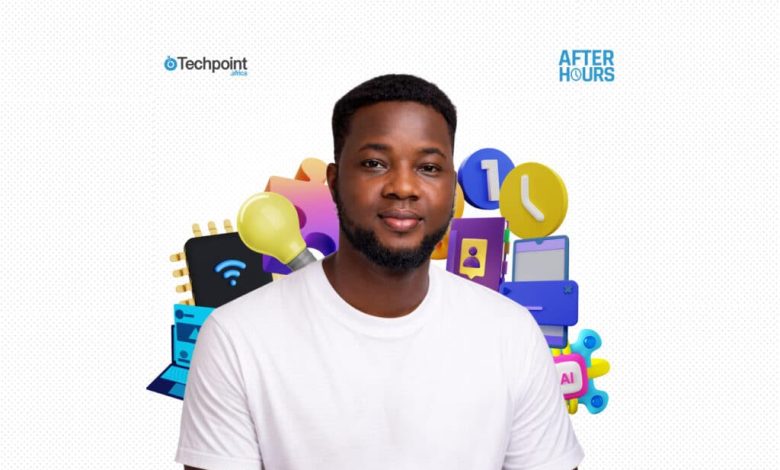
What began as a childhood fascination with computers in Lagos cyber cafés has evolved into a career in machine learning, data science, and MLOps. And while he initially wanted to become a medical doctor, Gift Ojeabulu found his way back to tech, with a few stops along the way as a rapper and dancer.
Today, he is a machine learning engineer working with global teams and a co-founder of Data Community Africa, an initiative advancing data and AI education across the continent.
In this edition of After Hours, Ojeabulu walks us through his journey from predicting Champions League scores with data models to becoming a machine learning engineer despite
Early encounters with technology
My earliest memory of technology takes me back to primary school. I grew up in Ketu, Lagos, when cyber cafés were everywhere. For many people, those cafés were tied to a certain kind of Internet culture, but for me, it was a window into something fascinating.
Through my older brothers, I was exposed to computers earlier than most of my peers. Whenever I got money for school, I would sometimes sneak into a café to browse for a few minutes. That was my first real interaction with a computer, mostly clicking around and learning to control the mouse.
Even in school, I stood out during ICT classes. At the time, I didn’t fully understand what that meant. I just knew I enjoyed it.
But if I’m being honest, gaming got to me way before that. We had a Sega at home, and I was always on it. My brother and I would also head to the game shop to play Winning 11 on PS1 and PS2. Those were good times. By SS1, I had my own laptop, though I mostly used it for FIFA and Mortal Kombat.
Around that same time, I was also DJing and playing at friends’ parties and birthdays. I didn’t think of it as tech then, but I was always fiddling with equipment, figuring things out. I was also big on sci-fi movies. The Matrix and Blade were the ones that really stuck with me. Looking back, all of it was quietly shaping how I saw technology; I didn’t realise it at the time.
From medicine to machine learning
My academic journey didn’t start with tech in mind. I originally wanted to study medicine and surgery, like many Nigerian students. When I didn’t hit the cut-off mark, I switched to medical biochemistry. Eventually, due to academic requirements, I was moved to computer science at Ambrose Alli University.

Victoria Fakiya – Senior Writer
Techpoint Digest
Stop struggling to find your tech career path
Discover in-demand tech skills and build a standout portfolio in this FREE 5-day email course
It wasn’t planned. In fact, when I got into computer science in my second year, I had to ask myself, “Where do I even begin?” The answer came through curiosity. I’ve always been a multi-faceted person. I rapped, I danced, I played the drums, and even acted.
At the time, I had a friend who was already building with web technologies like HTML and Bootstrap. I would follow him around, watch him work, and observe how he turned lines of code into actual products.
Soon, I started learning on my own, with Udemy, Udacity, and anything I could find. I explored web development, then transitioned into Android development, diving deep into Java. I was fascinated by the idea of building something from scratch.
Around 2017–2018, I built my first real project, an Android app. It wasn’t deployed, and I didn’t even know about GitHub at the time, but it worked. My friends and I could use it.
Then my laptop crashed. Everything I had built was gone. At that point, I didn’t have the money to replace it, so I stepped back from tech temporarily and focused on school. Looking back, that moment could have ended my journey, but thankfully, it didn’t.
In 2018, a friend introduced me to an AI bootcamp. That was my entry point into data science and machine learning. I started learning online, watching lectures, studying concepts like eigenvectors, and diving into the fundamentals.
By 2019, I participated in a competition and ranked among the top participants. My team also won Best AI Poster at a national event hosted in Lagos. That experience made things clear for me: this was the path I wanted to pursue. From there, I doubled down. In 2020, I took more structured courses, including programs that helped me understand not just the technical side, but also the business side of AI.
By 2021, I landed my first major role as a data scientist at a basketball analytics company, where I applied machine learning to sports data. That role opened doors.
I later worked as an MLOps developer advocate at a global AI company, where I spent about two years. At one point, another company approached me with an offer and asked me to name my price. I did, and they accepted immediately. It was one of those moments where you realise how far you’ve come.
Today, I work across multiple roles, including with a Canada-based AI automation company focused on document intelligence and another organisation working on African-language voice systems.
Living through technology
Technology isn’t just my career, it’s how I think.
At one point, I built models to predict football match outcomes, not for betting, but out of curiosity. I would feed historical data into a system, analyse patterns and outcomes, and calculate scoring probabilities. Surprisingly, my predictions were often accurate. That experience eventually influenced my work in sports data science.
Beyond that, tech shapes how I make decisions, the kind of content I consume, and even how I interact with people. I actively encourage others to explore tech, not just as a career, but as a tool.
One of the most important parts of my journey is community. I co-founded Data Community Africa in 2022, which has grown to 15,000+ members across 40 African countries, with 5,000+ DataCamp licenses and an annual physical conference and hackathon that draws 1,500–3,000 attendees.
We also launched MLOps Circles to increase African representation in the global MLOps ecosystem, because at some point, I realised Africans were largely missing from that conversation.
Community, for me, is about access. If I had more guidance earlier in my career, I would have avoided certain setbacks. So now, I try to create that support system for others.
Right now, one tool I can’t do without is Claude. I’ve been an early advocate of it, even before it became widely popular. It aligns with how I think and helps me work more efficiently. I also use tools like NotebookLM, though it’s not yet widely adopted here.
To stay updated with tech trends, I rely heavily on newsletters like Techpoint Digest, Twitter, and LinkedIn. I follow people deeply embedded in the AI space who constantly share insights. I also use AI tools to research trends and deepen my understanding.
If there’s one thing I wish technology would do better, it’s representation, especially for African languages. We need systems that understand local contexts. Imagine AI tools that can interact fluently in Yoruba, Hausa, or Swahili, not just translating, but truly understanding cultural nuance. That would unlock access for millions of people.
Beyond that, there’s the issue of mobility. As a Nigerian, travelling for global opportunities can be difficult. I’ve missed out on fully funded international events due to visa challenges. It’s frustrating, especially in a field as global as tech.
If I were to build a product today, I’d focus on two things: advancing African-language AI and creating systems that make global mobility easier through better data verification and trust frameworks.
I believe the next decade will be defined by African participation. We have one of the youngest populations in the world, and that comes with energy, curiosity, and adaptability. As more young Africans gain access to resources and global exposure, they won’t just participate, they’ll lead.
The challenge is infrastructure: power, Internet, and economic stability. It’s hard to innovate when you’re focused on survival. But if those barriers improve, I’m confident that Africans will play a central role in shaping the future of AI and technology globally.