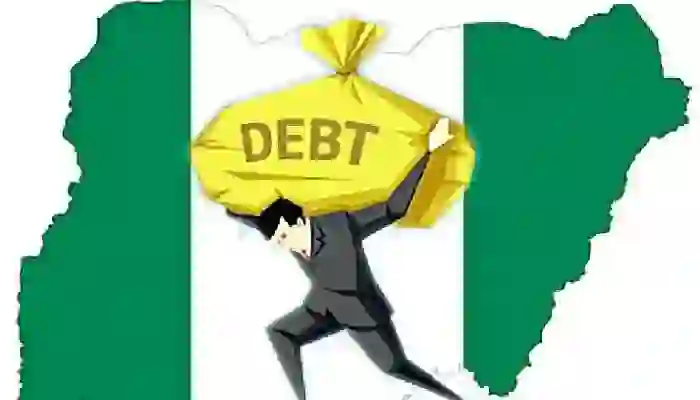
Nigeria’s total public debt has swelled to ₦159.28 trillion as of December 31, 2025, the Debt Management Office (DMO) confirmed on Tuesday — a figure that lays bare the country’s deepening dependence on borrowed funds to keep its finances afloat.
The latest figures mark a ₦5.98 trillion jump from the ₦153.29 trillion posted just three months earlier in September 2025, translating to a 3.9 percent quarter-on-quarter increase. Measured against December 2024, the debt pile has grown by ₦14.61 trillion — a 10.1 percent surge year-on-year.
The DMO cautioned that the December 2025 numbers are provisional, computed using the Central Bank of Nigeria’s official exchange rate of ₦1,435.26 to the dollar, compared to ₦1,474.85/$ used for the September figures.
In dollar terms, the picture is equally sobering. Nigeria’s debt rose from $94.23 billion in December 2024 to $110.97 billion by the close of 2025 — an increase of $16.75 billion within a single year.
Domestic Borrowing Leads the Charge
The home front remains the government’s preferred hunting ground for financing. Domestic debt climbed from ₦81.82 trillion in September 2025 to ₦84.85 trillion in December — a ₦3.03 trillion or 3.7 percent quarterly rise. Compared to December 2024’s ₦74.38 trillion, the domestic debt stock has expanded by ₦10.47 trillion, or 14.1 percent, over the year.
In dollar terms, domestic obligations rose from $48.44 billion in December 2024 to $59.12 billion by the end of last year.
The Federal Government holds the lion’s share, carrying ₦80.49 trillion of domestic debt — equivalent to 50.53 percent of the country’s entire public debt stock. States and the Federal Capital Territory together account for a comparatively modest ₦4.36 trillion.
External Debt Edges Higher
Nigeria’s external debt reached ₦74.43 trillion by December 2025, representing 46.73 percent of total public debt. That is up ₦2.95 trillion from September’s ₦71.48 trillion and ₦4.14 trillion above the December 2024 figure of ₦70.29 trillion.
Measured in dollars, external obligations moved from $45.78 billion at end-2024 to $51.86 billion by December 2025 — a climb of more than $6 billion across the year.
Here too, the Federal Government dominates, holding ₦66.27 trillion of external borrowings, while states and the FCT account for ₦8.16 trillion.
Debt Structure Holds Steady
Despite the upward trajectory in overall borrowing, the composition of Nigeria’s debt portfolio has remained broadly stable. Domestic debt accounted for 53.27 percent of the total in December 2025, marginally lower than 53.37 percent in September but above the 51.41 percent share recorded a year earlier. External debt, at 46.73 percent, moved within a similarly tight band over the same period.
READ ALSO: