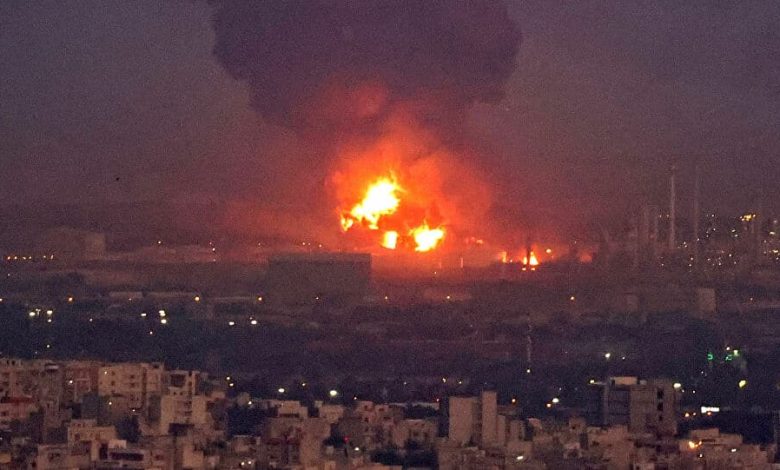
Fresh explosions rocked Tehran on Wednesday, April 1, as United States President Donald Trump said the ongoing war involving Iran could end within “two weeks, maybe three.”
Papers News reports that the conflict, which has rapidly escalated into a regional crisis, has already claimed thousands of lives, displaced millions, and triggered economic shocks across the globe.
The war began after the United States and Israel launched coordinated airstrikes across Iran, reportedly killing the country’s supreme leader, Ayatollah Ali Khamenei.
The development marked a dramatic turning point, triggering widespread retaliation and drawing multiple countries and armed groups into the conflict.
Since then, sustained attacks have spread across the region, with oil and gas prices surging amid fears of prolonged instability.
Despite the escalating violence, Trump struck a cautiously optimistic tone late Tuesday, suggesting the fighting might soon come to an end.
He said the war could be over in “two weeks, maybe three,” adding that the White House would provide “an important update on Iran” later Wednesday.
However, uncertainty remains over diplomatic efforts, with Tehran denying it is currently engaged in negotiations with Washington.
Iranian state television confirmed that Tehran came under fresh attack on Wednesday, with explosions heard across parts of the capital.
Reports revealed that the strikes hit areas near the former US embassy, now a museum known as the “Den of Spies,” a long-standing symbol of tensions between the two nations.
Iranian media also reported strikes on steel complexes in central and southwestern parts of the country, resulting in “significant damage and destruction.”
The Israeli military later confirmed carrying out the strikes, while also intercepting an Iranian missile attack that reportedly injured 14 people, including an 11-year-old girl.
Papers News reports that the war has expanded beyond Iran and Israel, drawing in several countries and armed groups across the Middle East.
In Lebanon, at least seven people were killed in strikes around south Beirut, while Israel said it had targeted a senior commander of Hezbollah.
Reports in the mainstream confirmed the killing of Hezbollah’s top commander for Iraq military affairs, Yousef Hashem, in the attack.
Residents described scenes of chaos and uncertainty.
“Nobody knows what’s happening,” one resident, Hassan Jalwan, told AFP, adding that “displaced people have been sleeping in the open.”
The crisis has also spread to Gulf countries, with Iran launching retaliatory attacks on nations it accused of supporting US operations.
Kuwait reported a drone strike on its international airport that caused “a large fire” at fuel storage facilities, while Bahrain confirmed a blaze at a business site following what it described as Iranian aggression.
Saudi Arabia said it intercepted several drones, and a tanker was damaged in waters off Qatar, though no casualties were recorded.
In the United Arab Emirates, a Bangladeshi national was killed by falling debris from an intercepted drone.
Meanwhile, Yemen’s Iran-backed Houthi rebels have intensified attacks, with Israel confirming its air defences intercepted another missile launched from Yemen.
Across the region, civilians continue to bear the brunt of the violence, with fear and uncertainty becoming a daily reality.
“Every day, we hear the sound of drones,” said Waad Abdulrazaq, a truck driver near Iraq’s Erbil airport.
“We hear them in the morning, and we hear them at night. We can no longer sleep or live in peace.”
Beyond the humanitarian toll, the conflict has triggered severe economic disruptions, particularly in the global energy market.
Iran has tightened control over the strategic Strait of Hormuz, through which about one-fifth of the world’s oil supply passes.
As a result, average petrol prices in the United States have risen above $4 per gallon for the first time in four years, while inflation has surged across Europe.
Governments worldwide have begun rolling out emergency measures to cushion the impact.
However, optimism sparked by Trump’s remarks helped ease oil prices slightly on Wednesday, with stock markets in Europe and Asia recording gains.
Despite backchannel communications, both sides have sent mixed signals about possible negotiations.
Iranian President Masoud Pezeshkian said the country has the “necessary will” to end the war, provided guarantees are in place to prevent a recurrence.
Meanwhile, Foreign Minister Abbas Araghchi acknowledged receiving messages from US envoy Steve Witkoff but insisted this did not amount to formal negotiations.
Earlier, Trump warned that failure to reach a deal could see US forces “obliterate” Iran’s oil infrastructure, including key export terminals.
Amid rising concerns, Britain announced plans to host a meeting of about 35 countries to discuss reopening the Strait of Hormuz and stabilising global energy supplies.