Two years after ECOWAS exit, Sahel traders turn to smuggling, stuck without trade partners

By Mohammed Dahiru Lawal –
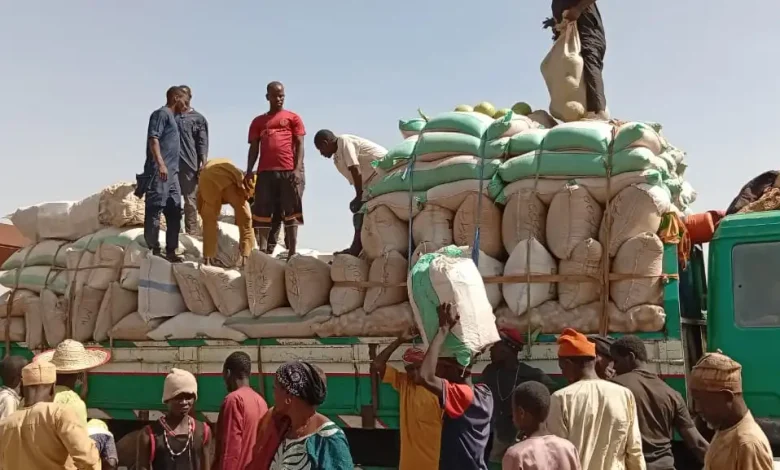
Sama’ila Zubairu [not his real name], a grain trader from Dan Issa, a small agrarian village south of Niger Republic, felt a chill the first time he saw armed men on motorbikes, weaving through dusty paths near the Maradi border in Niger and hauling sacks of maize under the cover of dusk.
Two years ago, the formal trade routes would have been used to move grains and other commodities profitably, but today, traders like him avoid those formal routes. Instead, they prefer to wait for the cover of darkness before embarking on the risky and strenuous journey through the dreaded Sahelian corridors that are off the radar of local authorities in the Niger Republic.
“We cannot use the old routes without paying too much. Now everything goes through the bush where we either pay more or less but with a guarantee of faster delivery,” he said.
Hundreds of kilometres away at the Ilela-Konni border, Bashar Ibrahim is facing a different version of the same crisis. A livestock trader whose family has moved animals across the Sahel for generations, he says the trade that once defined his livelihood is collapsing.
“Someone who used to supply me 500 animals now barely brings 50,” he lamented. “People are afraid of seizures, of attacks, of losing everything.”
Since the withdrawal of Mali, Burkina Faso and Niger from the Economic Community of West African States (ECOWAS) to form the Alliance of Sahel States (AES), regional trade has not collapsed, but it has been fundamentally reshaped.
Formal trade corridors have weakened under the weight of new tariffs, export restrictions and political uncertainty, but the movement of goods has not stopped. Instead, it has shifted into informal channels, mostly through smuggling, which is creating a parallel economy that is harder to regulate and more expensive to operate, with the costs ultimately borne by ordinary people.
“Exiting the regional bloc granted political autonomy but also removed access to West African financial safety nets, regional trade guarantees and investor confidence anchored in established ECOWAS mechanisms,” said Sadiq Aliyu, Deputy Director and Head of Public Relations, Nigeria Export Promotion Council (NEPC).
Export bans introduced in the AES countries to protect domestic markets and encourage local value addition have instead trapped commodities within their borders, while the introduction of a 0.5 percent levy on ECOWAS-related goods has added another layer of cost to an already strained system. The result is a fragmented market in which goods are harder to move, more expensive to trade, and less accessible to those who need them most.
“Wealthy traders usually afford the tariffs on their goods, while others converge on a single vehicle to contribute what they can risk to the passage,” said Lawali Maradi, acting Secretary, Traders Association of Niger. “Others who cannot afford it at all follow illegal ways and become targets of law enforcement agencies.”
At the Nigeria-Niger border near Maradi, traders along the Maradi-Katsina corridor, which is roughly a 200 to 250 kilometre journey, say that moving a single truck of maize from northern Nigeria into southern Niger markets now requires navigating more than a dozen informal checkpoints, each with its own demands. What once took a day can now take three days, doubling transport costs and pushing food prices higher across the Niger Republic.
Nigeria exports maize and other grains to Niger, serving as a primary source for Niger’s dry grain imports and often accounting for 60 to 70 percent of the regional supply. Official data suggest that between 50,000 and 75,000 tons of maize are exported annually, though unrecorded cross-border trade is likely far higher.
In parts of Mali and Burkina Faso, efforts to promote local processing have collided with limited industrial capacity, leaving surpluses of raw commodities without viable export markets. Analysts say this has reduced farmer incomes without achieving the intended industrial growth. In Niger, a country that relies heavily on imports for food security, disruptions to established supply corridors have intensified dependence on informal networks, undermining price stability and supply reliability.
“What emerges from this shifting landscape is a system under strain, adapting in real time to constraints imposed by policy, politics and geography,” said Aliyu.
Across the central Sahel, food markets are fragmenting under pressure from insecurity and trade disruptions. In Niger, a net importer of key staples, dependence on cross-border supplies – particularly grains from Nigeria – has deepened vulnerabilities as formal corridors weaken.
In some regions of Burkina Faso affected by insecurity, including Gayéri, Kompienga and Sebba, prices of staple foods have surged to over 100% compared to the five-year average. By contrast, in relatively stable urban markets such as Ouagadougou, the same commodities are typically 40–60% above average, reflecting uneven market conditions and limited corridor access.
Meanwhile, in northern Nigeria’s border corridors such as Illela and Jibiya, traders report rising transport costs and delays due to informal checkpoints and policy restrictions, further constraining the flow of food into neighbouring Sahelian markets. Together, these pressures are creating a patchwork of price instability across the region, where location increasingly determines who can access affordable food.
Rising food inflation and trade deficits
The most measurable economic impact of the rupture is reflected in food prices.
World Bank food inflation datasets show that Niger experienced a major food price shock between mid 2023 and mid 2024, with inflation exceeding 40 percent before cooling in 2025 and rising again through 2026. Mali experienced an extreme spike in 2022, with food inflation reaching roughly 60 percent, followed by volatility and renewed increases in 2024 to date. Burkina Faso recorded a steady rise through 2021, a sharp spike in 2022, a partial correction in 2023, and renewed pressure into early 2025 and beyond.