Central Bank of Nigeria Retains Interest Rate at 26.5% as Inflation Slows to 15.69%

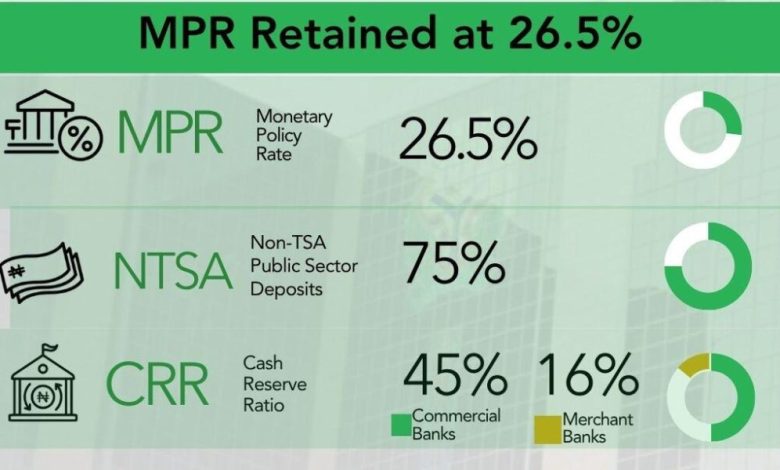
Central Bank of Nigeria (CBN) has retained all key monetary policy parameters at the conclusion of the 305th Monetary Policy Committee meeting as policymakers continued efforts to consolidate inflation moderation and maintain exchange rate stability.
The Monetary Policy Committee voted to keep the Monetary Policy Rate at 26.5 percent, maintaining the benchmark lending rate at its current level amid improving inflation indicators and relatively stable financial market conditions.
The committee also retained the Cash Reserve Ratio for commercial banks at 45 percent while merchant banks’ CRR remained unchanged at 16 percent.
In addition, the apex bank maintained the 75 percent reserve requirement on non-Treasury Single Account public sector deposits.
The asymmetric corridor around the Monetary Policy Rate was also left unchanged at +50 basis points and -450 basis points.
The latest decision comes as Nigeria’s inflation rate eased to 15.69 percent, reflecting continued moderation in consumer price pressures following aggressive tightening measures implemented by the central bank over the past year.
At the foreign exchange market, the naira traded at ₦1,373.34 against the United States dollar according to current Central Bank of Nigeria data at the time of the MPC announcement.
Meanwhile, yields on fixed-income instruments remained elevated as the 91-day Nigerian Treasury Bills rate stood at 15.95 percent while the Nigerian Overnight Financing Rate settled at 22 percent.
Market analysts said the decision to hold rates steady suggests that the Monetary Policy Committee is prioritizing policy consistency while assessing the impact of previous tightening measures on inflation, liquidity and economic growth.
The retention of the benchmark rate also reflects the apex bank’s cautious approach toward balancing inflation control with the need to support financial system stability and investment flows.
Investors are expected to closely monitor future inflation readings, exchange rate movements and liquidity conditions for signals on the central bank’s next policy direction.
The outcome of the MPC meeting comes amid ongoing efforts by monetary authorities to stabilize the naira, strengthen foreign exchange inflows and manage inflationary risks within the broader Nigerian economy.