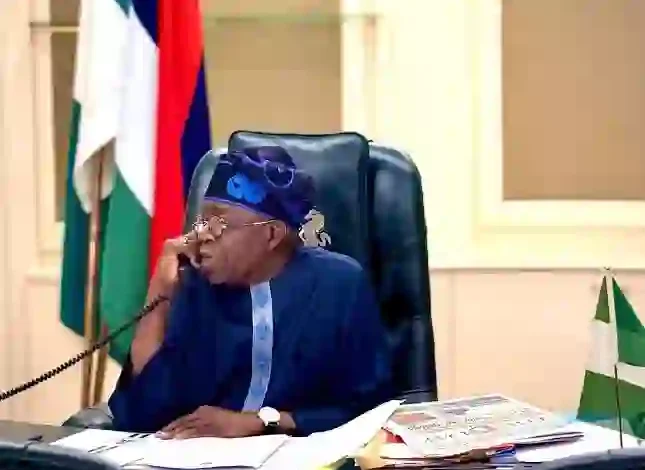
President Bola Tinubu has called for stronger economic integration across Africa, urging leaders on the continent to prioritise industrialisation, regional cooperation, and fair access to global financing.
Tinubu made the call on Tuesday while leading Nigeria’s delegation to the Africa Forward Summit in Nairobi, Kenya, where African and global leaders gathered to discuss economic transformation and development priorities across the continent.
The summit, jointly hosted by French President Emmanuel Macron and Kenyan President William Ruto, attracted representatives from more than 30 countries.
According to a statement by presidential spokesman Bayo Onanuga, opening remarks were delivered by United Nations Secretary-General Antonio Guterres and African Union Commission Chairman Mahamoud Youssouf.
On the sidelines of the summit, Tinubu held talks with Madagascar’s president, Michael Randrianirina, and also met with CAF President Patrice Motsepe, where he reiterated Nigeria’s readiness to host the 2026 CAF Awards.
During his address, Tinubu highlighted the importance of Africa’s blue economy, describing maritime development as critical to the continent’s economic future. He noted that insecurity and uncertainty had discouraged investment in ocean-based industries and maritime trade.
The president announced Nigeria’s willingness to strengthen regional maritime cooperation by making the country’s Deep Blue Project intelligence infrastructure available as a shared data platform for interested Gulf of Guinea nations.
Tinubu stressed the need for harmonised maritime laws, coordinated enforcement systems, secure sea routes, and efficient judicial processes to attract private investment into Africa’s maritime sector.
He added that Nigeria would continue pursuing climate-friendly port modernisation and digital reforms within the maritime industry.
According to Tinubu, Africa must shift from what he described as “sea blindness” to “ocean sovereignty,” insisting that the continent’s waters must be collectively protected through stronger institutions, legal cooperation, and regional security partnerships.
Speaking on global financial reforms, the Nigerian leader criticised existing international financial structures, saying they continue to disadvantage developing economies, especially in Africa.
Tinubu observed that Africa contributes less than two per cent of global manufacturing output because many countries still export raw materials while importing finished products.
He blamed the situation on restrictive global policies, illicit financial flows, and limited access to affordable industrial financing.
The president said Nigeria had already embarked on major economic reforms, including the removal of fuel subsidies, exchange rate unification, and banking recapitalisation worth over 45.5 billion dollars, aimed at restoring investor confidence and stabilising the economy.
Despite these reforms, Tinubu lamented that African countries still faced extremely high borrowing costs. He revealed that Nigeria is expected to spend about 11.6 billion dollars on debt servicing in 2026, reducing funds available for industrial growth and development projects.
He argued that African manufacturers could not effectively compete with businesses in Europe, Asia, and North America when borrowing rates on the continent remained significantly higher.
Tinubu maintained that African countries were not seeking charity from the international community but rather a fair financial system that would support industrial growth, crude oil refining, pharmaceutical production, and mineral processing within the continent.
On migration, the president urged African governments and development partners to tackle the root causes of irregular migration by investing in agriculture, infrastructure, digital skills, energy, and other sectors capable of creating sustainable jobs for young people.
He also called on development partners to channel more support toward programmes aimed at reducing poverty and unemployment, noting that people with opportunities and security are less likely to undertake dangerous migration journeys.
Tinubu further advocated stronger African collaboration in shaping global migration policies, while supporting the African Union’s Migration Policy Framework and the Khartoum Process.
The president attended the summit alongside ministers, senior government officials, and prominent Nigerian business leaders, including Aliko Dangote, Abdulsamad Rabiu, Tony Elumelu, and Aigboje Aig-Imoukhuede.
READ ALSO: