Argentina has announced it will move its embassy in Israel to Jerusalem in 2026, departing from the country’s traditional caution over the city’s contested status, writes Luciano Zaccara. [GETTY]
When Argentine President Javier Milei declared himself “the most Zionist president in the world” at Yeshiva University in March, he did more than reaffirm his personal support for Israel. He placed Argentina inside the strategic language of Benjamin Netanyahu and Donald Trump.
Iran, he said, was Argentina’s enemy, citing the 1992 bombing of the Israeli Embassy in Buenos Aires and the 1994 AMIA attack. He also justified that position by pointing to Argentina’s “strategic alliance” with Israel and the United States. That formulation is the essence of Milei’s Middle East policy. It is not simply warmer relations with Israel. It is a personalised doctrine of ideological alignment with Netanyahu’s Israel and Trump’s Washington, built around civilizational language, religious symbolism and anti-Iranian confrontation.
For a US audience, this matters because Milei is not only trying to reshape Argentina’s diplomacy. He is offering Trump something politically useful: a loud Latin American validation of the US-Israel line at a moment when much of the region, and many US allies, are far more cautious.
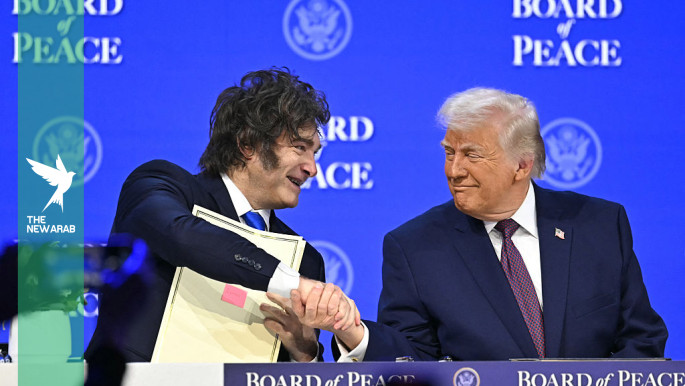
Milei has cultivated that relationship carefully. Trump and Milei have met several times; the Argentine president has been a regular presence at pro-Trump conservative gatherings in the United States, and Trump has reportedly described him as his “favourite president.”
The relationship is not just rhetorical. In 2025, the Trump administration extended a $20 billion currency-swap facility to Argentina to help stabilise the peso ahead of key legislative elections. Milei’s alignment with Washington, therefore, sits at the intersection of ideology, personal affinity and economic dependence.
Strengthening ties with Israel
That context helps explain why Milei has gone so far on Israel and Iran. Argentina has announced it will move its embassy in Israel to Jerusalem in 2026, departing from the country’s traditional caution over the city’s contested status.
His government has also broken with Argentina’s historical approach to Palestine at the United Nations. In May 2024, Argentina voted against a General Assembly resolution supporting Palestine’s bid for full UN membership; in September 2024, it voted against a resolution demanding an end to Israel’s unlawful occupation of Palestinian territories. These votes marked a clear departure from Argentina’s earlier recognition of Palestine as a state and its long-standing support for a negotiated two-state framework.
Milei and Netanyahu have promoted the “Isaac Accords,” an initiative designed to strengthen Israel’s ties with Latin America. The Argentine government declared Iran’s Quds Force a terrorist organisation in January and the Islamic Revolutionary Guard Corps in March. During his April visit to Israel, Milei called the US-Israel war against Iran the “right thing to do” and framed Argentina’s support as part of a shared struggle against terrorism.
There are legitimate Argentine concerns behind part of this agenda. The embassy and AMIA attacks remain open wounds. Argentine courts and successive governments have accused Iranian officials and Hezbollah-linked actors of responsibility. Any Argentine president has reason to pursue justice, protect the country’s Jewish community and cooperate against terrorism. But Milei has turned those concerns into something broader and more dangerous: a foreign policy of ideological enlistment in the Trump-Netanyahu worldview.
The problem is not Argentina’s relationship with Israel or its pursuit of justice for past terrorist attacks. It is Milei’s decision to trade Argentina’s historically cautious, two-state-oriented diplomacy for symbolic participation in wars it cannot shape and does not need to join.
What the people don’t want
The domestic evidence suggests, however, that most Argentines do not want that role, nor do they support Milei’s approach to conflicts in the Middle East. A March AtlasIntel/Bloomberg poll asked Argentines about Milei’s Yeshiva remarks, including his self-description as the world’s most Zionist president, his characterisation of Iran as an enemy and his statement that “we are going to win” in reference to the ongoing war. 64% said those statements were “very negative” because they unnecessarily committed Argentina to a foreign conflict. Only 19.9% described them as positive or very positive.
The same survey found resistance to Milei’s attempt to insert Argentina into Trump’s Gaza-related diplomacy. Asked about Argentina joining the “Board of Peace,” described in the poll as a Trump-created international body aimed at “rebuilding Gaza” and “seeking peace in conflict zones,” 57.5% said they were totally opposed. Only 23.7% said they were totally in favour.
When asked about Milei placing Argentina’s White Helmets humanitarian body at the service of an international stabilisation force, 58.3% disapproved and 32.7% approved.
Other polls point in the same direction. A Zuban Córdoba survey found that 72.7% of Argentines opposed a war involving Israel, the United States and Iran, while only 14.2% supported it. Even among Milei voters, 53.4% opposed such a war. The same poll found that 66.4% believed Milei’s position did not represent the country as a whole.
This does not necessarily mean Argentines are sympathetic to Iran, Hamas or any anti-Israel axis. That would be a simplification of the data. The polls instead show a preference for restraint, distance, and non-involvement, reinforced by a long-standing suspicion in Argentine political culture of automatic alignment with Washington.
Across Peronism, the left and parts of the nationalist right, resistance to US tutelage has been a persistent current. Many Argentines may therefore distinguish between condemning terrorism, recognising Israel’s security concerns and rejecting the idea that Argentina should become a rhetorical extension of US or Israeli war policy. That distinction should matter in Washington.
Milei’s enthusiasm may make him look like an ideal ally for Trump: pro-US, pro-Israel, anti-Iran and willing to translate US strategic narratives into Latin American language. For Netanyahu, he offers symbolic validation at a time when Israel faces growing international criticism over Gaza. But symbolic loyalty is not the same as strategic capacity. Argentina is not going to alter the balance of power in the Middle East, secure Israel, determine the future of Gaza or shape Iran’s calculations. What it can do is expose itself diplomatically, import external polarisation, and blur the line between solidarity and overcommitment.
For the United States, there is also a broader lesson. If Washington rewards leaders mainly for ideological loyalty, it encourages allies to perform alignment rather than develop credible, sustainable foreign policies. That may produce friendly speeches and photo opportunities, but it does not build durable regional support.
In Argentina’s case, it risks turning a fragile economic partner into a stage for distant conflicts that most of its own citizens reject. A more responsible Argentine policy would not require indifference, nor would it require abandoning Israel or ignoring Argentina’s own history of terrorism. But it would require drawing a line between legitimate security cooperation and rhetorical enlistment in Netanyahu’s wars or Trump’s confrontation with Iran.
Milei likes to frame his foreign policy as moral clarity. But clarity without prudence becomes recklessness. His Middle East policy is not making Argentina safer or more influential. It is maximising exposure while offering Trump and Netanyahu an eager diplomatic echo. That may satisfy Milei’s ideological identity, but the polls suggest something more politically damaging: his Middle East policy does not speak for the country he claims to represent.
Dr. Luciano Zaccara is Principal Researcher at New Ground Research, Qatar. Also, a Visiting Associate Professor at the Georgetown University in Qatar, and Director of the Observatory on Politics and Elections in the Arab and Muslim World, Spain.
Follow Luciano on X: @LucianoZaccara
Have questions or comments? Email us at: editorial-english@newarab.com
Opinions expressed in this article remain those of the author and do not necessarily represent those of The New Arab, its editorial board or staff.