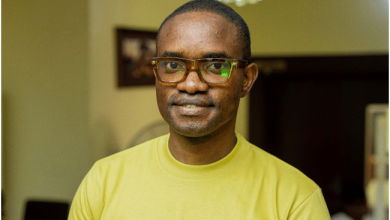
Youssef Baalousheh has covered roughly 40 international and regional tournaments across his career, travelling between six and nine months a year to photograph stadiums around the world. Today, the 54-year-old father of eight follows what sports coverage he can on his phone when he has a signal.
Those 40 tournaments were the architecture of his professional life. They took him across football, volleyball, basketball, tennis, cycling, and athletics, a career built on movement, on being present at the moment a body crosses a finish line or a ball hits the back of a net.
He was one of Gaza’s most widely travelled sports journalists, and the circuit of international competitions was not an occasional perk but the rhythm his year was built around. Six to nine months away, then home, then away again.
Four years ago, Youssef was among 24 sports journalists selected from Gaza to cover the 2022 World Cup in Qatar, chosen through a competitive process that drew 79 applicants and included interviews in Arabic and English.
His existing credentials with the Asian and African football federations enabled him to secure media accreditation, alongside his volunteer work, to cover one of the sport’s defining moments up close.
He had hoped the 2026 World Cup would be next.
But that journey has now come to an abrupt halt, as Israel’s genocide, siege and blockade continue.
“I feel grief, frustration, and a deep sadness that I couldn’t continue the journey and be among those participating or volunteering in the next World Cup,” he tells The New Arab.
“We were living on the hope of covering the 2026 tournament. Today, the reality is completely different.”
Invitations that lead nowhere
The invitations have kept coming. Youssef holds accreditation with the Asian and African football federations and FIFA’s media platform, and membership in several international sports media bodies. He applied to cover the AFC Women’s Asian Cup in Australia and tournaments in Qatar and, in some cases, received visas. None of the trips happened. The crossings were closed.
“The professional opportunities and invitations are still available to me,” he said, “but the current circumstances prevent me from benefiting from any of them.”
For sports broadcaster Ihab Abu al-Khair, the same pattern played out repeatedly.
A member of local, Arab, and international sports institutions, he continued to receive notifications from the Asian and African football federation platforms — tournament draws, volunteer programmes, and events in Saudi Arabia and Qatar. Approvals came through.
He also registered for the World Cup draw, but due to Israeli restrictions, he could not leave Gaza.
“Over the past three years, there have been many opportunities,” Ihab tells The New Arab, “but the war and the closure of the crossings have deprived us of benefiting from them, and that in itself is a major source of frustration.”
Displaced 13 times
Ihab, originally from Jabalia camp, has been displaced with his family of nine since the first day of Israel’s war on the enclave, moving between locations more than 13 times.
He now lives in a tent with no reliable electricity or internet, the conditions that define not just his personal life but also his working life.
With the 2026 tournament kicking off today, the buildup of familiarity begins — the draw coverage, the qualification stories, the broadcast packages. Ihab, however, will watch it in fragments. A notification on a phone with an intermittent charge. A headline glimpsed before the connection drops.
The infrastructure of global sports media that he was once part of now reaches him only in pieces, through a screen in a tent, in a camp he did not choose.
He had registered for volunteer programmes. He had seen the emails come in. Each one lands differently now, less as an opportunity than as a reminder of the distance between where he is and where he expected to be at this point in his career.
The broadcaster who once spent long hours tracking tournaments and sporting events now finds his attention pulled elsewhere. Not because the passion has faded, he says, but because daily survival under displacement leaves little room for anything else.
What cuts deepest, he says, is not only the loss of professional opportunities but also the physical loss of memory.
When his home in eastern Jabalia camp was destroyed, he lost the keepsakes he had kept from Qatar 2022: a piece of turf from Lusail Stadium, where Argentina and France played the final; part of the goal net from that match; the official tournament kit and souvenirs.
“All these things went with the house that was destroyed,” he said. “I didn’t just lose possessions, I lost memories tied to the most beautiful experience of my professional life.”
‘A completely different world’
Ashraf Matar, head of the sports journalists’ syndicate, draws a sharp line between the conditions journalists faced before and after October 7.
In 2022, journalists in both Gaza and the West Bank were able to register through FIFA platforms, complete the required procedures, and travel. A number of them did.
That landscape no longer exists. “The challenges journalists face today are no longer about professional competence or the ability to compete,” Ashraf said, “but about coercive circumstances beyond their control.”
The toll, he says, extends well beyond the individuals most visibly affected.
Across the syndicate, there are journalists who have built careers around international coverage, accumulated credentials, established relationships with federations, and carved out a professional identity that depends on being able to move.
That entire professional category has effectively been suspended. Not ended, perhaps, but held in a kind of forced pause with no clear release date.
He notes that the 2026 tournament, hosted by the United States, introduced additional layers of procedural complexity that make accreditation harder under any circumstances, let alone for journalists who cannot leave their territory.
“There is a clear psychological toll on journalists who could not participate,” he said. “Many of them had dreamed of repeating the World Cup experience or attending other tournaments, but the oppressive conditions we live in today have denied them that.”
That psychological weight, Ashraf suggests, compounds over time. Missing one tournament is a setback. Missing every tournament, every draw, every regional competition for years on end, while the invitations continue to arrive and the credentials remain technically valid, becomes something closer to sustained professional grief — a life that exists on paper and nowhere else.
Waiting with what remains
Youssef has lost some of his equipment during Israel’s war. He still has some of it. He keeps it, he says, against the possibility of a day when he can return to work, when a crossing opens, when a credential can be used, when a stadium is reachable again.
What he misses most, he shares, is the sound of the crowds, the roar of supporters when a goal goes in, the slump in a stadium when a team loses.
He describes sports photography as “the love of his life,” years spent moving between football, volleyball, basketball, tennis, cycling, and athletics.
When social media surfaces old photographs — memories from past tournaments, images from stadiums he stood in — he feels, he says, a mixture of anger and grief. The algorithm does not know what has changed.
“Before the war,” he said, “my entire life was in the stadiums. Suddenly, I lost all of that.”
He is not optimistic about a quick return.
“Even until 2030, I think it will be difficult. I don’t know when things in Gaza will improve, but I still hold on to what remains of my equipment, hoping that one day I will return to the stadiums that were my second home.”
Ansam Al-Kitaa is a freelance journalist based in Gaza. For years, she has covered the successive wars in Gaza and their humanitarian and social impacts for international and local outlets
This piece is published in collaboration with Egab